







Breaking News







Romania's first K9 Thunder howitzer exits production line in South Korea for NATO artillery upgrade.
Romania’s first K9 Tunetul 155 mm self-propelled howitzer, produced by Hanwha Aerospace, has exited the production line in South Korea and been declared ready for delivery, marking a key milestone in the Romanian Land Forces’ artillery modernization program.
The Tunetul (Romanian for Thunder) is part of an initial batch of 18 K9 howitzers and 12 K10 resupply vehicles, with delivery scheduled in 2026 under the July 2024 contract, establishing the baseline configuration for future local production in Romania. This milestone strengthens Romania’s transition to a NATO-standard long-range fire support capability, enhancing range, rate of fire, and survivability through advanced “shoot-and-scoot” operations along the Alliance’s eastern flank.
Read also: South Korea Unveils 8x8 Wheeled 155mm Howitzer with K9 Firepower for NATO Exports
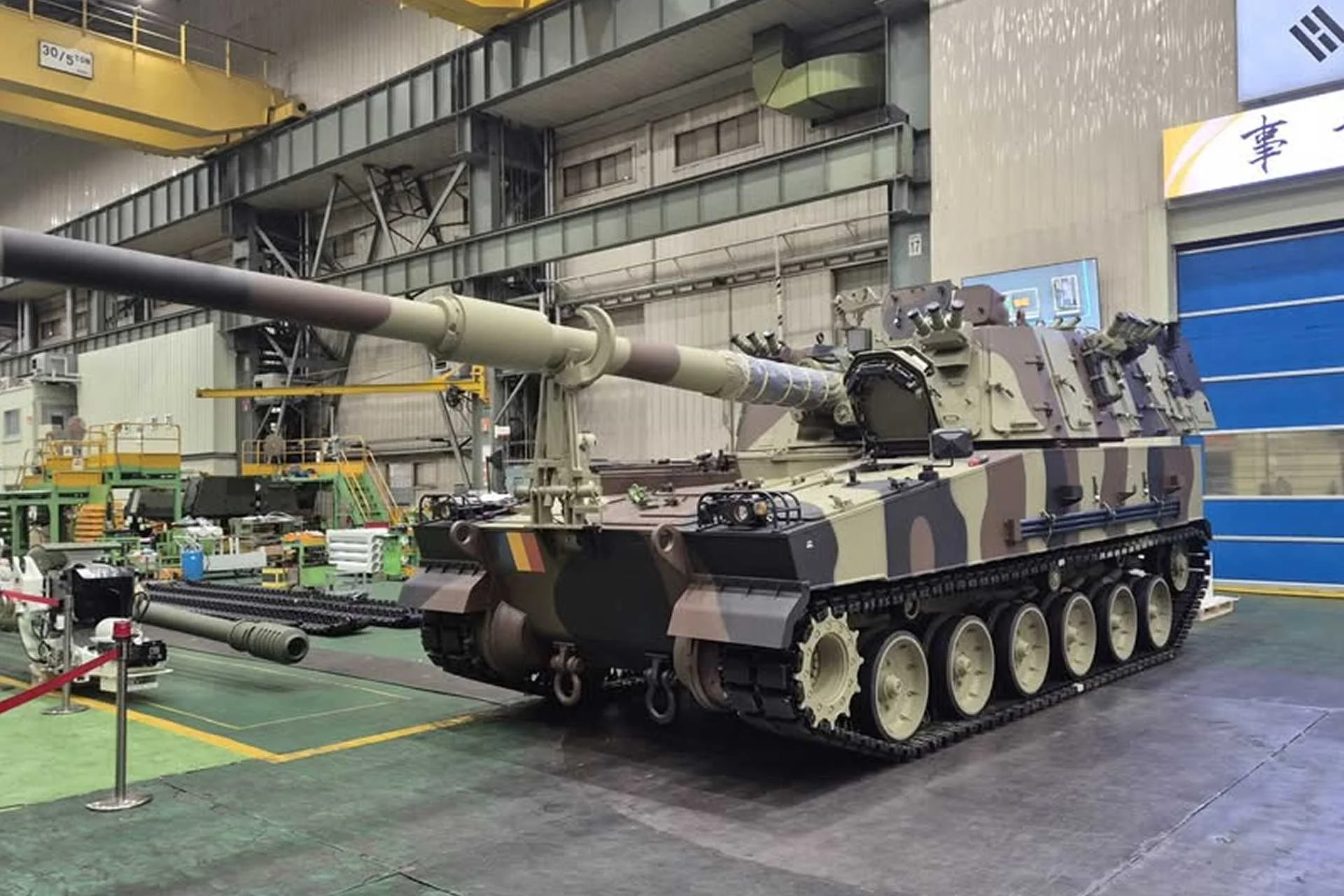
The first K9 Thunder 155 mm self-propelled howitzer for Romania has been completed in South Korea under a 2024 contract with Hanwha Aerospace that includes 54 howitzers and 36 K10 resupply vehicles. (Picture source: Romanian MoD)
On March 30, 2026, the first K9 Tunetul 155 mm self-propelled howitzer for the Romanian Land Forces exited the production line in South Korea and was declared ready for delivery, marking the first completed unit under the acquisition contract signed with Hanwha Aerospace in July 2024. The K9 Tunetul (Romanian for Thunder) was manufactured entirely in South Korea as part of the initial production tranche and is scheduled for delivery during 2026. This rollout confirms that production has progressed from contract signature to physical output within less than two years. It also establishes the reference configuration for subsequent systems that will be assembled in Romania.
The event also represents the transition of Romania’s fire support capabilities to NATO standards in terms of caliber, range, and deployment doctrine. The program is intended to replace Soviet-era 152 mm and older 155 mm systems still in Romanian service. The first Romanian K9 Thunder belongs to an initial batch of 18 howitzers that are manufactured entirely in South Korea before the shift to domestic manufacturing. Deliveries are structured across three battalion-level groupings, with timelines defined at 30, 40, and 60 months after contract entry into force. The first battalion set includes 18 howitzers and 12 K10 resupply vehicles, with associated support elements delivered in parallel.
Following this initial batch, expected to be delivered during 2026, production will transition to Romania, with local assembly expected to begin in 2027 at the Petrești facility. This sequencing, extending over five years, allows time for workforce training, infrastructure completion, and supply chain integration before domestic production ramps up. The phased delivery structure is designed to avoid capability gaps while older systems are gradually retired, and it also enables operational units to integrate new equipment incrementally rather than simultaneously. The timeline indicates full program completion by the end of the decade.
The contract signed in July 2024 between Romania and South Korea is valued between $920M and $1B and includes 54 K9 self-propelled howitzers and 36 K10 ammunition resupply vehicles. These vehicles are organized to form three complete artillery battalion sets, each comprising 18 howitzers and 12 resupply vehicles, supported by additional specialized equipment. Each battalion also includes nine artillery observation vehicles, three acoustic detection systems, three recovery vehicles for damaged equipment, and one meteorological station. The agreement also includes the delivery of 18,000 rounds of 155 mm ammunition, divided into high-explosive, smoke, illumination, and inert training types.
The majority of ammunition deliveries are aligned with the first system tranche to ensure immediate operational capability. The contract integrates equipment, ammunition, and support assets into a single package, further reducing the need for separate follow-on procurement for logistics and fire support. The K9 howitzer is a tracked self-propelled howitzer weighing about 47 tonnes and equipped with a 155 mm/52 caliber gun compatible with NATO-standard ammunition. It is capable of engaging targets at distances exceeding 40 km, and extending this range is possible using rocket-assisted projectiles such as the K315. The K9 can fire three rounds within 15 seconds in burst mode and sustain a rate of 6 to 8 rounds per minute, while newer configurations with automated loading exceed 10 rounds per minute.
It supports multiple round simultaneous impact (MRSI) missions, allowing several shells to arrive on target at the same time through trajectory variation. The howitzer can reach speeds of up to 67 km/h, providing a “shoot and scoot” capability that enables firing and immediate displacement to reduce exposure to counter-battery fire. The Thunder entered service in 1999 and is currently deployed in at least 10 countries, with more than 1,800 units produced. The K10 Ammunition Resupply Vehicle, built on a similar chassis, is designed to operate directly alongside K9 units to maintain continuous fire support.
Each K10 can carry 104 rounds of 155 mm ammunition and 504 propellant charges, enabling sustained firing operations without external resupply. The system uses an automated transfer mechanism capable of delivering up to 12 rounds per minute from the K10 to the K9 under armored protection. A complete transfer cycle can be completed in about 37 minutes, depending on operational conditions. This reduces crew exposure and shortens resupply times compared to manual handling. The integration of K10 vehicles at the battalion level allows each firing unit to maintain a high operational tempo.
The inclusion of 18,000 rounds of ammunition ensures that initial deployments are supported without immediate reliance on external supply chains. Industrial participation is centered on the Hanwha Armoured Vehicle Centre of Excellence in Petrești, Dâmbovița County, which is under construction as the company’s first European production site. The facility covers about 181,055 square meters and includes assembly lines, testing and validation infrastructure, a 1,751-meter test track, and research and development laboratories. It is designed to support assembly, integration, maintenance, and lifecycle management of K9 and K10 systems.
Local production is planned to achieve up to 80 percent localization by involving Romanian companies in manufacturing and supply activities. More than 30 local partners are expected to participate in the supply chain. The facility is projected to create up to 2,000 direct and indirect jobs. It is also intended to support future production of additional land systems, including infantry fighting vehicles and unmanned ground vehicles. The scale of the acquisition places it among the largest artillery modernization efforts undertaken by Romania since joining NATO. Therefore, Romania becomes the tenth operator of the K9 system globally and the sixth within NATO, joining Poland, Norway, Finland, Estonia, and Türkiye.
The K9 Thunder is widely deployed, with more than 1,800 units in service, representing a significant portion of modern tracked artillery inventories. Romania is also among a limited number of countries operating the K10 resupply vehicle, which expands its artillery logistics capabilities. The acquisition aligns with a broader trend across Eastern Europe, where countries are increasing investment in long-range artillery systems. This reflects operational requirements observed in recent conflicts, where sustained indirect fire has been a decisive factor. As the adoption of standardized 155 mm systems improves interoperability with NATO forces, the Romanian K9 Tunetul howitzer is expected to increase available artillery mass and range along the Alliance’s eastern flank.
Written by Jérôme Brahy
Jérôme Brahy is a defense analyst and documentalist at Army Recognition. He specializes in naval modernization, aviation, drones, armored vehicles, and artillery, with a focus on strategic developments in the United States, China, Ukraine, Russia, Türkiye, and Belgium. His analyses go beyond the facts, providing context, identifying key actors, and explaining why defense news matters on a global scale.