







Breaking News







Belgium Unveils Blue Dome Air Defense Network to Strengthen NATO Protection Against Drones and Missiles.
Belgium has unveiled Blue Dome, a new ground-based air defense architecture combining NASAMS missiles, GM200 MM/C radars and Skyranger 30 guns to strengthen national protection and contribute to NATO’s integrated air defenses. Designed to counter drones, cruise missiles, helicopters, and combat aircraft, the future network will help defend critical infrastructure, military installations, and command centers in a country hosting NATO headquarters and Supreme Headquarters Allied Powers Europe (SHAPE).

Belgium’s Blue Dome air defense network will combine GM200 MM/C surveillance radars, NASAMS surface-to-air missile systems and Skyranger 30 antiaircraft guns to provide layered protection against aerial threats and strengthen NATO’s integrated air defenses. (Picture source: Belgium MoD)
Key Tactical Insights:
• Belgium Blue Dome purpose and role: Belgium’s Blue Dome will establish a layered air defense network to protect the population, military installations, command centers, critical infrastructure, and deployed forces while contributing to NATO’s collective air defense.
• Belgium Blue Dome components: The architecture will connect GM200 MM/C surveillance radars, NASAMS short- and medium-range missile systems, Skyranger 30 close-range anti-aircraft guns, and command vehicles to detect, track, and engage aerial threats.
• Strategic importance of Belgium Blue Dome: The growing threat from drones, cruise missiles, and combat aircraft makes air defense increasingly important for Belgium, which hosts NATO headquarters, SHAPE, and major logistics infrastructure supporting national security and Allied operations.
Belgian Defense presented Blue Dome at the Royal Military Academy on November 9, 2026, alongside the announcement that the Air Force’s 51st Squadron had been reactivated at Beauvechain. In its statement published the following day, the ministry outlined plans to acquire 14 GM200 MM/C radars, 10 NASAMS firing units, 20 Skyranger 30 systems and 54 command vehicles.
Belgium and the Netherlands also signed three Program Arrangements covering NASAMS, GM200 MM/C and Skyranger 30. These agreements provide a framework for developing the Belgian capability in cooperation with a neighboring NATO ally acquiring systems in identical configurations, supporting common training, logistics, maintenance and operational cooperation.
Related Topic: Belgium Orders 20 Rheinmetall Skyranger 30 Air Defence Systems to Protect Critical Infrastructure
Blue Dome’s intended protection extends beyond military installations. Belgian Defense identifies the population, government and command centers, logistics hubs, ports, strategic infrastructure, and deployed forces as beneficiaries. The program reflects the growing requirement to protect both military capabilities and the infrastructure needed to sustain them against increasingly diverse aerial threats.
Missiles and guns within one defense architecture
Blue Dome will combine surveillance, command and engagement capabilities in a coordinated network. GM200 MM/C radars will detect and track incoming threats, NASAMS will provide the short- and medium-range missile layer, and Skyranger 30 will complement it with very-short-range gun protection. Belgian Defense says continuous information exchange between these components will support coordinated responses to several threats simultaneously.
NASAMS, the National Advanced Surface-to-Air Missile System, is a modular ground-based air defense system developed by Norway’s Kongsberg and the United States’ Raytheon. Its Fire Distribution Center processes information from connected sensors and coordinates missile engagements. Radars and launchers can be dispersed across a defended area, providing flexibility in protecting air bases, ports, population centers, and other high-value locations. According to Kongsberg, radar and launcher elements can operate more than 20 kilometers from the command center. That figure describes deployment separation rather than missile interception range.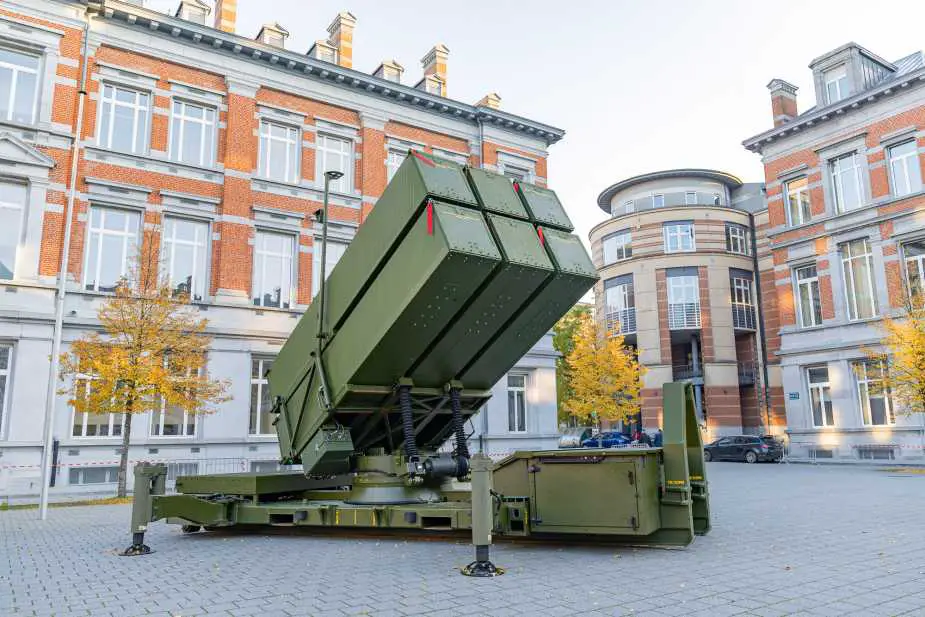
The NASAMS Multi-Missile Launcher carries six ready-to-fire missiles and supports engagements against individual or multiple aerial targets. Compatible interceptors include the active radar-guided AIM-120 AMRAAM, the AMRAAM Extended Range, and the infrared-guided AIM-9X Sidewinder Block II. These weapons offer different engagement characteristics within the same launcher architecture. Belgium’s Blue Dome announcement, however, does not specify its interceptor mix or corresponding engagement ranges. The planned acquisition of 10 firing units should therefore not be interpreted as confirmation of a particular number of launchers or ready-to-fire missiles.
Skyranger 30 will provide close-range protection against drones and other low-flying threats. Its principal weapon is the Oerlikon KCE revolver cannon, firing 30 × 173 mm ammunition, with an effective range of up to 3,000 meters according to Rheinmetall. Programmable airburst ammunition releases its payload at a calculated point near a target, helping the system engage small aerial threats without depending solely on a direct projectile impact.
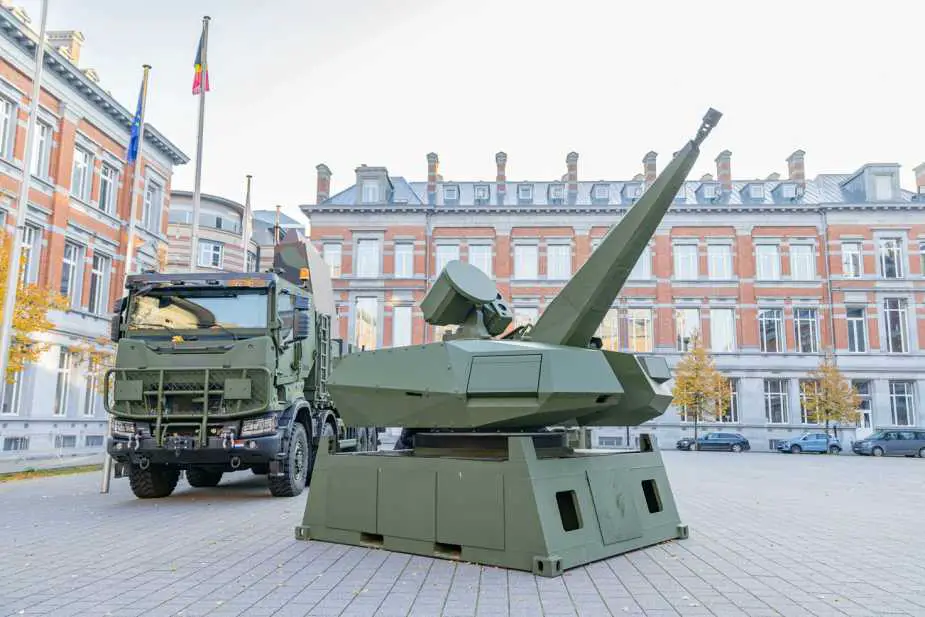
Rheinmetall describes the wider Skyranger architecture as combining search radar and electro-optical sensors for all-around surveillance and target tracking, allowing independent operation or employment within a network. Belgium’s Defense announcement does not detail the exact national sensor and ammunition package. Although the Skyranger family can accommodate short-range missiles, that option has not been included in Belgium’s configuration.
Belgium’s 20 Skyranger 30 systems will be installed on hooklift platforms for stationary protection of territory and critical infrastructure, Rheinmetall announced separately on November 9. Their employment will therefore differ from Skyranger turrets mounted on armored vehicles accompanying maneuver formations. Within Blue Dome, the guns will add a close-range engagement layer around protected locations, complementing NASAMS. Deliveries are scheduled to begin at the end of 2028.
The Ground Master 200 Multi-Mission Compact, or GM200 MM/C, will provide a principal surveillance component. Developed by Thales, the radar uses four-dimensional active electronically scanned array technology, known as 4D AESA. Electronic beam steering allows radar resources to be directed rapidly between surveillance and tracking tasks. Thales describes the system as capable of simultaneously detecting, tracking, and classifying aircraft, missiles, helicopters, unmanned aerial vehicles, and rockets, artillery, and mortar projectiles.
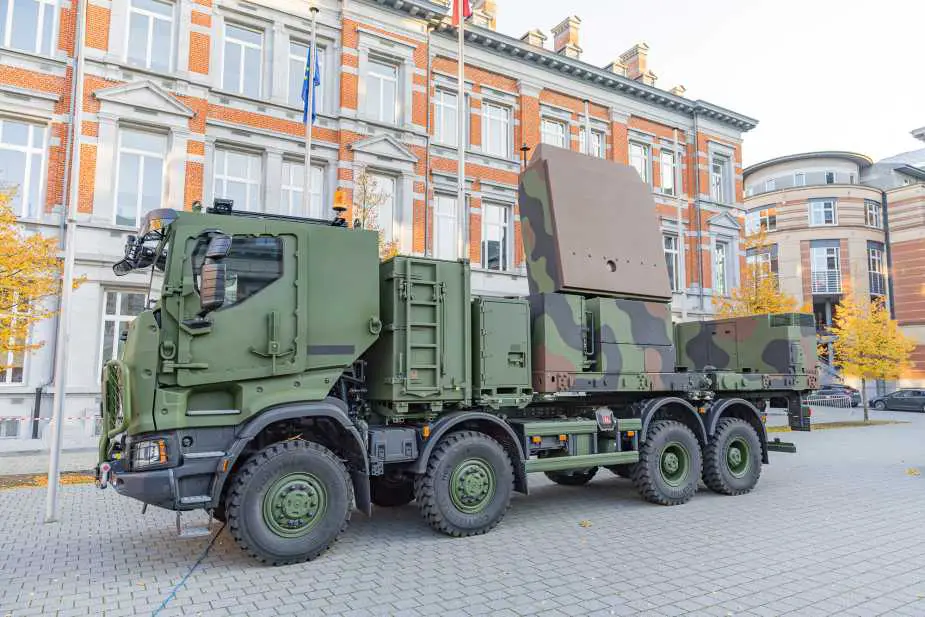
The radar also supports weapon location and counter-battery missions, although those functions are distinct from its announced air defense role in Blue Dome. Detecting a projectile does not establish that the associated Belgian weapons are configured to intercept it. For the air defense network, the radar’s central contribution will be maintaining tracks that help command centers assess threats and coordinate engagements. Its software-defined architecture also supports future capability upgrades.
Together, these systems will provide complementary engagement options across different defensive layers. Actual coverage will depend on deployment positions, terrain, communications, available ammunition, and trained crews. The procurement totals alone do not establish continuous protection across Belgian territory.
Protecting Belgium and strengthening NATO’s air defenses
The importance of Blue Dome extends beyond Belgium’s national borders. Belgium hosts NATO’s political headquarters in Brussels and SHAPE in Mons, alongside ports and logistics infrastructure supporting Allied activities. Protecting these locations supports the continuity of Alliance command, coordination, and military support functions.
Recent conflicts have reinforced the requirement for layered defenses against drones, cruise missiles and other aerial threats. For Belgium, combining missile and gun systems provides different engagement options around priority assets. Connecting those weapons to shared surveillance and command capabilities is intended to support coordinated responses rather than isolated defensive actions.
Blue Dome will form part of the NATO Integrated Air and Missile Defense System, or NATINAMDS, which connects Allied sensors, command capabilities and weapons within a multilayer defense network. Its contribution will therefore extend beyond acquiring individual radars, launchers and guns: the program will add Belgian surveillance and engagement capabilities to the Alliance’s collective air defense structure.
The announced equipment addresses drones, cruise missiles, helicopters and combat aircraft. Belgium’s statement does not establish a dedicated ballistic missile interception capability, despite Blue Dome’s place within NATO’s broader integrated air and missile defense approach.
The reactivated 51st Squadron will play a central role in developing the expertise needed to operate the network. Belgian Defense will continue investing in infrastructure, personnel training and the squadron’s development alongside equipment deliveries. Initial systems are expected to arrive and enter service progressively from 2027, with subsequent deliveries, including Skyranger 30 from late 2028, expanding the network as its components and crews become available.
Explore More Defense News
• Land Defense News
• Naval Defense News
• Defense Aerospace News
Written by Alain Servaes – Chief Editor, Army Recognition Group
Alain Servaes is a former infantry non-commissioned officer and the founder of Army Recognition. With over 20 years in defense journalism, he provides expert analysis on military equipment, NATO operations, and the global defense industry.