






Breaking News






US Sends Troops to Latvia for High Intensity Training to Boost Deterrence Against Russia.
According to information published by the U.S. Army on June 15, 2025, soldiers from the 1st Battalion, 125th Infantry Regiment, part of the 37th Infantry Brigade Combat Team of the Michigan Army National Guard, participated in the multinational exercise Baltic Viking, held from June 1 to 13 at Camp Adazi, Latvia. This training took place in a tense strategic context, marked by the ongoing war in Ukraine, the increasing militarization of NATO's eastern flank, and the Alliance's stated intention to strengthen its deterrence posture in response to Russian territorial ambitions. Baltic Viking is not merely a military drill; it serves as practical preparation for potential high-intensity conflict in Europe and represents a direct strategic signal to Moscow.
Follow Army Recognition on Google News at this link
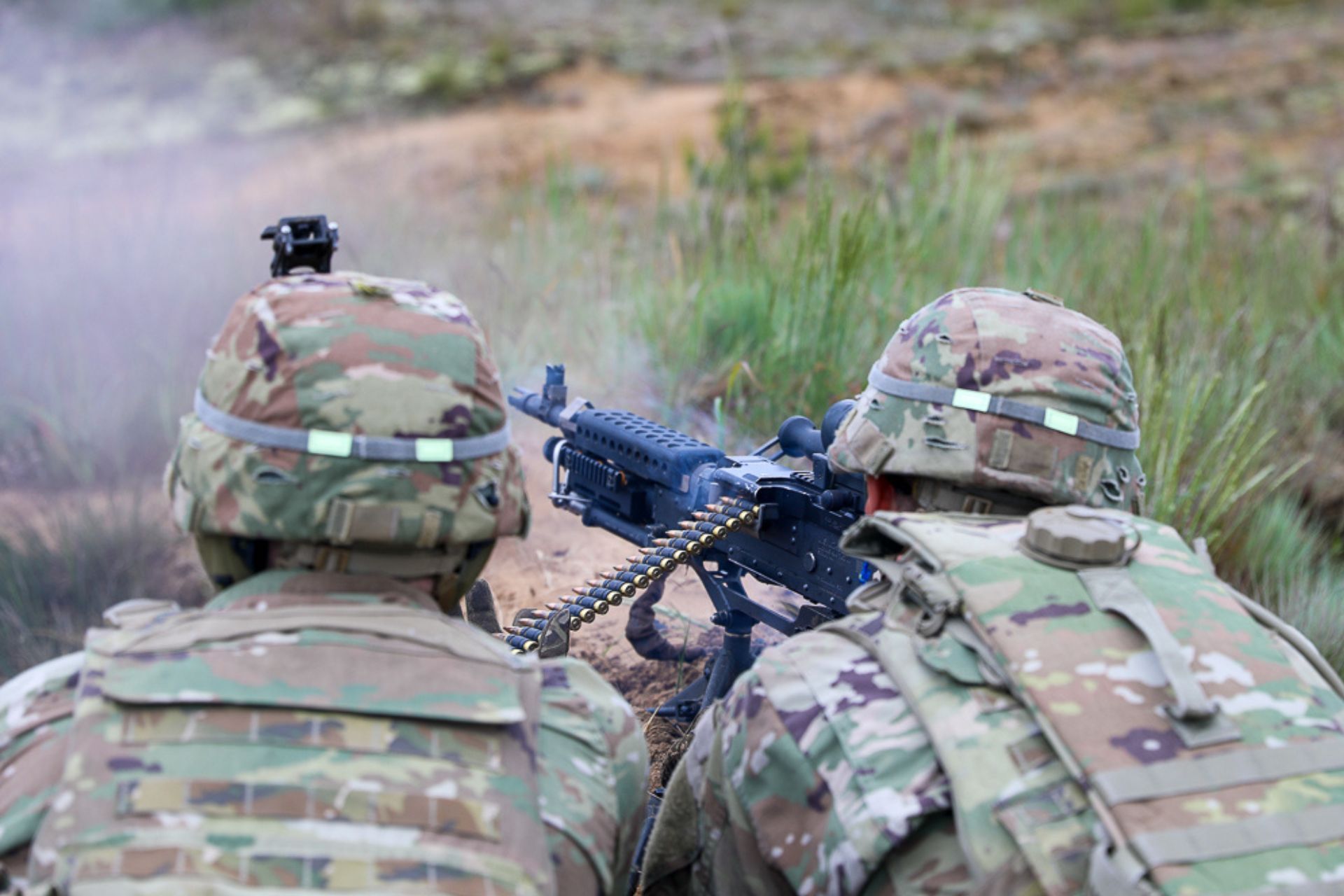
A US Army M240 machine gun team in support of a squad live-fire training during Exercise Baltic Viking (Picture source: US DoD)
The exercise was conducted in close coordination with the Latvian Armed Forces and NATO’s Multinational Division North (MND-N), including Danish forces and other allied contingents. It enabled U.S. troops to train under conditions that closely replicate actual combat, including live-fire maneuvers, machine gun section coordination, and simulated engagements in a purpose-built trench system. This complex training environment, composed of firing lines, support and reserve trenches, and fortified dugouts, provided full immersion into the dynamics of modern battlefield operations, where positional warfare has regained tactical relevance. Such training infrastructure is not available in the United States, making this exercise particularly valuable for conventional warfare preparation.
Baltic Viking was also part of a broader Mobilization Exercise (MOBEX), involving the simultaneous deployment coordination of over 2,000 personnel from both the Army and Air components of the Michigan National Guard. Approximately 225 soldiers were deployed to Latvia on short notice, demonstrating the United States' capacity for rapid response in the European theater. This readiness is a key element of NATO’s collective defense strategy, especially in the event of an attack against a member state near the Russian border. The involvement of the National Guard, often viewed as a reserve force, highlights its increasingly central role in U.S. force projection alongside active-duty units.
According to field commanders such as Lieutenant Colonel Tad Reed, leader of the 1-125 Infantry Regiment, Baltic Viking offered a rare opportunity to generate a high level of operational readiness within a short timeframe. Soldiers were able to experience the human dimension of multinational cooperation, operate alongside partners with different military cultures, and refine essential skills needed for operational effectiveness in a European theater. Staff Sergeant Samual Weber emphasized the rigor and complexity of the training, while Specialist Evan Redwine noted the strategic benefit of working with Latvian and Danish troops, contributing to enhanced allied cohesion.
Baltic Viking stands out as a military exercise with both symbolic and strategic implications, illustrating the U.S. approach to preparing for high-intensity conflict in Europe. It reflects a shared interest between the U.S. military, Baltic partners, and NATO to maintain regional stability amid sustained geopolitical pressure from Russia. Through such deployments, the United States reaffirms its commitment to collective defense and provides its forces with training adapted to contemporary security challenges.