






Breaking News






US Nuclear Triad Modernization Highlights Sentinel Missile, B-21 Bomber and Columbia Submarines.
The Pentagon detailed nuclear triad modernization featuring Sentinel missiles, B-21 bombers, and Columbia-class submarines. The move ensures U.S. deterrence as global power competition and new threats intensify.
At the Air, Space and Cyber Conference organized in National Harbor by the Air and Space Forces Association on September 22, 2025, Major General Brandon D. Parker, Director of Global Operations at U.S. Strategic Command, presented the American view of nuclear modernization. In an international environment marked by intensified great power competition and the rise of new technological threats, he stressed the need to combine innovation with continuity. According to him, deterrence depends both on the introduction of next-generation systems and the preservation of legacy platforms that continue to play an essential role in the current posture.
Follow Army Recognition on Google News at this link
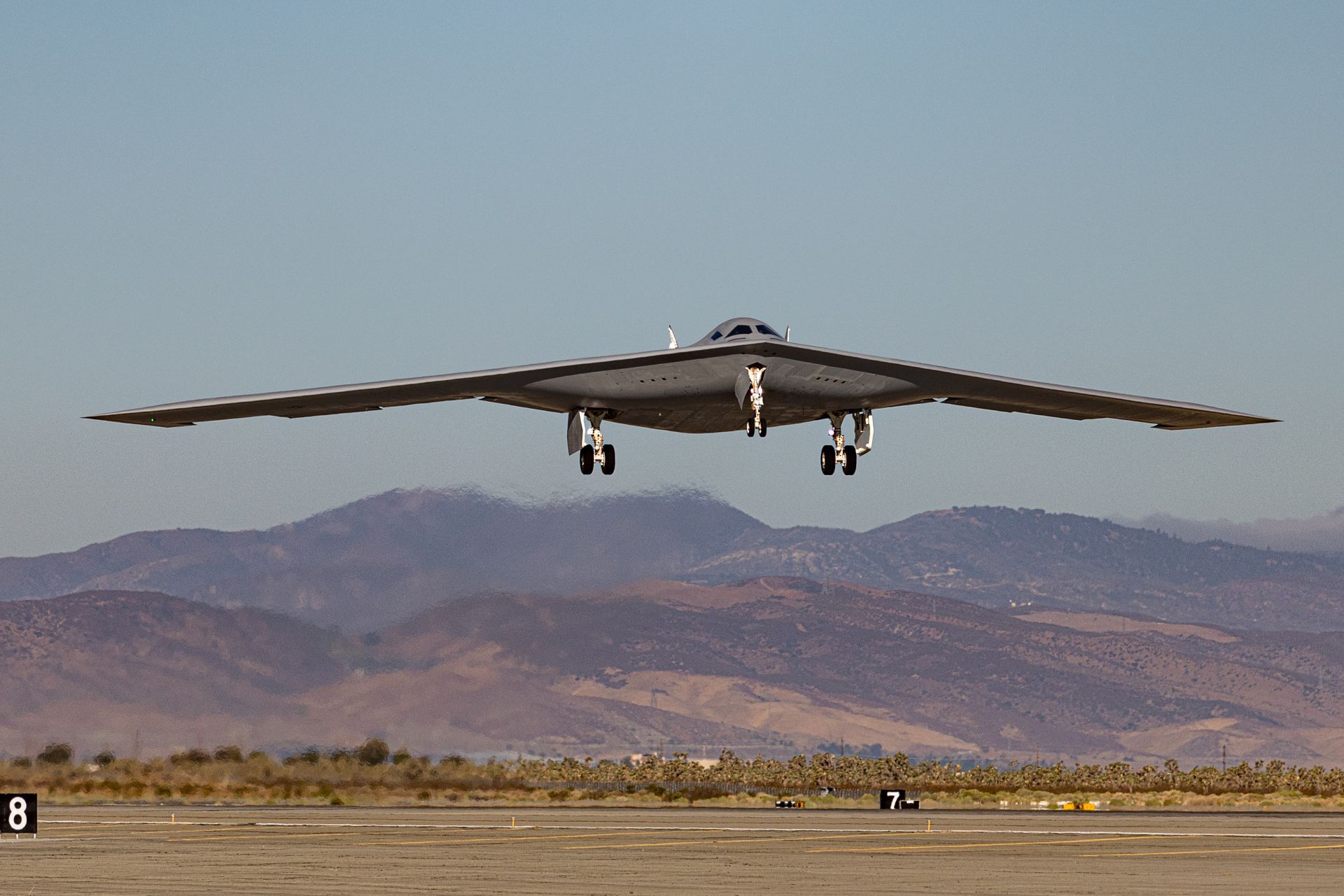
A U.S. Air Force B-21 Raider stealth bomber, designed to penetrate advanced air defenses and form the future backbone of America’s nuclear triad. (Picture source: Army Recognition)
The nuclear triad, built on land-based intercontinental ballistic missiles, long-range bombers, and ballistic missile submarines, continues to anchor U.S. strategy. According to Military Balance 2025, around 400 Minuteman III missiles are still deployed at bases in Montana, Wyoming, and North Dakota. First introduced in the early 1970s, they will eventually give way to the LGM-35A Sentinel. The new system is being designed with higher accuracy, stronger communications, and survivability improvements that should keep it in service into the 2070s.
The air leg is also in transition. Roughly 45 B-52H Stratofortress bombers remain on duty, flying with updated avionics and capable of carrying AGM-86 nuclear cruise missiles or precision-guided conventional weapons. Alongside them, 16 B-2 Spirits still provide the fleet’s only stealth nuclear capability. Looking ahead, the B-21 Raider will become the backbone of long-range strike. The aircraft is being built to slip through heavily defended airspace, and the Air Force plans to field about 100 in the coming years. Taken together, this mix shows the Air Force is managing a dual track: keeping old aircraft relevant while bringing new ones online.
At sea, the Ohio-class submarines are still the most visible proof of U.S. deterrence. Fourteen boats, launched in the 1980s, remain in service, each capable of carrying up to 20 Trident II D5LE missiles. Their service lives have been extended through steady upgrades, but construction of their replacement is already underway. The Columbia-class will take over, with 12 planned hulls featuring quieter propulsion, advanced sonar, and design features meant to keep them effective into mid-century.
The reliance on older systems is deliberate. Minuteman IIIs have been modernized several times to keep them reliable. The B-52H, despite closing in on seven decades of service, still has unmatched endurance and flexibility. The B-2 Spirit, first fielded in the 1990s, remains the only aircraft combining stealth and nuclear reach. All of them show that deterrence today cannot rely only on future projects; it also depends on forces that can operate immediately.
Modernizing NC3, the command-and-control backbone of the triad, is another central challenge. Parker stressed that the goal is not just to swap out old communications but to design a new system from the ground up. Cybersecurity must be built in from the start, future systems have to work alongside the current ones, and technologies like artificial intelligence and machine learning will be used to speed up decisions and strengthen resilience. The idea is that even in a contested environment, the President should always have every option available.
This push is framed by today’s strategic environment. The 2022 Nuclear Posture Review had already reaffirmed the U.S. commitment to maintaining a reliable and effective deterrent. Since then, Russia has kept nuclear threats front and center, fielding new delivery systems such as hypersonic glide vehicles. China has moved quickly to expand its arsenal with mobile ICBMs and a growing fleet of nuclear submarines. North Korea continues to advance its own nuclear program, heightening tensions in Northeast Asia. Against that backdrop, U.S. modernization looks less like an optional policy choice and more like a necessary step.
For Parker, the logic is clear. The Sentinel, the B-21, the Columbia-class submarines, and the future NC3 network are meant to carry deterrence forward. The Minuteman III, the B-52H, the B-2, and the existing NC3 keep the posture steady until then. By running both paths in parallel, Washington avoids gaps during the transition. It also sends a signal abroad: America’s nuclear shield is intact, adaptable, and prepared to meet emerging threats.