






Breaking News






U.S. Coast Guard tracks Russian spy ship Kareliya off Hawaii.
A Russian Vishnya-class intelligence ship, Kareliya, is being tracked by the US Coast Guard about 15 nautical miles south of Oahu after first being detected on 29 October. The patrol highlights how Russian long-range signals intelligence platforms are mapping US activity around Hawaii, a critical logistics, missile defense, and command hub for the wider Indo-Pacific posture.
The US Coast Guard has confirmed it is monitoring the Russian Navy Auxiliary General Intelligence ship Kareliya operating just outside US territorial waters south of Oahu, after the vessel was first detected about 15 nautical miles from the island on 29 October. A Coast Guard aircraft and cutter were dispatched from Honolulu to maintain visual and electronic contact with the Vishnya class spy ship, which remains in international waters but within reach of major US Navy, Air Force, and Coast Guard facilities across the Hawaiian archipelago, according to service statements and local reporting.
Follow Army Recognition on Google News at this link
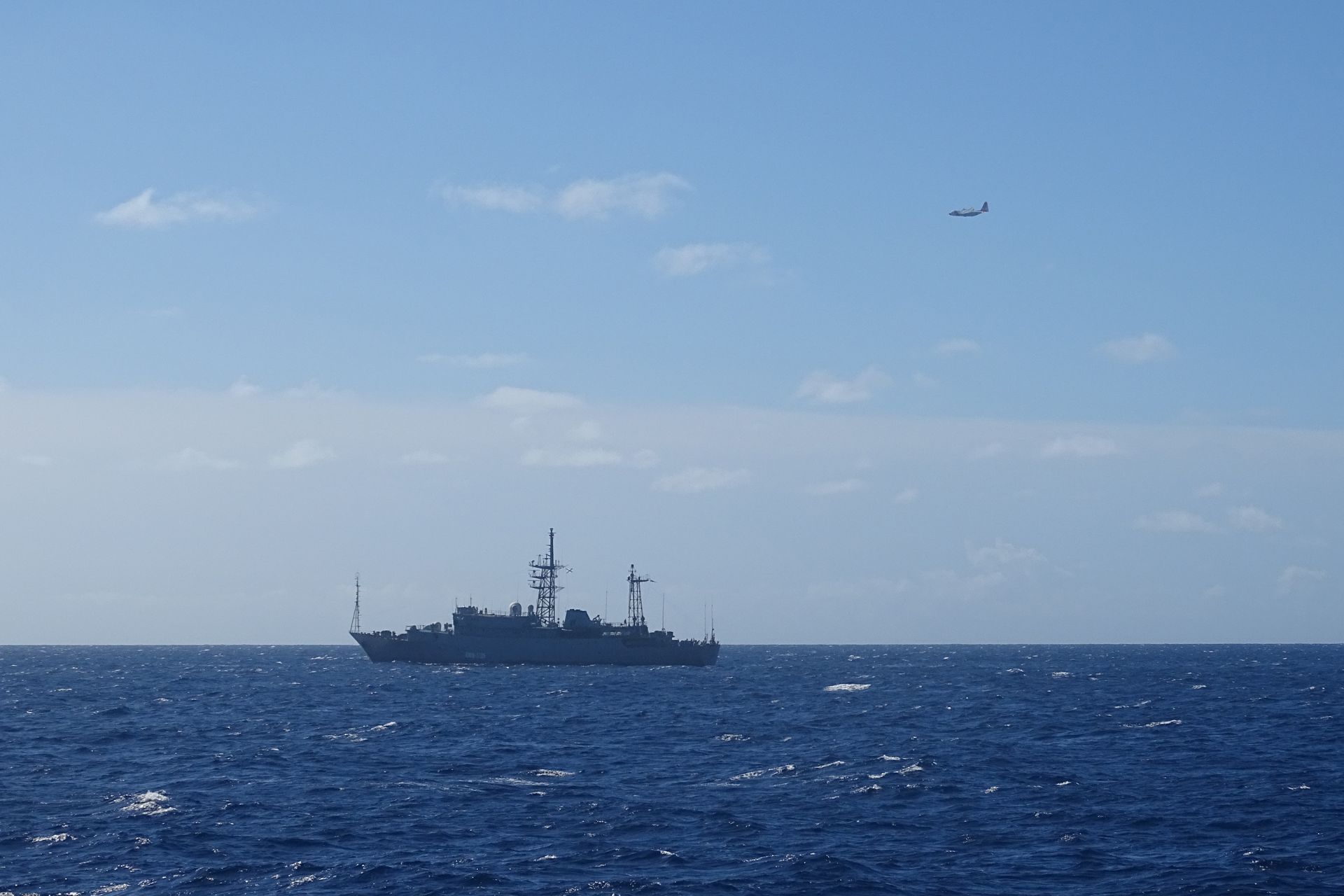
On 29 October 2025, a Coast Guard HC-130 Hercules crew from Air Station Barbers Point monitors a Russian military vessel about 15 nautical miles south of Oahu, just outside the 12-mile limit of U.S. territorial waters. (Picture source: US DoD)
According to the Coast Guard, sensors and patrol assets detected Kareliya operating south of Oahu on 29 October. A Coast Guard HC-130 Hercules from Air Station Barbers Point conducts an overflight to confirm identity and activity, while the Coast Guard Cutter William Hart (WPC 1134), a Sentinel-class fast response cutter, transits to the area to maintain visual and electronic contact. Officials underline that the response is conducted safely and professionally, in accordance with customary international law and long-standing U.S. practice toward foreign warships or auxiliaries near American waters. At roughly 15 nautical miles from shore, the Russian vessel remains in international waters, but it operates in direct proximity to the main logistics and command hub for U.S. forces in Hawaii.
Kareliya belongs to the Vishnya-class of intelligence collection ships, known in Russian designation as Project 864, designed for long-duration signals intelligence missions rather than high-end surface combat. A typical hull measures around 91.5 meters in length with a full-load displacement close to 3,500 tons, providing space for large antenna arrays, processing rooms, and dedicated berthing for specialist crews. Propulsion is usually provided by twin diesel engines on two shafts, giving a top speed of about 16 knots but, more importantly, considerable endurance at economical cruising speeds. The overall architecture favours persistence and electrical power for sensors and processing, turning the ship into a long-endurance listening platform able to remain on station for extended periods in areas of interest.
The defensive fit on the Vishnya-class is limited and focused on self-protection. Kareliya is understood to field 30 mm close-in weapon systems designed to engage low-flying missiles or small surface targets at short range, backed by short-range man-portable surface-to-air missiles for last-ditch air defence. This configuration does not give the vessel offensive reach, but it provides a basic layer of resilience in a crowded maritime environment and reduces vulnerability to opportunistic harassment. The crew, usually in the 140 to 150 personnel range, combines sailors and engineers with linguists, cryptologists, and electronic warfare specialists responsible for exploiting intercepted traffic before it is routed into the wider Russian command-and-control network.
Kareliya functions as a mobile node for signals intelligence that contributes to the Russian Pacific Fleet’s Recognized Maritime Picture (RMP) and Common Operational Picture (COP). By remaining just outside U.S. territorial waters, the AGI can intercept radar emissions, VHF and HF communications, maritime data links, and other electronic signatures associated with U.S. Navy and Coast Guard units, as well as nearby commercial shipping. The ship is designed to operate under tight electromagnetic emission control (EMCON), limiting its own electronic footprint while exploiting the emissions of others, which complicates tracking beyond direct radar coverage and increases demand for persistent U.S. air and surface surveillance. For commanders in Hawaii, the presence of such a platform tends to drive stricter EMCON discipline, adjustments in tactical procedures, and closer civil-military integration of the maritime picture to protect the integrity of the RMP and COP.
Coast Guard Oceania District stresses that monitoring of foreign naval units around Hawaii forms part of a wider surveillance effort across the central Pacific, including waters near Guam and American Samoa. Russian intelligence ships, including Kareliya, have already reported near Kauai and the Pacific Missile Range Facility in previous years, sometimes in parallel with missile-defence events and large-scale exercises. The legal framework remains clear, since foreign military vessels are allowed to operate beyond the 12-nautical-mile limit and the United States itself relies on this principle when its own ships and aircraft work near other states’ coasts. The operational reality is more complex, as repeated close approaches by intelligence platforms to testing ranges, undersea cables, and logistical hubs gradually build a detailed picture of U.S. posture in the Indo-Pacific and test the responsiveness and interoperability of American and allied command chains.
The presence of Kareliya off Honolulu shows that Russia continues to allocate scarce resources to long-range maritime intelligence operations even as its surface fleet faces losses and constraints linked to the war in Ukraine. Maintaining an AGI on patrol near Hawaii sends a quiet signal about reach and persistence and aligns with a broader pattern of increased Russian and Chinese naval activity across the Indo-Pacific. The ship does not, by itself, alter the regional military balance, but recurring deployments close to U.S. territories risk normalising intrusive behaviour at sea and raise the probability of miscalculation in a crisis involving Taiwan, the Korean Peninsula, or wider Pacific contingencies.