






Breaking News






US Army Partners With Czech Company To Build Iowa Plant Producing 432.000 155mm Shells Annually.
On August 20, 2025, the Czechoslovak Group (CSG) confirmed that its American subsidiary, MSM North America, has been awarded a $632 million contract by the U.S. Army to establish a large-scale ammunition plant in Iowa, as reported by CSG. The facility will deliver up to 432,000 155 mm artillery shells per year, a capacity that reflects NATO’s urgent need for sustained firepower. With global stockpiles under strain due to Ukraine and other conflicts, this project highlights the strategic importance of ensuring industrial readiness to meet future wartime demands.
Follow Army Recognition on Google News at this link
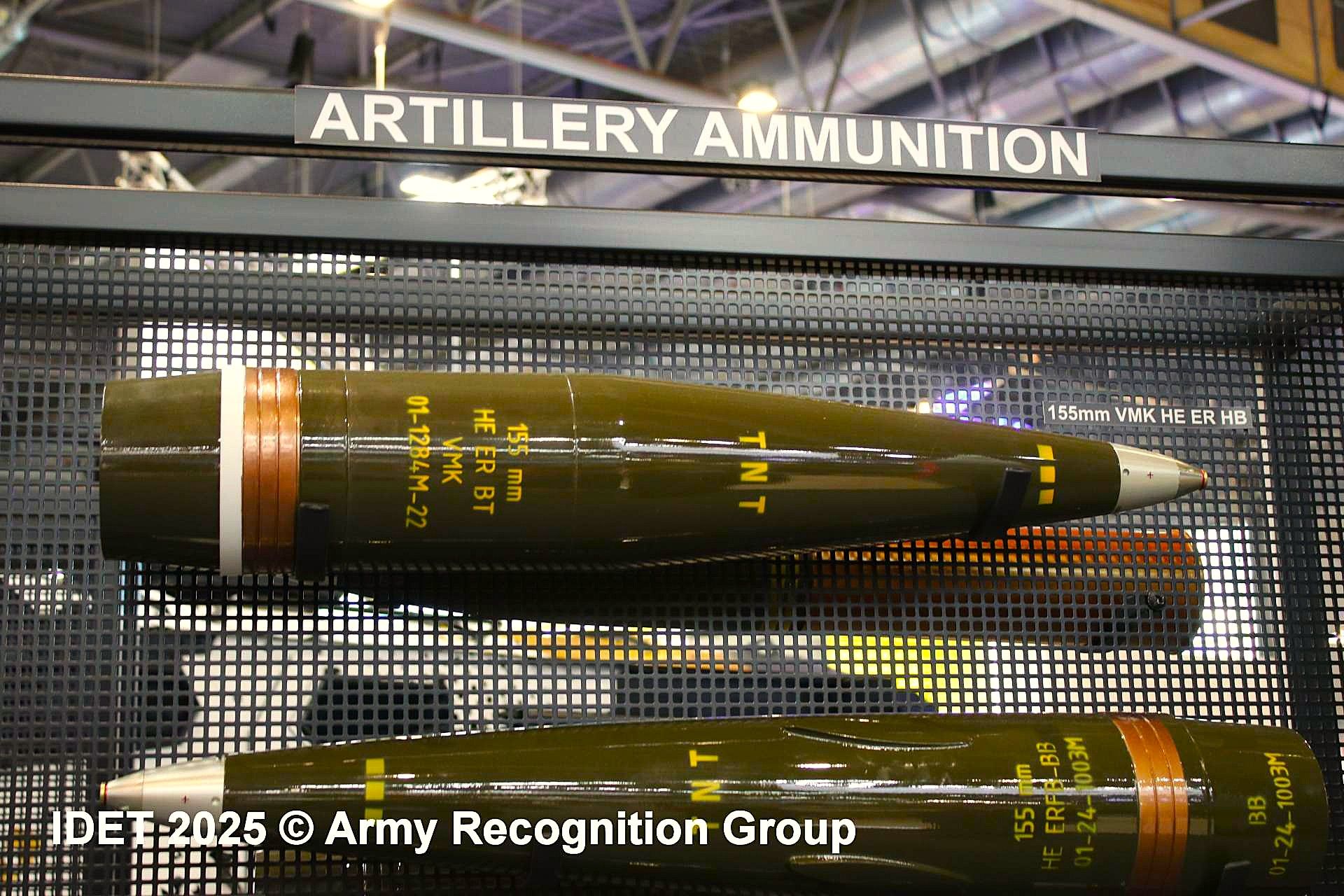
Operationally, the 155 mm shell is central to NATO’s artillery doctrine. It is the standard caliber for systems such as the American M777 lightweight howitzer, the M109 Paladin self-propelled gun, Germany’s PzH 2000, South Korea’s K9 Thunder, and the French Caesar (Picture source: Army Recognition Group)
The Future Artillery Complex (FAC), to be built at the Iowa Army Ammunition Plant, will serve as one of the most advanced explosive loading facilities worldwide. Designed around robotics, automation, and lean manufacturing principles, it will be capable of filling and packaging 36,000 shells monthly. Beyond its technological sophistication, the facility represents a rare case of a European defense industrial group spearheading a strategic U.S. Army project. For the American military, this investment is part of a broader initiative to modernize ammunition production, aiming to reach over one million 155 mm shells annually.
Operationally, the 155 mm shell is central to NATO’s artillery doctrine. It is the standard caliber for systems such as the American M777 lightweight howitzer, the M109 Paladin self-propelled gun, Germany’s PzH 2000, South Korea’s K9 Thunder, and the French Caesar. The Ukraine war has further reinforced its role: Kyiv’s counteroffensive and defensive operations rely heavily on sustained artillery barrages. Since 2022, the United States alone has delivered more than 3 million 155 mm rounds to Ukraine, depleting its reserves and exposing production shortfalls. Stockpiles in Europe face similar pressure, with Poland and other NATO states now scrambling to multiply their own capacities.
The development of the Iowa facility must be understood in the context of artillery warfare’s enduring relevance. Despite advances in drones and precision strike weapons, the Ukraine conflict has demonstrated that artillery remains the backbone of land combat, inflicting up to 80% of battlefield casualties. The dependence on high-intensity shell consumption mirrors earlier wars of attrition, recalling how World War I industrialized firepower production. Today’s challenge is not technological obsolescence, but industrial endurance, ensuring enough shells are produced to sustain operations over prolonged campaigns.
Strategically, the plant reinforces both U.S. and allied security. By entrusting a European group such as CSG with a pivotal role in its ammunition supply chain, Washington underscores transatlantic defense integration at a time of growing demand. The Future Artillery Complex is not only about supplying the U.S. Army; it also has potential to support Foreign Military Sales and allied needs, making it a pillar of NATO readiness. The Pentagon’s $632 million allocation, scheduled to bring the plant online by September 2029, reflects a long-term commitment to rebuilding the ammunition base after decades of contraction. Although production goals have slipped, 100,000 shells per month was initially targeted for 2026, this project is part of the effort to close the gap.
The budget for the program also reveals Washington’s industrial strategy. The $632 million investment, complemented by earlier contracts to expand facilities in Pennsylvania, Texas, and Kentucky, shows that the United States is diversifying production sites to mitigate risks. MSM North America acts as the prime contractor, coordinating American firms for construction, automation, safety, and environmental compliance. This European-led but U.S.-integrated consortium offers a model of hybrid defense industrial cooperation that may be replicated for other critical munitions in short supply.
The establishment of this facility is more than an industrial expansion; it is a recognition that the outcome of modern wars still depends on artillery mass and supply resilience. As conflicts in Ukraine and the Middle East illustrate, the 155 mm shell remains indispensable to combined-arms operations. By 2029, the Iowa plant will provide NATO with a vital reserve of firepower, ensuring that artillery, the so-called “king of battle”, retains its decisive role in 21st-century warfare.