
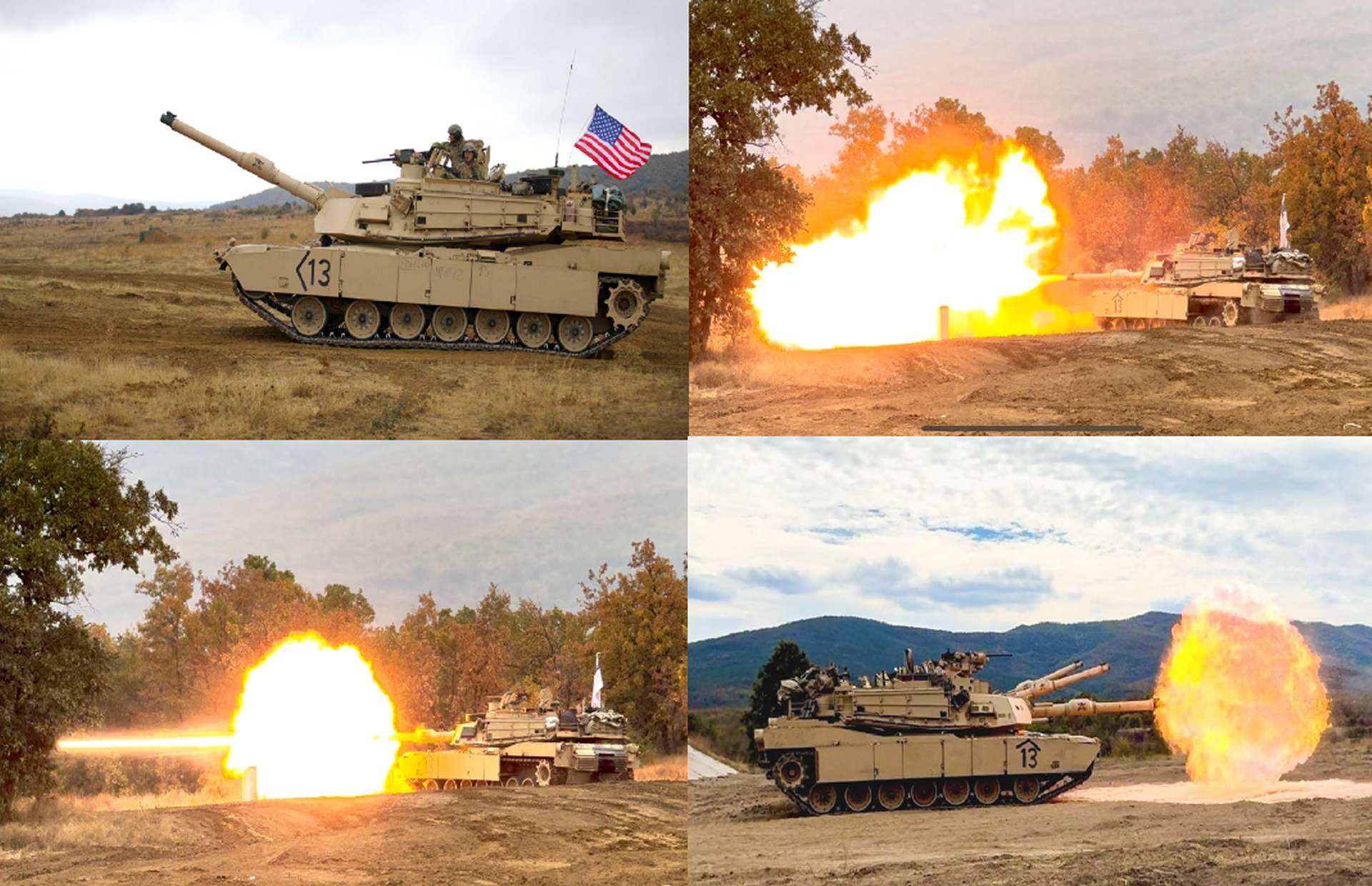










U.S. tank units train in real battlefield conditions in case of a conflict in Europe.
Tank crews from the U.S. Army’s 1st Infantry Division completed an Abrams gunnery rotation at Bulgaria’s Novo Selo Training Area on October 7, 2025. The drills boost NATO’s combat readiness along its eastern flank amid ongoing regional security tensions.
According to information published by the U.S. Department of War on October 5, 2025, tank crews from 1-16 Infantry, 1st Armored Brigade Combat Team, 1st Infantry Division, completed an Abrams gunnery rotation at Bulgaria’s Novo Selo Training Area, running day and night engagements after a Live Fire Accuracy Screening Test that confirmed each tank’s fire-control precision. The event, held September 29 to October 5, is part of a broader push to keep combat-credible U.S. armored forces forward in Europe along NATO’s eastern flank. Crews progressed toward subsequent platoon and company situational exercises before a combined-arms live fire.
Follow Army Recognition on Google News at this link

U.S. Army M1A2 Abrams main battle tank during live-fire training in Bulgaria. The 70-ton platform combines a 120 mm smoothbore gun, advanced thermal sights, and digital fire control with a 1,500 hp turbine engine, delivering superior firepower, mobility, and battlefield awareness across NATO’s eastern flank (Picture source: U.S. DoW).
The centerpiece was the M1A2 Abrams main battle tank and its 120 mm M256 smoothbore gun, validated during the LFAST calibration drill before crews moved into the gunnery tables. LFAST matters because it aligns the tank’s ballistic solution with real-world shot data at range, raising first-round hit probability and reducing wasted ammunition and time on the line. In practice, evaluators confirm impacts inside a defined accuracy circle at approximately 1,500 meters, applying offsets to the fire-control computer when necessary, so crews start gunnery with a dialed-in gun and sighting system.
On the vehicle, the Abrams brings a four-person crew and a hard-hitting, multi-mission weapons suite: the 120 mm main gun for armor defeat and multi-purpose effects, a coaxial 7.62 mm M240 for suppressive fire, and a .50 caliber M2HB on the commander’s station for countering light vehicles, drones of opportunity, and dismounted threats. The M1A2’s digital architecture, thermal imagers, and commander’s independent viewer enable hunter-killer tactics, allowing rapid handoff from commander to gunner for near-continuous target servicing. A 1,500 hp AGT1500 turbine pushes the 70-ton-class platform with high power-to-weight for short, violent dashes between firing positions. These characteristics, paired with stabilized optics and a modern FCS, are precisely what gunnery tables stress under both daylight and thermal conditions.
While this iteration spotlighted Abrams crews, the brigade’s broader package at Novo Selo included complementary live-fire qualifications for M2A3 Bradley infantry fighting vehicles days earlier. That sequencing underscores combined-arms integration at the company and battalion level, pairing the Abrams’ overmatch and shock effect with Bradley-delivered dismounts, sensors, and 25 mm direct fire for close fights in broken terrain. The result is a cohesive task force with overlapping fields of fire and flexible maneuver options across Bulgaria’s expansive training complex.
LFAST reduces variables before the first table, letting teams focus on communication, fire distribution, and engagement sequencing rather than chasing zero. By the time they transition to platoon and company lanes, Abrams crews are executing hunter-killer drills, bounding between hull-down positions, and interleaving coax, main-gun sabot or multi-purpose rounds, and commander’s heavy machine gun based on target set and range. The pathway to the Combined Arms Live Fire is deliberate: confirm the gun, qualify the crew, then stress the formation in time-sensitive, multi-target engagements under limited visibility.
Novo Selo sits at the hinge of the Black Sea and the Balkans, where NATO has reinforced a multinational unit since Russia’s full-scale invasion of Ukraine. Bulgaria’s growing role in the alliance’s southeastern flank, coupled with recurring U.S. armored rotations and security cooperation investments, makes American Abrams gunnery there more than routine training. It is a signal to Moscow and a reassurance to allies from the Danube to the Dardanelles that NATO heavy forces can deploy, sustain, and fight from forward ranges on short notice.