






Breaking News





U.S. Defense Secretary Hegseth Urges U.S. Army to Modernize and Enhance Anti-Drone Capabilities.
U.S. Secretary of Defense Pete Hegseth has issued a formal directive to senior Pentagon leadership to set forth a clear mandate to accelerate Army modernization and acquisition reform, focusing on countering the growing threat posed by unmanned systems. The memorandum, dated April 30, 2025, outlines specific targets for the U.S. Army to integrate unmanned systems (UMS) and counter-drone capabilities into operational formations by 2026 and 2027. This strategic guidance emerges against the backdrop of heightened drone activity in global conflict zones, including the ongoing threats emanating from Yemen and the broader Red Sea region.
Follow Army Recognition on Google News at this link
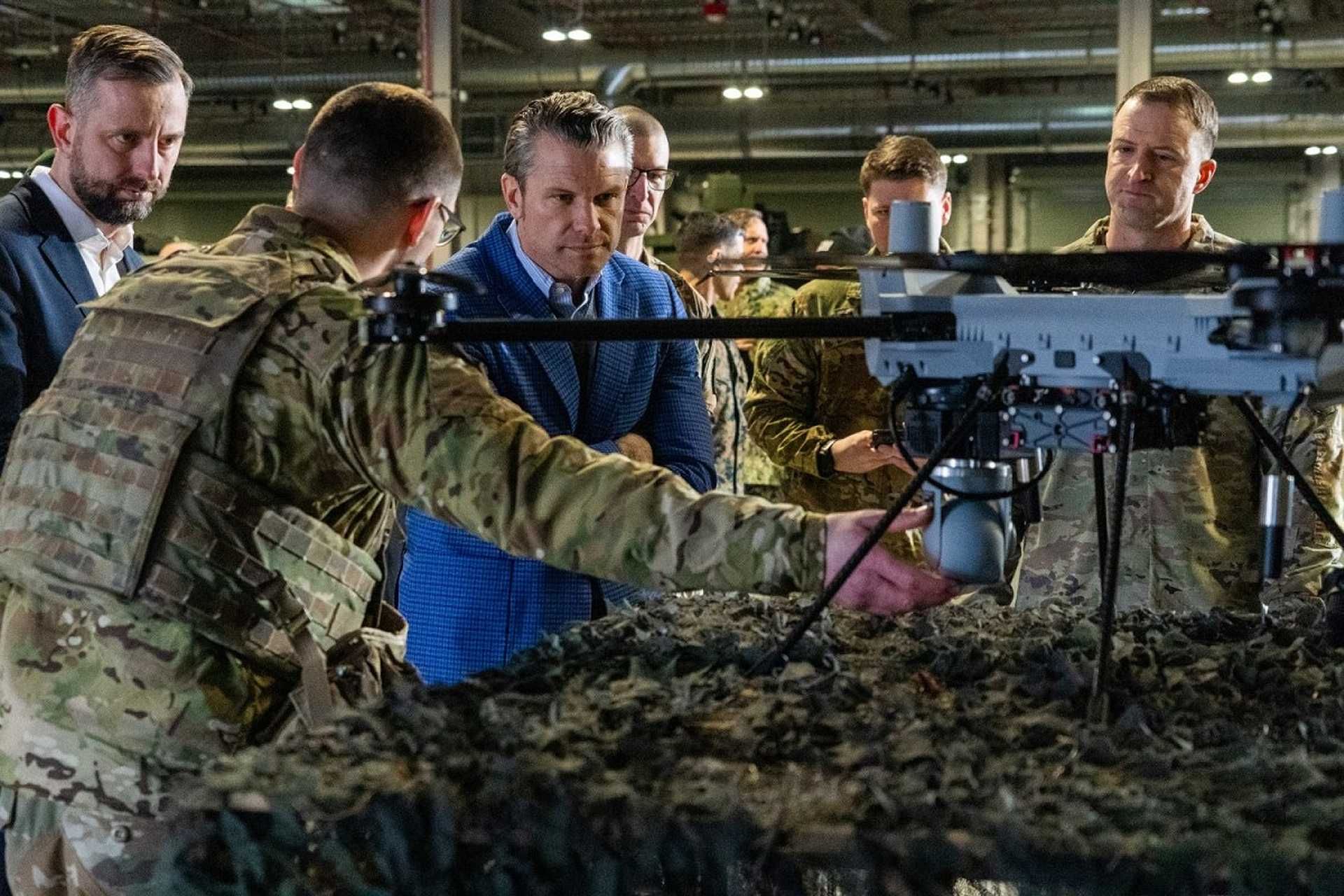
U.S. Secretary of Defense Pete Hegseth and Polish Deputy Prime Minister Władysław Kosiniak-Kamysz visited the U.S. Army Prepositioned Stocks-2 (APS-2) site in Powidz, Poland. (Picture source: U.S. DoD)
U.S. Secretary of Defense Hegseth’s directive reflects growing concern within the U.S. Department of Defense over the evolving nature of unmanned aerial systems (UAS), which both state and non-state actors increasingly use to target U.S. military assets, allies, and civilian infrastructure. “Unmanned systems present both an urgent and enduring danger to American personnel, facilities, and critical assets,” the memo states. “To win tomorrow’s wars, we must adapt today.”
Recent developments in the Middle East—most notably the escalation of drone attacks launched by Iranian-aligned Houthi forces in Yemen—have reinforced the urgency of this initiative. Throughout the past year, U.S. naval and allied commercial vessels operating in the Red Sea have faced swarms of loitering munitions and explosive-laden drones, launched from within Houthi-controlled territory. These low-cost, asymmetric tools have disrupted maritime security and exposed vulnerabilities in existing air defense systems. The Defense Department now views these tactics as indicative of a broader shift in modern warfare, in which drones play a central role across all domains.
To address this evolving threat landscape, Secretary Hegseth has directed the U.S. Army to field Unmanned Systems (UMS) and Ground- and Air-Launched Effects (GLE/ALE) in every division by the end of 2026. In parallel, counter-UAS capabilities must be embedded directly into maneuver platoons by 2026 and extended to maneuver companies by 2027. The initiative emphasizes not only the tactical deployment of these technologies but also the need for enhanced mobility and cost-efficiency to ensure operational relevance in future conflicts.
This modernization effort is already underway with the deployment of systems such as the Marine Air Defense Integrated System (MADIS) and the Maneuver-Short Range Air Defense (M-SHORAD) platform. MADIS, mounted on the Joint Light Tactical Vehicle (JLTV), is equipped with radar, electro-optical sensors, and electronic warfare suites, enabling it to detect and neutralize aerial threats—including small drones—in real time. MADIS units have been deployed to the Middle East and Indo-Pacific, where they serve a critical role in force protection.
M-SHORAD, based on the Stryker armored vehicle, integrates Stinger missiles, a 30mm cannon, and advanced optics to provide highly mobile short-range air defense for maneuvering ground units. Its recent deployment with the 2nd Armored Brigade Combat Team during European training exercises demonstrates its integration within NATO's broader air defense architecture. These systems serve as the vanguard of the Army’s tactical counter-drone capability and exemplify the direction outlined in Secretary Hegseth’s strategy.
The U.S. Department’s new Strategy for Countering Unmanned Systems provides a unified framework to confront this challenge, emphasizing interoperability, rapid acquisition cycles, and scalable solutions. “Drones are transforming the security environment. From reconnaissance to kamikaze attacks, they are changing how wars are fought,” said a senior defense official. “Our strategy brings all components of the Department into alignment to meet this challenge with speed and unity.”
The work of specialized units such as SGT STOUT, a test platform for new technologies including autonomous ground systems, drone defense networks, and AI-enabled sensor fusion further supports these reforms. This experimental approach to force design is expected to serve as a model for future division-level integration of advanced unmanned and counter-unmanned capabilities.
As drone threats continue to expand—from the mountains of Yemen to the South China Sea—the U.S. Department of Defense is advancing a comprehensive and proactive posture. Through a combination of technological innovation, structural reform, and battlefield integration, the U.S. Army is preparing to meet and defeat the threats of tomorrow’s conflicts with decisive capabilities already in motion today.