







Breaking News




U.S. Dark Eagle Hypersonic Weapon in Australia to counter Chinese Threat in Indo-Pacific.
According to information published by the U.S. Army Pacific on August 5, 2025, the United States Army has executed the first-ever overseas deployment of its Long-Range Hypersonic Weapon (LRHW) system, marking a historic milestone in American military modernization and strategic deterrence. As part of the large-scale multinational Exercise Talisman Sabre 2025, the 3rd Multi-Domain Task Force (3MDTF) successfully transported and activated the LRHW system in Australia's Northern Territory. This represents the first operational fielding of the weapon outside the continental United States and its first integration into a coalition-led training scenario. The deployment not only validates the LRHW’s rapid mobility and combat readiness but also underscores the United States' commitment to forward-deployed advanced strike capabilities in support of allies across the Indo-Pacific region.
Follow Army Recognition on Google News at this link
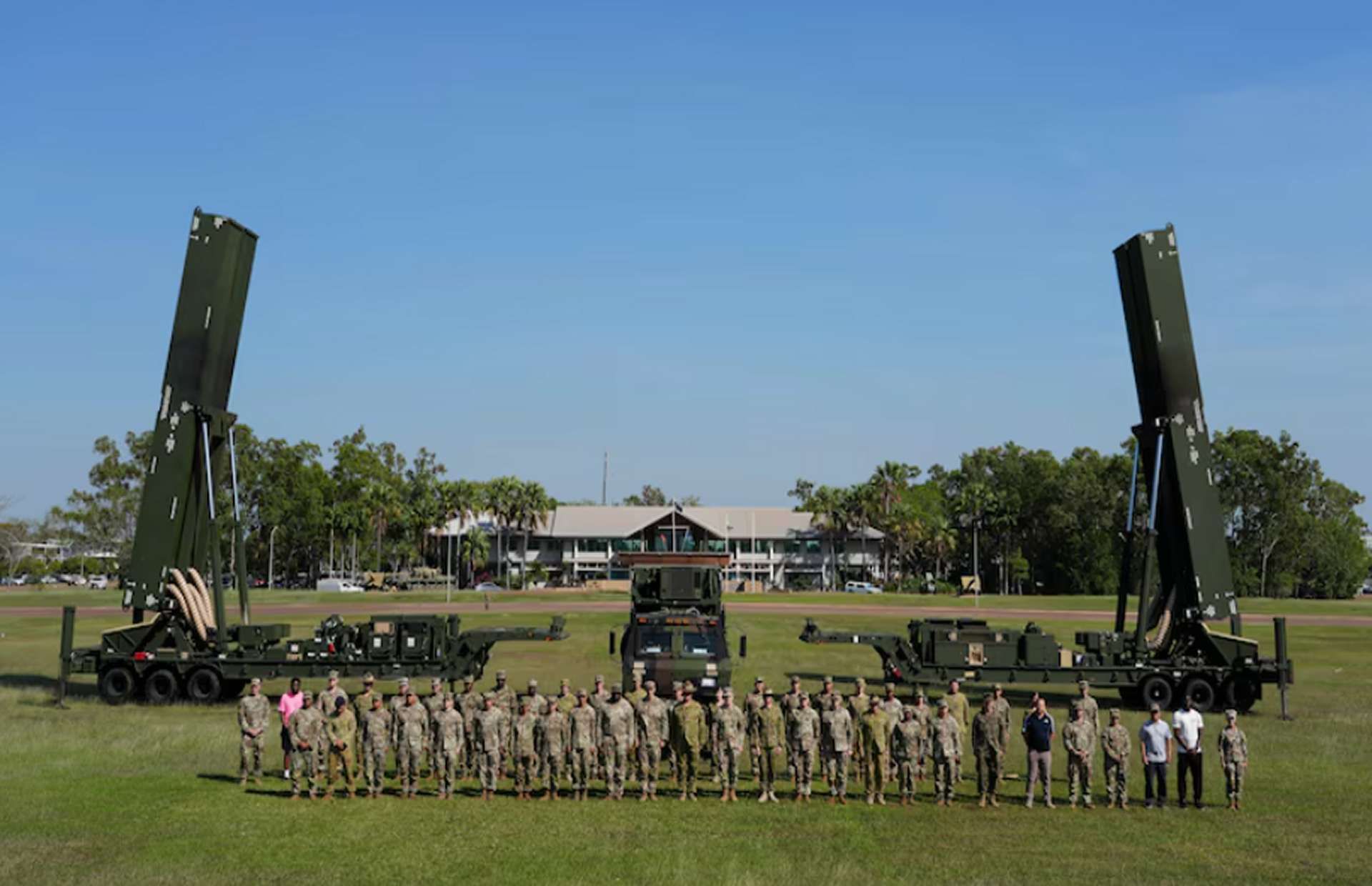
The Dark Eagle strikes over 2,775 km at Mach 5+ with a maneuverable glide body, evading defenses (Picture source: U.S. Army)
The Long-Range Hypersonic Weapon, also referred to as the Dark Eagle system, is among the most advanced elements of the U.S. Army’s long-range precision fires portfolio. The system is built around the Common Hypersonic Glide Body (C-HGB), developed in partnership with the U.S. Navy, and a two-stage solid rocket booster. Once launched, the C-HGB separates and glides through the atmosphere at speeds exceeding Mach 5, with the ability to maneuver laterally and vertically, making it highly unpredictable and extremely difficult for conventional missile defense systems to intercept. The range of the system is officially classified, but it is estimated to exceed 2,775 kilometers, enabling it to strike deeply into denied environments. The complete LRHW battery includes mobile launchers mounted on M870A4 trailers, a Battery Operations Center for fire mission planning, and support vehicles designed for rapid deployment and setup.
This deployment to Australia is not only a demonstration of technological maturity but also a carefully calibrated geopolitical signal. Amid intensifying strategic competition in the Indo-Pacific, the positioning of hypersonic assets in Australia sends a clear message regarding U.S. intent and capability. The People's Republic of China has significantly expanded its anti-access/area denial (A2/AD) umbrella, with a growing arsenal of long-range missiles, air defense systems, and anti-ship capabilities aimed at deterring U.S. military presence in the Western Pacific. By placing the LRHW within range of potential regional flashpoints such as the Taiwan Strait, the South China Sea, and the First Island Chain, the U.S. and its allies are enhancing their ability to conduct deterrence by denial. Australia’s strategic location provides a secure, sovereign platform for operations beyond the reach of most adversary strike systems, while its close political and military alignment with Washington under the AUKUS and Quad frameworks makes it a natural partner for such a capability.
From a tactical and operational standpoint, the deployment serves as a validation of the U.S. Army’s evolving doctrine of Multi-Domain Operations (MDO). The 3rd Multi-Domain Task Force was specifically designed to integrate long-range fires, cyber-electromagnetic activities, space operations, and intelligence in order to support joint forces in contested environments. The LRHW serves as a central component of this concept, enabling long-range precision strikes against time-critical and high-value targets in support of air and maritime campaigns. During Talisman Sabre, the system was fully integrated into joint command-and-control architecture, enabling real-time sensor-to-shooter engagements, simulated strategic targeting, and mission rehearsals under coalition command structures. The exercise also tested logistical movement, deployment timelines, launcher setup in austere environments, and sustainment of advanced munitions in theater, all critical components of operational readiness.
The presence of the Dark Eagle in Australia also marks a turning point in the U.S. Army’s return to theater-level strike capabilities. For decades, long-range conventional strike has been largely the domain of the U.S. Air Force and Navy. With the reemergence of peer adversaries, particularly in the Indo-Pacific, the Army is now reasserting its relevance in strategic deterrence through land-based hypersonic and mid-range systems. The LRHW’s capability to deliver immediate and precise effects across the depth of an adversary’s battlespace gives joint force commanders a powerful new option to shape the battlefield and suppress enemy capabilities before they can be employed. This is particularly relevant in scenarios where access to air or maritime platforms may be contested or delayed.
This historic fielding of the LRHW in Australia represents more than just the arrival of a new weapon system, it signals a transformative shift in U.S. Army force posture, deterrence strategy, and allied integration in the Indo-Pacific. As the race for hypersonic supremacy accelerates globally, the U.S. Army has demonstrated that it not only possesses the technological edge but is also willing and able to forward-deploy it in support of allies. With continued testing, exercises, and operational refinement, the Dark Eagle is poised to become a cornerstone of American deterrence architecture and a key instrument of power projection in one of the world’s most strategically dynamic regions.