






Breaking News






U.S. Authorizes Transfer of Excalibur Guided Munitions and Javelin Anti-Tank Systems to India.
The U.S. State Department has cleared a pair of Foreign Military Sales to India covering M982A1 Excalibur 155 mm projectiles and FGM 148 Javelin anti-tank missiles worth 92.8 million dollars. The packages deepen India’s precision strike toolkit at both brigade and squad levels as New Delhi modernizes for potential crises along the Pakistan and China borders.
The U.S. Defense Security Cooperation Agency (DSCA) announced on November 19, 2025, that the U.S. State Department approved two possible Foreign Military Sales to India covering M982A1 Excalibur 155 mm precision projectiles (FMS 1) and FGM 148 Javelin anti-tank guided missiles (FMS 2) worth a combined 92.8 million dollars. The Excalibur case covers 216 projectiles and associated fire control equipment, while the Javelin package includes 100 missiles, 25 launch units, training, refurbishment, and life cycle support.
Follow Army Recognition on Google News at this link
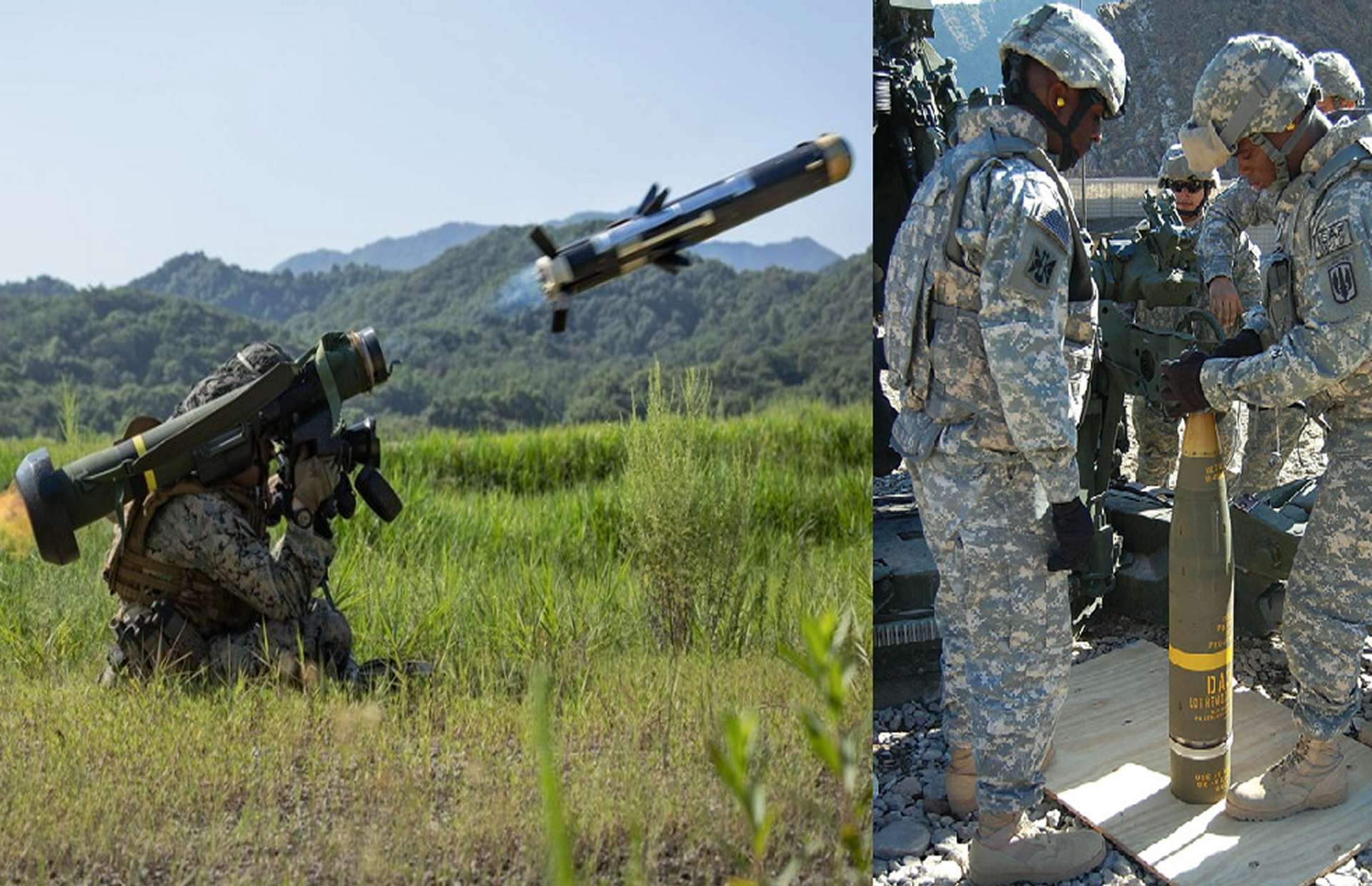
Excalibur delivers GPS-guided 155 mm precision fire out to 40–50 kilometers with meter-level accuracy, while Javelin provides fire and forget, top-attack anti-tank capability for frontline infantry with a tandem warhead effective against modern armor (Picture source: U.S. DoW).
The centerpiece on the artillery side is the Excalibur Increment Ib round, designated M982A1, a 155 mm GPS and inertial navigation guided projectile that uses folding glide fins and a base bleed section to more than double the useful range of conventional high explosive shells. U.S. program documentation and test data credit the latest variant with ranges out to 40 to 50 kilometers from 39 and 52 caliber guns and a circular error probable of a few meters, even at maximum range, thanks to hardened GPS and refined guidance software.
For India, this is a follow-on rather than a first step. New Delhi procured an initial emergency batch of Excalibur rounds in 2019 and test-fired them from M777 ultra-light howitzers at the Pokhran range, with Indian media highlighting their use to strike targets with “surgical” accuracy. DSCA now explicitly notes that the new sale will “increase first strike accuracy within its brigades,” a clear nod to India’s push to embed precision artillery into its broader Field Artillery Rationalisation Programme and the mediumisation of its gun park toward 155 mm systems such as M777, K9 Vajra T, Dhanush, and ATAGS.
Excalibur fits neatly into an Indian doctrine that increasingly prizes non-contact warfare and long-range precision effects along the Pakistan and China fronts. After Operation Sindoor, senior officers and planners stressed how long-range precision missiles made geography “almost irrelevant,” and the same logic now extends to tube artillery. Precision 155 mm rounds allow Indian commanders to service high-value bunkers, gun lines, and logistics nodes near civilian areas or across politically sensitive borders with single-round engagements, rather than area bombardment. In any future iteration of Sindoor or a Ladakh-style crisis, Excalibur stocked across M777, K9, and, in time, ATAGS units gives the Army a scalable tool for escalation control.
The Javelin package addresses the same demand for precision, but at the squad and platoon level. According to DSCA, India has requested 100 FGM 148 rounds and 25 Lightweight Command Launch Units or Block 1 CLUs, along with simulators and test equipment. Javelin is a third-generation, fire-and-forget anti-tank missile with an imaging infrared seeker, selectable top attack or direct attack profiles, a tandem high-explosive anti-tank warhead designed to defeat explosive reactive armor, and an effective range that current U.S. Army references place near 4 kilometers when fired from the improved lightweight launcher.
From a tactical standpoint, New Delhi will not immediately displace existing Israeli Spike or legacy Konkurs and Milan inventories. Instead, Javelin is likely to equip high readiness formations in the Northern and Western Commands, mountain strike brigades, and special forces that need a truly fire-and-forget, soft-launch weapon that can be fired from defilade or confined high altitude positions. The combination of a quiet soft launch, minimal backblast, and autonomous terminal homing allows two-person teams to engage tanks or hardened firing points, break contact, and displace before counterfire or drones can fix their position, which is particularly attractive in a post Sindoor environment saturated with sensors.
Both sales intersect directly with India’s indigenous efforts and illuminate a capability gap in the near term. On the artillery side, DRDO and Indian industry are working on 155 mm guided projectiles and terminally guided munitions under Make in India frameworks, while Reliance Defence has partnered with Germany’s Diehl to produce Vulcano precision rounds domestically. In parallel, India has invested heavily in other precision strike tools such as Nagastra loitering munitions and the ULPGM series of UAV-launched missiles. Yet these lines are still ramping toward volume production. Until that happens, Excalibur provides a mature, combat-proven round that keeps Indian magazines full and offers a benchmark for domestic designs.
DRDO’s Man Portable Anti-Tank Guided Missile has completed successful warhead trials at Pokhran, with several sources converging on a target of operational clearance around 2026. MPATGM is designed as a Javelin-class weapon, with fire-and-forget infrared guidance and a top-attack profile, and will eventually replace aging Milan and Konkurs stocks. In the meantime, a modest Javelin fleet gives frontline units a high-end capability immediately and allows Indian engineers and tacticians to study how a mature third-generation system is trained, maintained, and integrated into combined arms operations.
Washington portrays the dual sale as a way to strengthen a major defense partner and improve India’s ability to meet current and future threats, language that tracks closely with the wider push to make precision weapons central to Indo-Pacific deterrence. For New Delhi, the deeper story is about precision at every echelon, from long-range air-delivered standoff missiles down to the infantry section’s anti-tank team. Excalibur and Javelin are not ends in themselves; they are bridging tools that help the Indian Army fight the next crisis with credible, discriminating firepower while its own indigenous precision ecosystem accelerates into full stride.
Written by Evan Lerouvillois, Defense Analyst, Army Recognition Group.
Evan studied International Relations, and quickly specialized in defense and security. He is particularly interested in the influence of the defense sector on global geopolitics, and analyzes how technological innovations in defense, arms export contracts, and military strategies influence the international geopolitical scene.