






Breaking News






U.S. Army Arctic Division Uses Alaska Drone Trials to Shape Future Electromagnetic Doctrine.
The U.S. Army’s 11th Airborne Division ran an extensive drone and counter-drone experimentation campaign in Alaska to study how unmanned systems and electronic warfare tools perform in extreme cold and a contested spectrum. The results aim to speed new tactics and technologies into the force as low-altitude airspace becomes more dangerous and more crowded.
On November 25, 2025, the U.S. Army disclosed that the 11th Airborne Division had conducted a large-scale unmanned aerial system (UAS) and counter-UAS experimentation campaign in Alaska’s Joint Pacific Alaskan Range Complex, using the Arctic as a live laboratory for electromagnetic warfare. In partnership with the Defense Innovation Unit and multiple industry vendors, the division combined electronic warfare (EW) teams, UAS operators and counter-drone technologies to measure how these systems behave in extreme cold and a contested electromagnetic spectrum. The exercise reflects how lessons from Ukraine and other theaters are accelerating the integration of EW and counter-UAS at tactical level, particularly in the airspace below 10,000 feet that is now crowded with small drones. This activity also supports the Army’s Arctic Strategy “Regaining Arctic Dominance,” which designates the 11th Airborne as the lead formation for cold-weather operations.
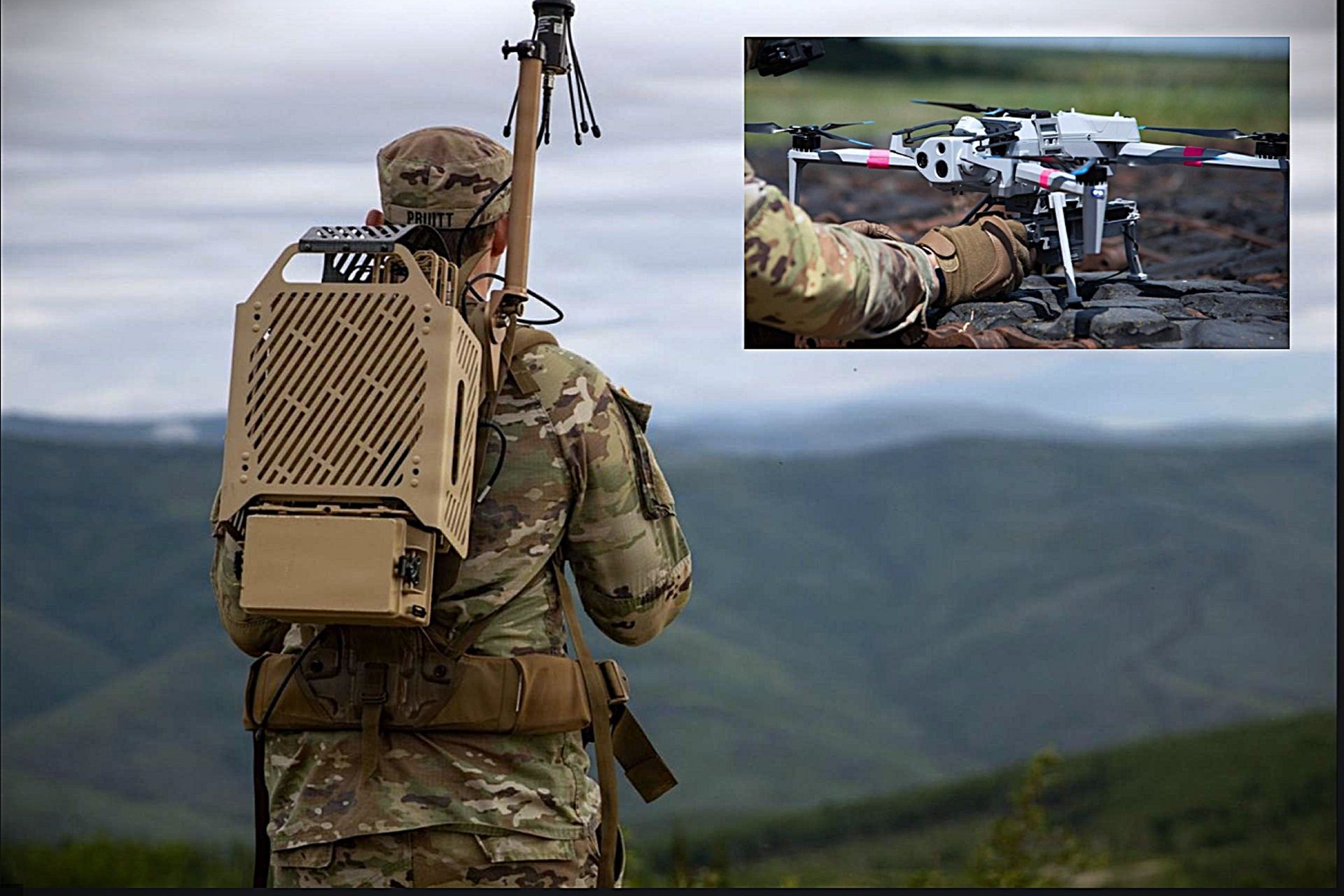
The U.S. Army’s 11th Airborne Division used Alaska’s Arctic ranges to blend drones, electronic warfare teams and counter drone tools in a large cold weather experiment that revealed how unmanned systems behave in extreme conditions and a congested electromagnetic spectrum (Picture Source: U.S. Army)
At the heart of the experimentation is a suite of EW and counter-UAS tools rather than a single platform. The 11th Airborne Division brought together its organic EW platoons and commercial UAS/C-UAS systems to detect, characterize and defeat small drones across the frozen expanses near Fort Greely and Fort Wainwright. Soldiers used their EW equipment to capture radio-frequency signatures, trace command-and-control links and assess how jammers, sensors and UAS payloads react when temperatures are well below freezing and snow hampers mobility and line of sight. Battery performance, antenna icing and data-link stability were all affected by the cold, forcing operators to adapt power management and operating procedures. In parallel, C-UAS vendors were able to see how their radars, passively cued RF detectors and effectors perform when atmospheric conditions distort signals and when drones fly low over rugged, snow-covered terrain. The objective was less about a single “winner” system and more about understanding which combinations of sensors, EW suites and UAS platforms give commanders a reliable picture of the “invisible battlefield” in the air littoral over the Arctic.
This experimentation forms part of a broader trajectory in operational and capability development for the 11th Airborne Division, which was reactivated in 2022 as the Army’s dedicated Arctic formation under the “Regaining Arctic Dominance” strategy. The Joint Pacific Alaskan Range Complex, recognized as one of the Department of Defense’s premier multi‑domain training environments, provides expansive instrumented air and land space where live, virtual, and constructive assets can be integrated. In recent years, the division has leveraged this range and the Joint Pacific Multinational Readiness Center–Alaska to validate Arctic mobility, air‑assault tactics, and cold‑weather sustainment. The addition of dedicated electronic warfare and counter‑UAS trials in 2025 extends this progression from maneuver into the electromagnetic domain, transforming earlier tabletop concepts into data‑driven evaluations. These exercises also institutionalize skills that, in other theaters, were learned under combat conditions, such as managing dense jamming, overlapping frequency use, and drone swarms in real time, and translate them into tactics, techniques, and procedures for large‑scale operations.
Compared with counter-UAS events in milder climates, the Alaskan campaign gives the Army specific advantages. Events such as Project FlyTrap 4.5 in Germany focus on evaluating lower-cost sensors and shooters for NATO’s Eastern Flank, connecting them to established command-and-control networks and assessing their ability to detect, discriminate and defeat small drones over training areas in Europe. In Alaska, the 11th Airborne is tackling a different problem set: how the same families of sensors, EW tools and UAS platforms behave when cold weather shortens battery life, reduces radar performance at low elevation angles and complicates maintenance and logistics. The division’s trials therefore, complement European efforts by stress-testing similar categories of systems under the worst environmental conditions the Army expects to encounter. As a result, the data gathered in Alaska will help refine not only technical requirements, such as power management, environmental hardening and antenna design, but also doctrine on how to synchronize EW and kinetic tools without impairing friendly drones in a cluttered electromagnetic environment, an issue repeatedly highlighted by front-line operators in Ukraine.
Strategically, these trials carry significance far beyond a single divisional exercise. The Arctic now occupies a central position in the defense strategies of the United States, Russia, and China, as emerging maritime routes, undersea communication cables, and long-range missile paths increasingly intersect in these northern regions. By developing systems capable of detecting and countering small drones in this environment, the 11th Airborne Division enhances the security of critical U.S. and allied infrastructure while strengthening deterrence credibility in the High North.
The capacity to control the airspace up to 10,000 feet through an integrated use of unmanned aerial systems (UAS), electronic warfare (EW), and counter-UAS (C-UAS) technologies directly supports homeland defense operations under NORAD and U.S. Northern Command. These efforts also generate valuable tactics and lessons for allies in Europe and the Indo-Pacific who face similar challenges with drone proliferation.
At the operational level, embedding EW and counter-UAS training into Arctic exercises ensures that any future deployment of the division, whether for crisis response in Alaska, reinforcement of NATO’s northern flank, or missions in other cold-weather environments, relies on refined procedures rather than improvised measures against aerial and electronic threats.
The UAS experimentation led by the 11th Airborne Division in Alaska signals a shift from observing drone warfare abroad to actively shaping solutions for future conflicts in one of the world’s harshest theaters. By blending EW expertise, industry innovation, and the unique conditions of the Joint Pacific Alaskan Range Complex, the Army is turning the Arctic into a proving ground for counter‑UAS concepts with relevance from the High North to Eastern Europe. Lessons on RF signatures, battery performance in deep cold, and spectrum congestion will guide future acquisitions, training, and operations. The message to allies and competitors alike is clear: the United States is adapting to the drone‑and‑EW era with a focus on environments where small technical edges can decide air dominance.
Written by Teoman S. Nicanci – Defense Analyst, Army Recognition Group
Teoman S. Nicanci holds degrees in Political Science, Comparative and International Politics, and International Relations and Diplomacy from leading Belgian universities, with research focused on Russian strategic behavior, defense technology, and modern warfare. He is a defense analyst at Army Recognition, specializing in the global defense industry, military armament, and emerging defense technologies.