






Breaking News






U.S. 2nd BCT 1st Cavalry Division completes first heavy-force training with drones and electronic warfare systems.
The U.S. Army 2nd Brigade Combat Team of the 1st Cavalry Division has completed the first heavy force training event shaped by the Transforming in Contact framework. The event marks the first time an armored brigade applied the approach during a live combat simulation.
According to information published on the X account of the U.S. Army’s 1st Cavalry Division on November 24, 2025, its 2nd Brigade Combat Team completed the first heavy force training event guided by the Transforming in Contact framework at the National Training Center in Fort Irwin, California. The division stated that the brigade used advanced aerial drones, electronic warfare systems, and restructured formations to accelerate maneuver and increase lethality against a near-peer enemy force inside a live combat simulation.
Follow Army Recognition on Google News at this link
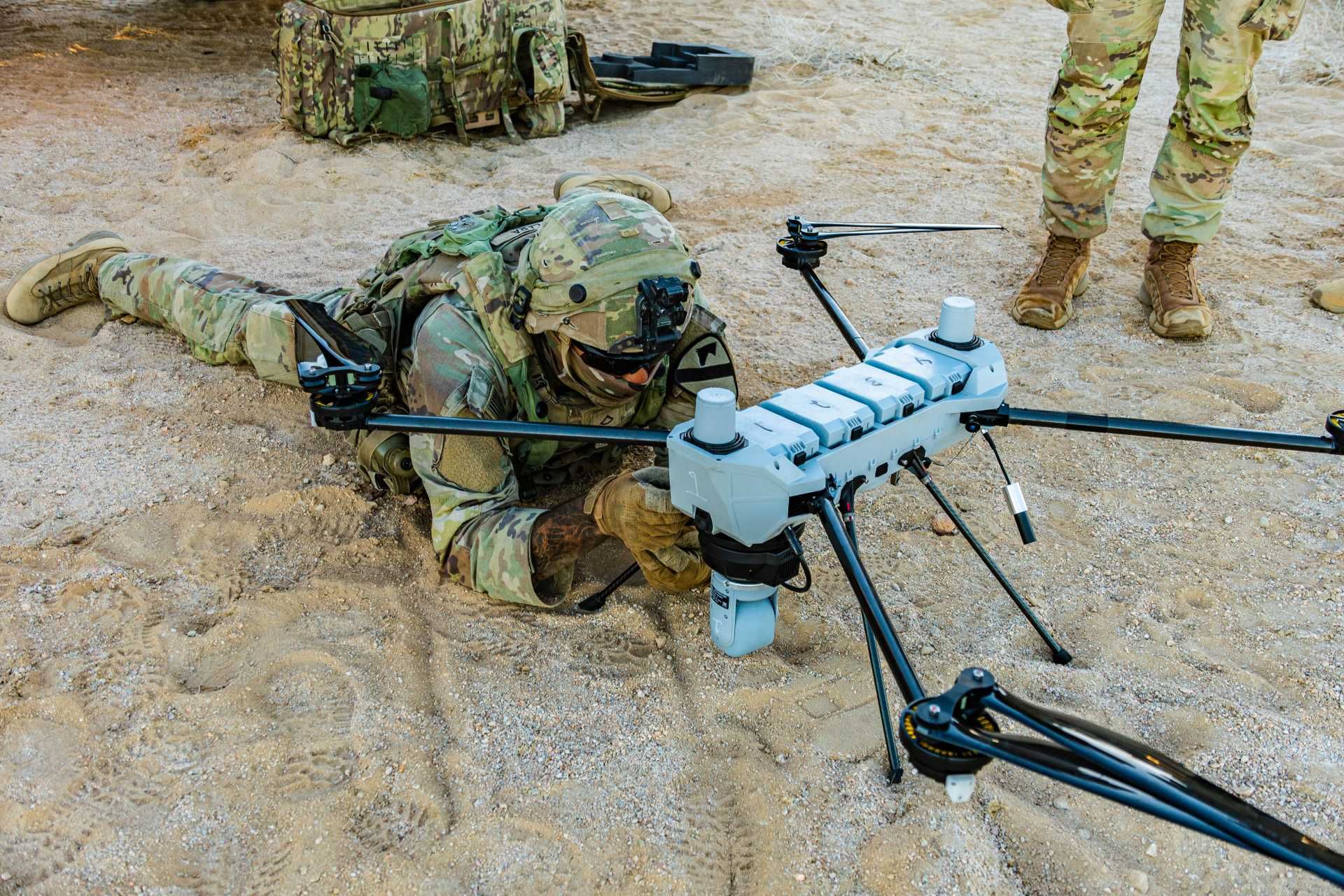
Pfc. Mario Lara, a small unmanned aircraft system operator with 1st Battalion, 8th Cavalry Regiment, 2nd Armored Brigade Combat Team, 1st Cavalry Division, prepares a C100 small UAS for launch during Rotation 26-02 at the National Training Center in Fort Irwin, California, on November 1, 2025. (Picture source: U.S. Department of War)
As the clearest operational demonstration of the U.S. Army’s evolving approach, the Black Jack Brigade’s rotation (26-02) showed how Transforming in Contact transforms armored combat in contested environments. Unlike prior infantry-led TiC experiments, the heavy version involved the M1A2 SEPv3 Abrams, M2A4 Bradley vehicles, and Paladin howitzers with extensive drone and cyber-electronic integration. Army imagery confirms frequent use of small unmanned aerial systems (sUAS) by scouts and infantry, providing real-time reconnaissance and targeting data directly to front-line units.
For the first time in a National Training Center environment, armored companies executed synchronized drone-supported attacks using a detect-suppress-maneuver-finish sequence that compressed decision-making cycles and neutralized opposing forces with unprecedented speed. The brigade’s multifunctional reconnaissance company, a new organizational element under TiC 2.0, proved especially decisive. Equipped with drone surveillance, electronic jamming systems, and organic strike assets, this unit pushed deep into contested zones and fed precise targeting data back to battalion fire support elements and armored task forces, enabling rapid envelopment of simulated enemy formations.
New technologies paired with updated formations formed a critical element of the TiC evolution. Brigade leaders transitioned to smaller, modular groupings at the company level, integrating counter-UAS, electronic warfare, and real-time intelligence fusion. Footage highlights the Mastodon Beast+, a deployable system that detects, tracks, and disrupts enemy drones and communications, providing armored units with decisive capabilities in electromagnetic maneuver warfare.
The successful armored execution of TiC 2.0 demonstrates the Army’s shift in both tactics and theater expectations. Senior officers indicate that these transformations are informed by lessons from Ukraine and by concerns about new threats, emphasizing the necessity of rapid, distributed, and drone-supported operations. The Black Jack Brigade’s Fort Irwin results underscore the Army's renewed focus on high-end conflict and peer adversaries, demanding armored formations capable of breaching defenses and striking decisively.
However, challenges remain. TiC 2.0’s increased dependence on drones, sensors, and electronic warfare systems places significant cognitive and logistical demands on soldiers and commanders alike. Commanders involved in the rotation acknowledged the difficulty of managing vast information flows during high-tempo operations. Sustainment of these new capabilities, especially drone platforms in austere environments, also emerged as a key consideration for future iterations.
The next phase will involve digesting lessons learned from Rotation 26-02 and refining the concept ahead of future deployments and full Army adoption. U.S. Army Futures Command and Training and Doctrine Command (TRADOC) are expected to incorporate feedback from this NTC rotation into doctrinal updates and force design evaluations throughout 2026. The 1st Cavalry Division is scheduled to continue leading the TiC transformation, with a culminating event for full division-scale armored TiC experimentation set for 2027.
For defense industry stakeholders, the implications are equally profound. The integration of swarming drones, ruggedized EW kits for ground vehicles, and AI-enabled data fusion tools is no longer a future projection. They are now operational requirements. As the Army recalibrates procurement priorities in light of this transformation, companies that can deliver modular, rapidly deployable, and secure systems will likely play a central role in the next generation of armored warfare.
With the Black Jack Brigade having led the first armored TiC rotation, the U.S. Army’s transformation in armored warfare is now operational. This core product launch demonstrates how integrated drone and electronic warfare techniques are shaping the future battlefield, as the Army accelerates the adoption of TiC 2.0 force-wide. Army Recognition will continue reporting as the TiC 2.0 framework becomes foundational to U.S. Army operations.
Why drone integration now matters more than ever
The significance of drone technology integration across armored units has been underscored by battlefield observations from Ukraine. There, both Russian and Ukrainian forces have used commercial and military-grade drones not just for reconnaissance, but for direct attack, artillery correction, logistics, and jamming. The pace of drone warfare in Ukraine has revealed how vulnerable large mechanized forces can be when operating without persistent overwatch and real-time situational awareness.
The U.S. Army has taken note. The Black Jack Brigade’s integration of multiple tiers of UAS is not a novelty; it is a deliberate answer to lessons learned in Eastern Europe. The mass use of small drones in Ukraine has shown that forces that fail to detect and counter enemy drones will be destroyed quickly and decisively. In response, the U.S. is embedding drone operators within maneuver elements to maintain persistent visual dominance over the battlefield. These platforms give American tank and infantry crews the ability to see first, strike first, and finish fights before the enemy can respond.
Just as important, drone-enabled reconnaissance allows for much faster kill chains. What previously required layers of radio communication and targeting approval can now be accomplished in seconds when drone feeds are networked into company-level fires and forward observers. The success of this concept during TiC 2.0 at Fort Irwin demonstrates that the U.S. Army is moving decisively toward a future in which every combat formation includes eyes in the sky and electronic dominance as part of its standard toolkit.
As the U.S. Army prepares for a new era of multidomain operations, the fusion of aerial drones with armored maneuver is no longer just an enhancement. It is the foundation of how America will fight and win in the next war.
Written by Alain Servaes – Chief Editor, Army Recognition Group
Alain Servaes is a former infantry non-commissioned officer and the founder of Army Recognition. With over 20 years in defense journalism, he provides expert analysis on military equipment, NATO operations, and the global defense industry.