







Breaking News




Serbia Debuts M-4 Anti-Drone Missile to Shield Troops and Critical Sites at Partner 2025.
Serbia’s defense industry introduced the M-4/BR-4 short-range missile at the Partner 2025 exhibition in Belgrade, aimed at defeating low-altitude drone and loitering-munition threats. The system targets near-frontline force protection and critical infrastructure defense, priority needs for militaries facing mass small-UAS attacks.
At the Partner 2025 exhibition held in Belgrade, the Serbian defense industry presented several systems intended to strengthen close-in protection. Among them was the M-4 missile, also designated BR-4, introduced as a short-range option tailored to the rise of low-altitude threats. Its main purpose is to safeguard deployed troops and critical infrastructure against attacks by drones, loitering munitions, and other aerial vectors.
Follow Army Recognition on Google News at this link
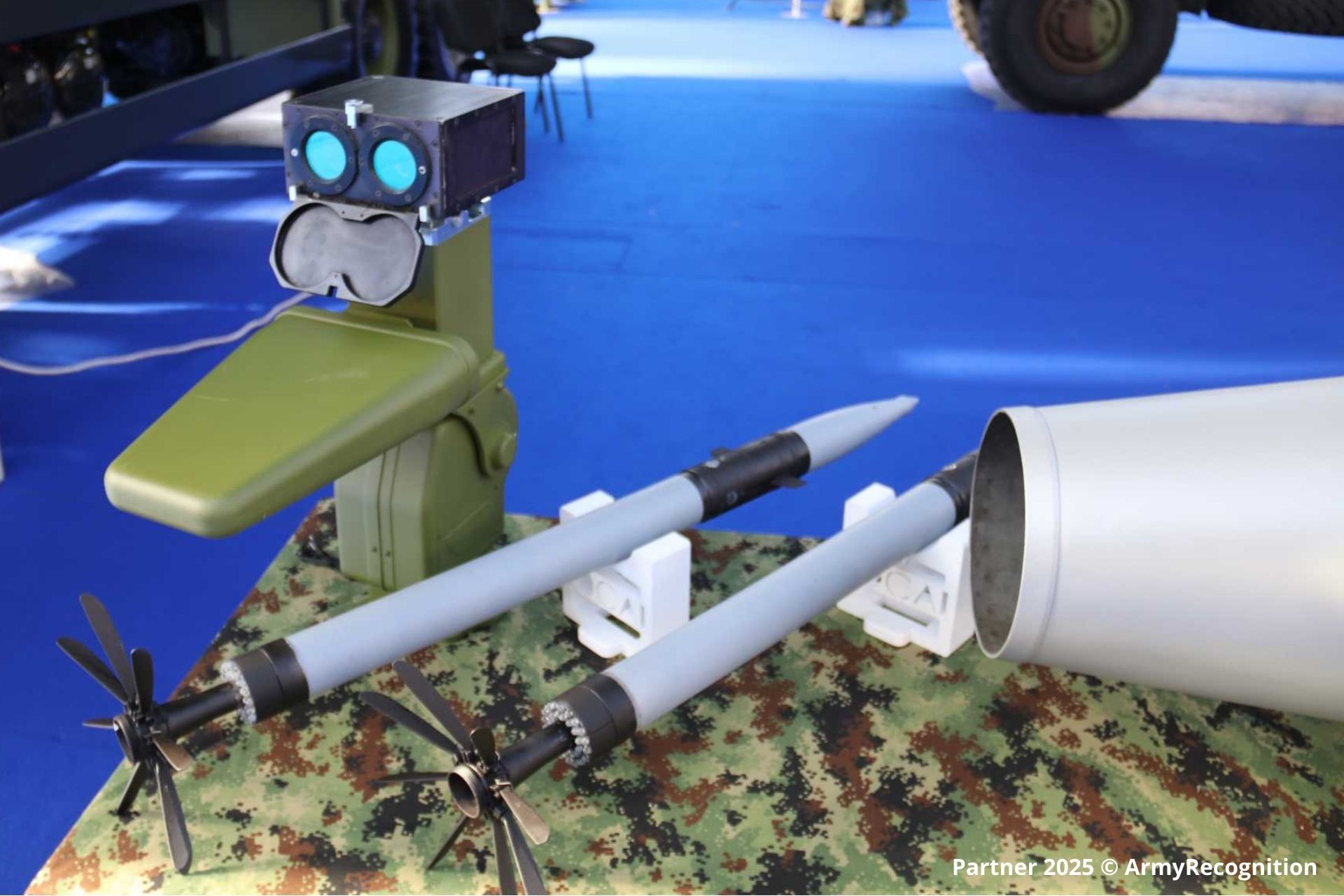
The M-4’s operational value lies in strengthening the close-in air defense bubble around ground units (Picture source: Army Recognition)
The M-4 is designed to intercept targets flying at low altitude and within short distances, with a range of 4 kilometers. It features a maximum speed of 700 meters per second, a length of just 960 millimeters, and a total mass of 4 kilograms, including a 1-kilogram warhead equipped with a fuze combining impact and laser proximity. Propulsion is provided by a composite solid-propellant motor, enabling rapid response at the moment of engagement. Guidance relies on radio command and can operate in automatic or semi-automatic modes. To maintain accuracy and counter jamming attempts, it is paired with a bi-spectral infrared sight and a coordinator, which keep the flight path aligned with the line of sight. In passive mode, the weapon limits emissions, lowering the likelihood of detection.
The M-4’s operational value lies in strengthening the close-in air defense bubble around ground units. Recent conflicts, particularly the war in Ukraine, have shown how the spread of tactical drones and glide munitions can saturate heavier and more costly air defense assets. In this environment, a compact, light, and fast missile able to strike at short range becomes a useful complement to medium- and long-range systems. With such a tool, forces can respond to multiple attacks, protect moving columns, and secure logistics sites exposed to precision strikes.
This class of missile also lends itself to integration on varied platforms. It can be deployed from light firing posts to defend fixed points, and it can be fitted to mobile anti-air vehicles to keep pace with mechanized units. The weapon’s compact form and low weight ease deployment in austere conditions, where operators require systems that are unobtrusive and simple to maintain. For armed forces working with constrained budgets, it offers a comparatively accessible way to thicken air defense layers while reducing reliance on complex and expensive systems.
In addition, the M-4 addresses a pressing need for versatile solutions capable of intercepting both slow quadcopter-type drones and low-flying cruise missiles. This versatility is an asset in a setting where threats evolve rapidly and militaries must adapt to asymmetric scenarios ranging from limited skirmishes to high-intensity conflict. By presenting this missile in Belgrade, Serbia, signals an ambition to provide systems aligned with current battlefield demands, where close-in protection has become central.
The M-4 thus reflects the present logic of short-range air defense, combining responsiveness, mobility, and resistance to electronic interference. Its public debut at Partner 2025 indicates Serbia’s intent to address immediate challenges posed by the wider use of drones and guided munitions, and to show that local solutions can complement the spectrum of modern surface-to-air defenses.