






Breaking News






Serbia debuts Aleksandar Unifier 4x4 armored vehicle at Unity Day Parade.
Serbia showcased its new Aleksandar Unifier 4x4 armored vehicle during the Strength of Unity military parade in Belgrade. The modular design highlights counter-drone defenses, patrol flexibility, and potential for export to smaller armies.
The Aleksandar Unifier made its first public appearance during the Strength of Unity military parade held for the Day of Serbian Unity, Freedom and National Flag in Belgrade. Footage from the parade showed a compact armored 4x4 with a roof fighting station for a heavy machine gun and a squared hull more akin to a practical patrol truck than a showpiece. The debut was clearly meant to underline that a homegrown multi-role platform is ready for routine security tasks as well as higher intensity missions if the situation demands it. The vehicle is a manually operated ring mount configured for a 12.7 mm machine gun with a full circular arc and a notably high elevation, suggesting that close range counter drone fire was part of the design brief alongside the usual convoy escort and checkpoint duties.
Follow Army Recognition on Google News at this link
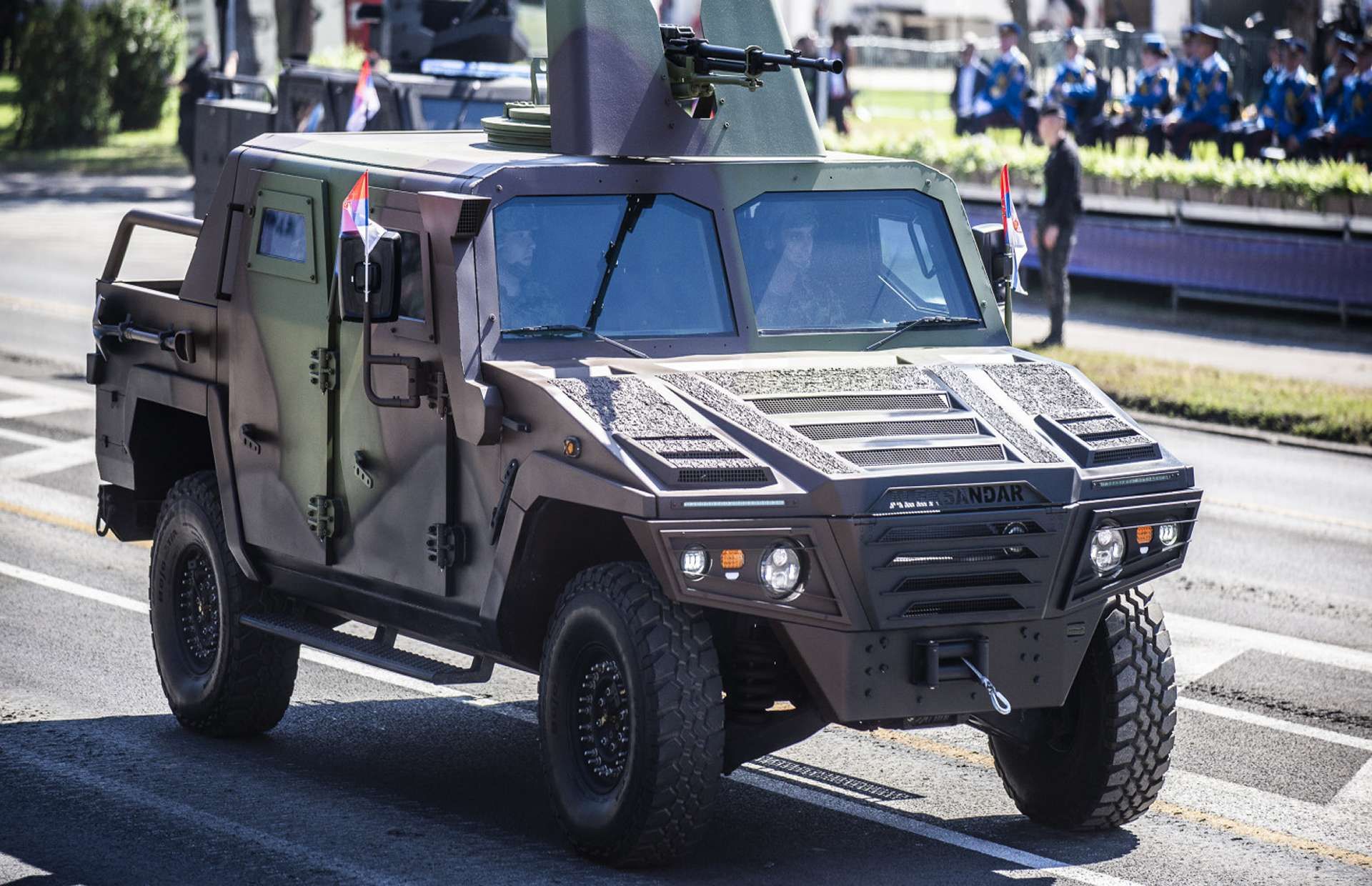
The Serbian-made Aleksandar Unifier is a 4x4 armored vehicle with STANAG Level 2 protection, a 12.7 mm roof-mounted machine gun, 205 hp diesel engine, and modular design for patrol, convoy escort, and multi-role missions (Picture source: Yugoimport).
The Unifier is described as a family of variants rather than a single fixed build, and the parade vehicle fits that logic. The base chassis uses a permanent 4x4 drivetrain with independent suspension and a central tire inflation system. Under the bonnet sits a 6.5 liter turbo diesel producing roughly 205 horsepower, paired to an automatic transmission with a two speed transfer case. Curb weight is about 5.6 tons and the gross weight sits just under 6.4 tons, which keeps it in the light armored truck category rather than moving into heavy mine resistant territory. On road top speed is around 113 km/h and the vehicle is rated for a 60 percent gradient, 40 percent side slope, and fording up to roughly 0.76 m. Range is given as about 400 km from a 95 liter tank, with an auxiliary tank option lifting endurance toward 675 km for units that operate far from fuel points.
Protection is advertised at STANAG 4569 Level 2 in the baseline configuration, a pragmatic band that covers rifle caliber threats and shell fragments. The body is a simple armored shell with four side doors and a rear cargo area, keeping weight under control and leaving room for radios or mission kits. Suspension uses DANA axles, hydraulic shocks and coil springs in a double A arm layout, and a central tire pressure system is part of the package. The turning circle, roughly 7.6 m, is tight for the class and matters on narrow streets or mountain roads. Approach and departure angles of about 49 and 37 degrees, together with 0.42 m of ground clearance, hint at a design that expects ditches, culverts and rough tracks rather than pampered asphalt.
Armament on the demonstrator stayed with a manual ring mount taking a 12.7×108 mm heavy machine gun. The mount traverses continuously and elevates from about minus eight to plus sixty five degrees. It will not turn a patrol truck into an air defense platform, but it gives crews a way to engage slow, low flying quadcopters or loitering drones at very short range when other measures are not immediately at hand. The roof architecture leaves room for alternative fits if users ask for them, including remote weapon stations or small effectors such as plural-purpose rocket pods or loitering munition launchers. The point is to let the 4x4 serve as a carrier for different payloads as missions rotate.
The vehicle’s listed acceleration from 0 to 48 km/h, around 9 to 10 seconds at combat weight, is in the right window for pulling through a junction or getting a convoy moving after a halt. HVAC is standard and the cabin layout looks deliberately uncluttered, which tends to win over crews who have to spend long hours at the wheel with a radio headset on. A front recovery winch and the tire pressure system are standard fit items that reduce the need for a support truck every time a patrol gets stuck.
The Unifier is pitched for high risk patrols, route clearance support, reconnaissance in areas with potential ambush, escort of logistics convoys, and fire support to light infantry or special operations detachments. In more specialized roles it can be set up as a sensor carrier, an artillery fire control node, or a transport for small loitering munitions. Urban operations benefit from the vehicle’s compact size and tight turning, while rural missions lean on the chassis’ grades and wheel travel to keep speed on broken ground. With Level 2 armor, crews will still need discipline in exposure and route planning, but the platform’s weight and mobility should help avoid the kind of bog downs that plague heavier vehicles on secondary tracks. If a remote weapon station is adopted, the crew can work more under armor without sacrificing observation, which is often the tradeoff on manual ring mounts.
The geopolitical backdrop gives this parade cameo more significance than a routine equipment pass-by. Serbia, which maintains military neutrality and is not a NATO member, operates in a region largely composed of NATO states. Belgrade balances cooperation programs with NATO and the EU while sustaining defense ties with partners such as Russia and China. Presenting a modular 4x4 under a national flag event sends several layered messages. Domestically, it signals steady modernization at a digestible price point and with local industrial utility. Regionally, it shows a platform that could fill border security and internal security roles without drawing attention for heavy armor or high escalation. Internationally, it positions a light armored truck family for export in a crowded market where buyers are sensitive to lifecycle cost, spare parts pipelines and the ability to re-role vehicles without retraining entire fleets. That last piece is crucial for smaller forces that need the same vehicle to be a convoy escort one month and a counter drone picket the next.