







Breaking News




Russia unveils new variant of Sarma 300mm rocket launcher on KamAZ-63501 chassis.
Russian defence firm Motovilikhinskiye Zavody displayed a new variant of the 300 mm multiple-launch rocket system called Sarma, mounted on an 8×8 KamAZ-63501 truck chassis during an exposition in Perm.
As reported by Military Informant on September 20, 2025, Russian industry presented a new variant of the 9A52-4 Sarma, a 300mm multiple launch rocket system (MLRS), during an exposition at the Motovilikhinskiye Zavody plant in Perm in the presence of senior officials. The vehicle shown is mounted on an 8x8 KamAZ-63501 truck with an armored cab, carries a combat package of six 300 mm launch tubes, and is fitted with an automated fire-control suite integrated with reconnaissance and target-acquisition inputs.
Follow Army Recognition on Google News at this link
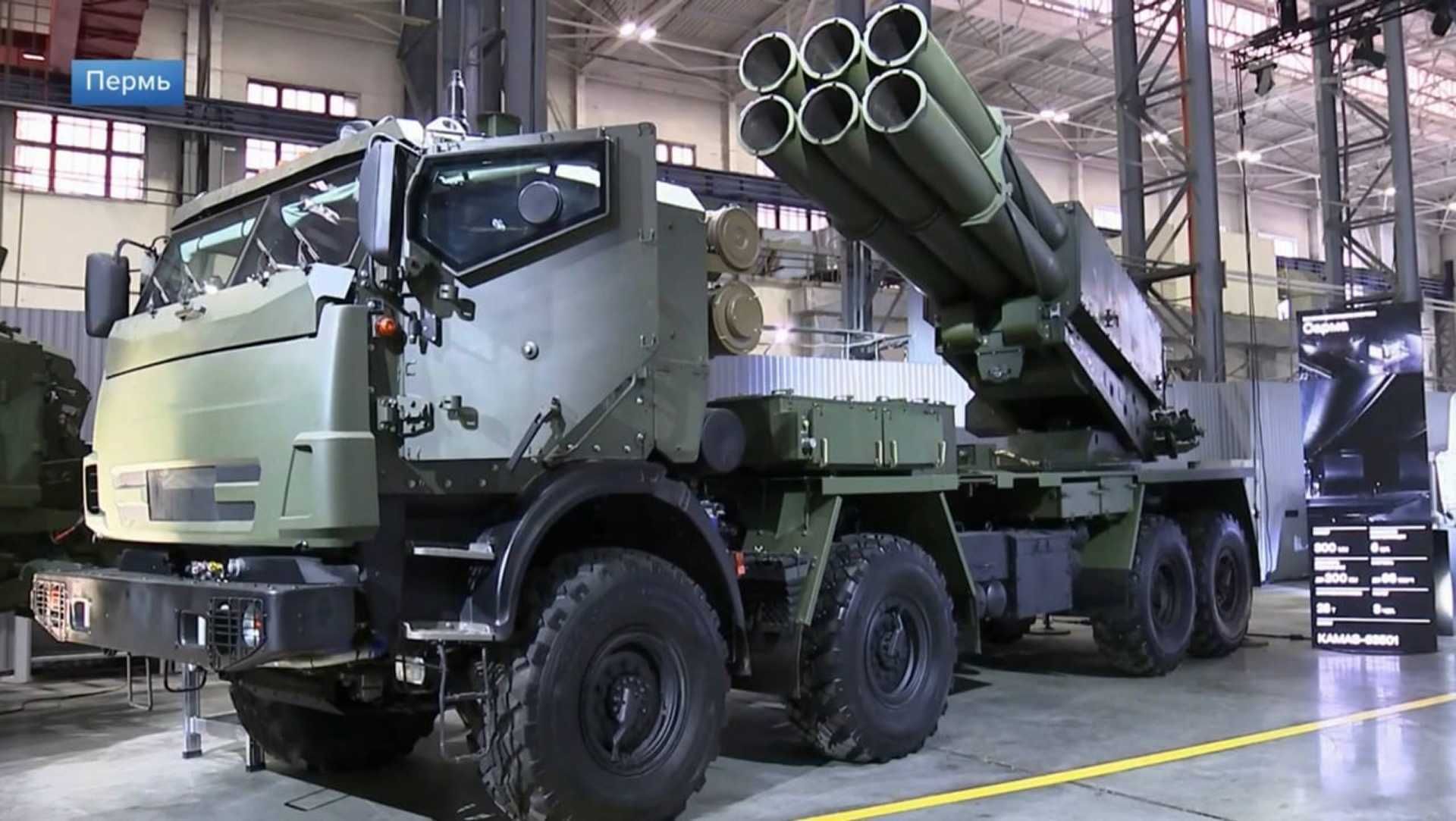
This new variant of the Sarma MLRS uses a protected KamAZ-63501 eight-by-eight chassis fitted with a six-tube 300 mm launcher and an upgraded automated fire control chain linked to reconnaissance and target acquisition assets. (Picture source: X/Military Informant)
This new variant was described by its developers as a direct continuation of prior KamAZ-based work and as part of a broader set of parallel modernization paths in Russian long-range rocket artillery that emphasize modular launch packaging, guided munitions, and truck mobility. The conceptual origins of Sarma lie in the Kama project first developed in the 2000s, when Motovilikhinskiye Zavody sought to produce a lighter, more road-mobile 300 mm launcher by using KamAZ-6350 truck chassis rather than heavy tracked carriers. Kama prototypes were publicly shown at events such as MAKS 2007, and engineering work for Kama explored removable transport-launch containers as well as a fixed six-tube launcher architecture with an associated transport-reloader. That early work produced concrete engineering solutions for containerization, rapid reloading, and integration with truck logistics, but at the time, the design did not proceed to large-scale adoption and remained at the experimental and trial stage.
Subsequent modernization programs informed and fed back into the concept now expressed as Sarma: the Tornado-S upgrades of the Smerch family, the Uragan-1M experiments with bi-caliber containers, and the Vozrozhdeniye bi-caliber program established industry practice for unified transport-launch containers, satellite-aided guidance, and improved automated fire control. Those efforts demonstrated that modular containers can simplify logistics across calibres, shorten rearming times, and permit wheeled vehicles to assume roles previously held by heavier tracked launchers; the Sarma variant combines these lessons with Kama-era mobility ideas and the guidance and navigation improvements fielded on Tornado-S type systems.
Technical baselines developed for Kama carry forward into the Sarma variant and remain central to its architecture. The earlier 9Ya295 transport-launch container tested under Kama measured about 7,512 by 1,130 by 996 millimetres and had a loaded mass of roughly 6.2 tonnes, and Kama-derived prototypes showed that a six-rocket payload on a KamAZ class chassis produced overall combat masses in the low- to mid-23 tonne range. That development work produced the 9T234-4 transporter-reloader concept able to carry and transfer a full six-rocket package, and it documented the trade-offs between reduced onboard salvo volume and gains in mobility, deployability, and logistical commonality with existing truck fleets.
The Sarma demonstrator uses a KamAZ-63501 8x8 tactical truck as its baseline chassis and is reported to include a protected cabin with increased ballistic and fragmentation resistance for the crew. Published vehicle parameters for the demonstrator include an overall footprint near 11.2 by 2.5 by 3.15 metres, ground clearance of around 390 millimetres, and a combat weight in the mid-24 tonne band. The powerplant cited for the vehicle class is a V8 diesel in the roughly 360 horsepower range, commonly referenced as the KamAZ 740.50-360, giving an on-road range approaching 1,000 kilometres and an approximate fuel consumption near 45 litres per 100 kilometres; those traits reflect a design choice that privileges wheeled strategic mobility and logistic integration with truck-based manoeuvre formations.
Operationally, Sarma accepts a deliberate set of trade-offs: the vehicle carries fewer rockets than heavy tracked 12-tube systems in exchange for higher tactical mobility, shorter emplacement and displacement times, and improved crew protection, and its architecture is intended to be used with dedicated transport-reloader vehicles to sustain fire missions. That choice reduces salvo volume per firing vehicle but increases the unit’s ability to shoot and vacate rapidly, thereby lowering counter-battery exposure; at the battery level it implies organisation around modular wheeled launchers, resupply and reloader elements and organic reconnaissance and targeting assets, with consequent changes to resupply patterns, counter-battery risk management and doctrine for how to distribute precision effects across a theatre.
The Sarma variant is described as compatible with the full contemporary Russian 300 mm rocket family, retaining the ability to use legacy 9M55 series rounds with ranges near 70 kilometres, 9M528 and 9M531 types with ranges near 90 kilometres, and guided Tornado-S family munitions such as the 9M542, 9M544 and 9M549 with reported ranges out to roughly 120 to 130 kilometres. Guided rounds for this class employ inertial navigation with satellite correction, rotating stabilisation, deployable control surfaces and programmable autopilots to reduce dispersion; reported accuracy figures for similar guided configurations are on the order of a few tenths of a percent of range, and the combination of guided long-range munitions with a six-tube wheeled launcher is intended to substitute precision and reach for sheer salvo volume. Developers have also examined modular launcher and container variants, and some assessments indicate future engineering trade-offs could permit increasing launcher packages to as many as ten or twelve tubes on wheeled chassis if weight and stability constraints are resolved.
Written by Jérôme Brahy
Jérôme Brahy is a defense analyst and documentalist at Army Recognition. He specializes in naval modernization, aviation, drones, armored vehicles, and artillery, with a focus on strategic developments in the United States, China, Russia, Türkiye, and Belgium. His analyses go beyond the facts, providing context, identifying key actors, and explaining why defense news matters on a global scale.