






Breaking News






Roshel to manufacture Singapore's ExtremV tracked vehicle in Canada for Arctic Mobility Program.
On June 4, 2025, Roman Shimonov, CEO of Roshel Smart Armored Vehicles, announced an exclusive agreement with the Singaporean ST Engineering to produce the ExtremV amphibious all-terrain vehicle in Canada. The vehicle is positioned as a primary contender for Canada’s Domestic Arctic Mobility Enhancement (DAME) program, which seeks to replace the aging BV206 fleet. According to Roshel, the agreement, signed during CANSEC 2025, is intended to enhance Canada's operational capabilities in Arctic regions and contribute to strategic sovereignty.
Follow Army Recognition on Google News at this link
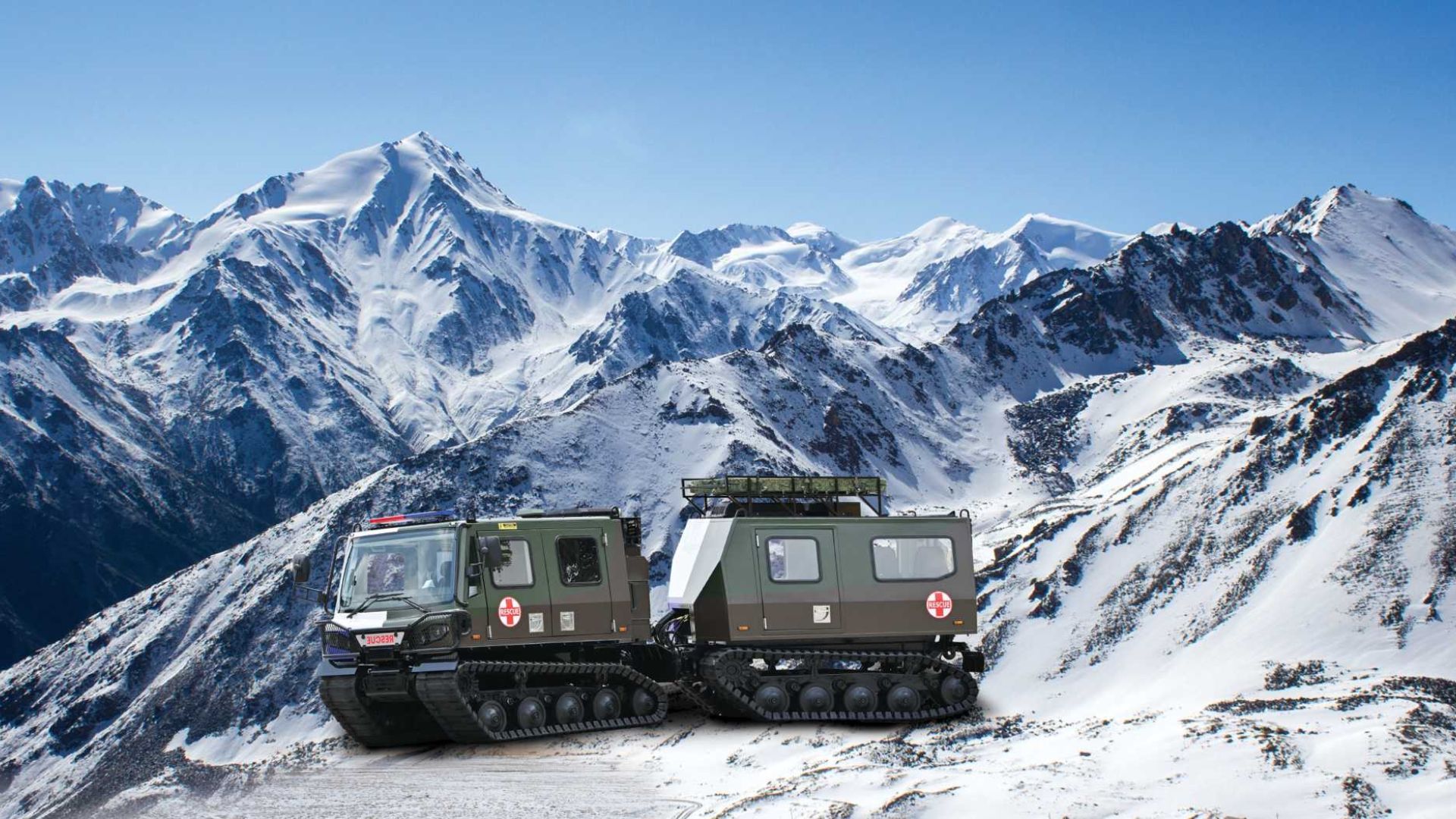
The ExtremV tracked amphibious vehicle is positioned as a primary contender for Canada’s Domestic Arctic Mobility Enhancement (DAME) program, which seeks to replace the aging BV206 fleet. (Picture source: X/Roman Shimonov)
Roman Shimonov stated that the project is not solely about mobility but also about expanding domestic manufacturing, creating employment, and integrating northern communities. As part of the agreement, Roshel will take the lead in domestic production and will involve Indigenous-owned companies in the manufacturing process. The announcement highlights climate change and rising geopolitical interest in the Arctic as key reasons for accelerating the development and deployment of Arctic-specific mobility solutions.
Canada’s Domestic Arctic Mobility Enhancement (DAME) program aims to acquire up to 170 medium-sized, amphibious, high-mobility vehicle platforms capable of operating in Arctic terrain and extreme weather conditions. The vehicles are expected to be delivered in four variants: Command Post, Troop Carrying, Cargo and Equipment Carrying, and Ambulance. Each vehicle must support a light infantry section of 10 soldiers and two crew members, sustain 72-hour missions without external support, and cover distances of up to 300 kilometers. The project, currently in its Options Analysis phase, has a projected budget between CAD 250 million and 499 million. The program schedule includes the start of the Definition phase in FY 2025/2026, implementation beginning in FY 2027/2028, initial deliveries in 2029/2030, and final deliveries by 2031/2032. DAME falls under the Joint Support & Sustainment and Land capability areas and is also categorized under Logistics Vehicles, Combat Support Vehicles, and Commercial Pattern Vehicles within the Defence Capability Investment framework.
Canada is implementing a wide-ranging strategy to strengthen its Arctic presence through sustained military operations, infrastructure development, and international cooperation. In addition to the Domestic Arctic Mobility Enhancement (DAME) initiative, the Canadian Armed Forces conducts recurring exercises under Operation Nanook and its subcomponents, such as Nunalivut and Tuugaalik, which facilitate interagency and allied Arctic deployments, as well as reinforce Canadian sovereignty across the North. In March 2025, Ottawa committed CA$2.67 billion over two decades to establish three Northern Operational Support Hubs in Iqaluit, Inuvik, and Yellowknife, complete with upgraded logistics, fuel depots, and airstrips to support rapid military deployment. The Royal Canadian Navy continues to expand its Arctic fleet with the commissioning of the sixth Arctic and Offshore Patrol Ship, HMCS Robert Hampton Gray, while the Canadian Coast Guard has initiated construction of two new polar icebreakers split between Seaspan and Chantier Davie. Surveillance enhancements include the acquisition of the Australian Jindalee Over-the-Horizon Radar system, valued at $6.5 billion, designed to improve detection of Arctic air and maritime activity. Canada also plays an active role in multilateral initiatives like the ICE Pact with the U.S. and Finland and maintains defense cooperation with France, all part of a broader effort to assert sovereignty and resilience in a region marked by growing Russian and Chinese activity.
The ExtremV is an articulated, rubber-tracked amphibious vehicle originally developed by ST Engineering and based on the Bronco vehicle family. It shares lineage with the Warthog, which was deployed by the British Army in Afghanistan and covered over 300,000 miles in service. The ExtremV offers several advantages over the BV206, particularly in terms of payload, modularity, terrain accessibility, and amphibious capability. While the BV206, introduced in the 1980s, has seen a gradual reduction in amphibious performance and limited adaptability to evolving operational needs, the ExtremV delivers significantly improved capabilities. With a maximum payload of 4,000 kg, nearly double that of the BV206, and a low ground pressure of 17 kPa, it performs effectively on snow, muskeg, and soft terrain. The vehicle achieves speeds of up to 60 km/h, covers a range of 350 kilometers, and handles gradients up to 100%, vertical obstacles of 0.6 meters, trenches of 2 meters, and side slopes of 70%. Measuring 7.6 meters in length, 2.3 meters in width, and 2.4 meters in height, the ExtremV is powered by a 200 hp COTS engine and uses an 8+1 automatic transmission with articulated hydraulic steering. It is capable of amphibious operations in inland waters and functions within an operational temperature range of -30°C to +49°C.
The vehicle also improves on the BV206 in terms of mission versatility through its modular rear cabin, which allows for rapid role changes between troop transport, cargo hauling, firefighting, mobile command, medical evacuation, and disaster response. Module configurations tested include hooklift systems, water jets, fire suppression equipment, and command modules. Interior ergonomics are designed for crew safety and efficiency, and optional features such as brush guards and winches can be added based on mission requirements. The front cabin houses a crew of four, one driver and three passengers. In testing environments such as the Sharjah desert, the ExtremV demonstrated its capacity to traverse unstable and sloped terrain without loss of traction or control. Its enhanced performance and adaptability respond directly to the operational shortcomings of the BV206, aligning with the demands of Arctic sovereignty patrols, casualty evacuation, and sustained deployment in remote and environmentally hostile regions.
Roshel has undergone rapid industrial growth, evolving from a Canadian-based manufacturer into a multinational armored vehicle producer with growing capabilities across North America and Europe. As of mid-2025, the company operates four production facilities in Ontario, Canada, employing around 500 personnel and maintaining a combined production rate of up to 140 armored vehicles per month. These Canadian plants have supported large-scale deliveries, including more than 1,700 Senator vehicles for Ukraine since 2022, with most funding sourced from international partners. In December 2024, Roshel opened a new manufacturing hub in Shelby Township, Michigan, mirroring its Canadian model and offering integrated manufacturing and service capabilities for U.S. defense and law enforcement agencies. The company is also actively expanding into Europe: Roshel CZ, a joint venture with OMNIPOL launched in May 2025, will manufacture Senator MRAPs and medevac variants in the Czech Republic for NATO clients. Additional production sites are under consideration in Germany and Ukraine, with the latter also involving the hiring of skilled Ukrainian refugees already working within Roshel’s Canadian facilities.
Roshel’s product portfolio is centered around the Senator family of armored vehicles, which is built on a Ford F-550 chassis and includes APCs, MRAPs, ERVs, pickups, and EOD variants, all designed to be reconfigured quickly for diverse mission sets. The Senator MRAP variant features a V-shaped monocoque hull and composite armor with NATO STANAG 4569 Level 2 ballistic and advanced mine protection, accommodating up to ten personnel. The ERV variant incorporates lightweight materials and modern electronics tailored for North American emergency response units, while other configurations support counter-drone missions and medical evacuation. Complementing the Senator is the lighter Captain model, based on the Toyota Land Cruiser 70, which offers enhanced off-road agility and STANAG 4569 Level 1 protection for reconnaissance and rapid intervention. Roshel’s vehicles are in operational use across various global clients, including South Korea, Costa Rica, Bosnia and Herzegovina, and Ukraine, with export volumes supported by short lead times and a two-week average assembly cycle. The company also maintains a collaborative relationship with Ford to ensure high availability of core components and to support international scalability.