










Report: US Army Drone Grenade System Brings Precision-Guided Firepower to Smallest Tactical Formations in JMTG-U training.
At Grafenwoehr Training Area in Germany, the Joint Multinational Training Group–Ukraine (JMTG-U) Unmanned Aerial Vehicle innovation team carried out an unusual and closely watched live-fire event. Between September 9 and 12, 2025, soldiers tested a purpose-built aerial dropper system by releasing 117 live M67 fragmentation grenades from a Skydio X10 Delta drone. The evaluation, supported by the U.S. Army Combat Capabilities Development Command (DEVCOM), represents the latest effort to integrate precision-guided firepower into the smallest tactical formations. For an army increasingly aware of the battlefield role of unmanned platforms, the trial marks a step forward in adapting low-cost drones for lethal missions.
Follow Army Recognition on Google News at this link

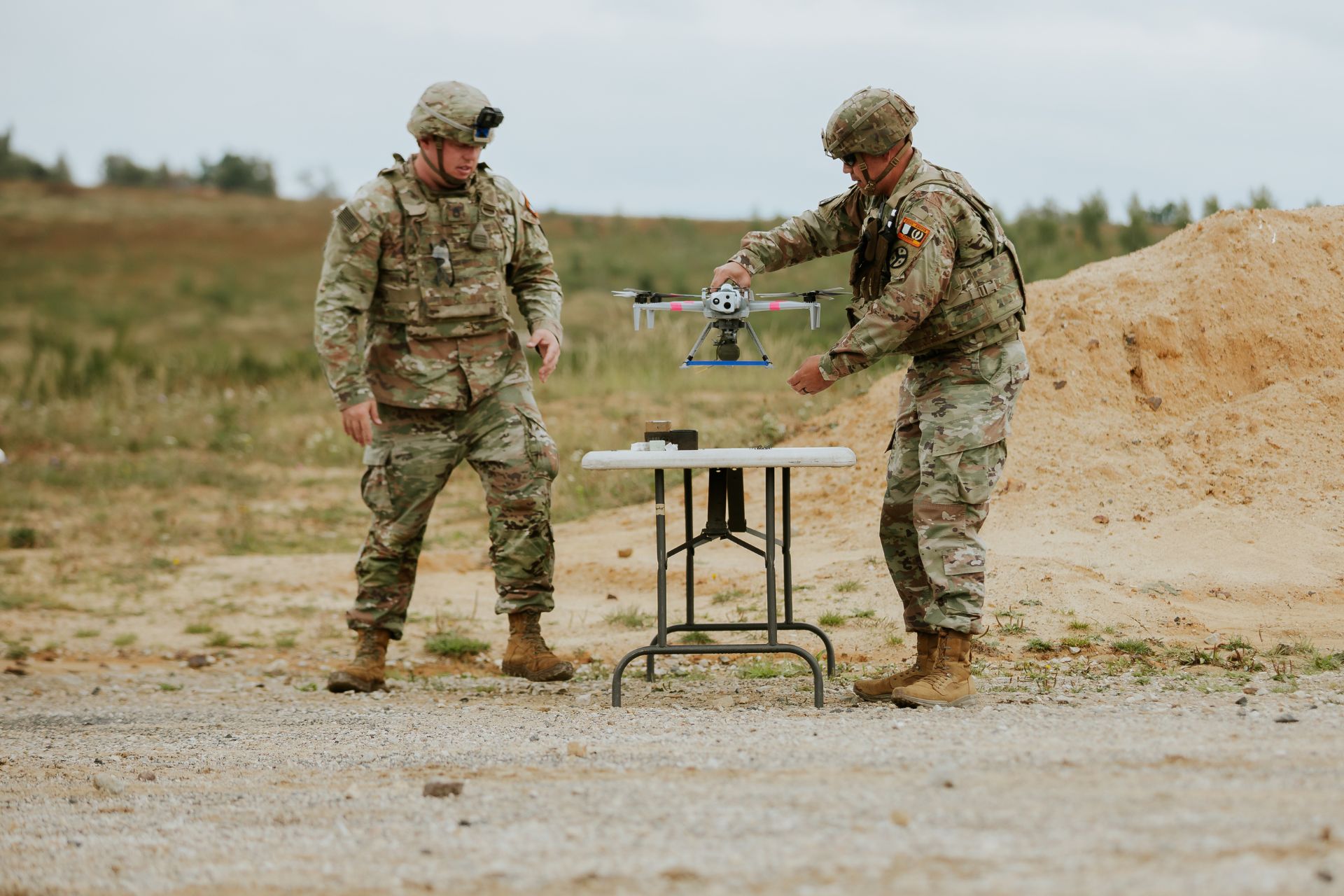
In September 2025 at Grafenwoehr Training Area in Germany, the JMTG-U UAV innovation team conducted a live-fire exercise with a Skydio X10 Delta drone, dropping 117 live M67 grenades. (Picture source: US DoD)
The Skydio X10 Delta is a small quadcopter optimized for military and security roles. While its base configuration provides reconnaissance and surveillance capabilities, it has been adapted to carry a lightweight payload delivery mechanism. For the Grafenwoehr tests, DEVCOM engineers equipped the drone with the second-generation Audible Dropper, a remotely triggered device designed to release hand grenades with controlled accuracy. The system builds on earlier prototypes that demonstrated basic release functions but lacked consistency under combat-like stress.
The M67 fragmentation grenade itself is a long-standing infantry weapon. Standard issue for U.S. and allied forces, it weighs about 400 grams and produces a lethal fragmentation radius of roughly five meters, with shrapnel effects reaching far beyond. By mounting these grenades on a drone, developers aimed to extend their range from a soldier’s 30-meter throw to a standoff employment distance of one kilometer or more. The intent is not to replace heavier drone-carried bombs but to give frontline units a way to apply suppressive or lethal fire without exposing themselves.
During the September evaluation, the UAV team deliberately pushed the system to its limits. Capt. Alexander King explained that the team’s goal was to find failure points early and refine the design before considering wider field use. Several modifications were introduced on site, addressing release reliability, stabilization under flight, and the timing of the drop. Engineers monitored performance to ensure that safety protocols remained intact while the grenades detonated on target.
The dropper mechanism itself is compact, designed to fit within the drone’s payload bay without compromising stability. Operators reported that accuracy improved over the course of the trials, with adjustments leading to more predictable fall patterns. The iterative process, where soldiers and developers adjusted parameters in real time, reflects a broader shift in U.S. Army innovation culture: rapid prototyping instead of slow acquisition cycles.
At the tactical level, the capacity to deliver fragmentation grenades from a drone changes the geometry of small-unit combat. Infantry patrols could use such systems to engage entrenched adversaries, clear defilade positions, or harass enemy supply points while remaining concealed. In urban combat, drones could be flown above rooftops or through alleyways, striking positions otherwise unreachable without high risk. The extended engagement distance also raises survivability, allowing squads to operate with less exposure.
Operationally, this capability aligns with lessons drawn from current conflicts, where small drones have transformed into precision strike assets for both state and non-state actors. Rather than improvising with commercial drones and makeshift release systems, the U.S. Army seeks to standardize a reliable, safe, and repeatable method. This shift ensures that soldiers are not left to experiment under fire, but instead benefit from rigorously tested designs.
This multinational training mission, established to support Ukrainian defense reforms, operates as a laboratory for tactics directly influenced by the war in Ukraine. Both Russian and Ukrainian forces have extensively employed drones to deliver munitions, often with devastating effect. By conducting structured tests in Germany, the U.S. Army signals its intent to absorb these battlefield lessons and institutionalize them.
Written By Erwan Halna du Fretay - Defense Analyst, Army Recognition Group
Erwan Halna du Fretay is a graduate of a Master’s degree in International Relations and has experience in the study of conflicts and global arms transfers. His research interests lie in security and strategic studies, particularly the dynamics of the defense industry, the evolution of military technologies, and the strategic transformation of armed forces, with a strong focus on multilateral cooperation and geopolitics.