






Breaking News






New US Army Manual Directs M1A2 Abrams to Engage Drones With 120mm Canister Rounds Marking Tactical Shift.
On July 10, 2025, a striking update has emerged from the evolving doctrine of modern armored warfare: the U.S. Army has officially published new instructions directing M1A2 Abrams tank crews to engage hostile drones using their main guns. As published by the Army Publishing Directorate of the U.S. Army, this revised Tank Platoon Tactics Manual signals a shift in operational priorities, reflecting growing concerns about the proliferation of unmanned aerial threats on today’s battlefield. The unprecedented move to train tank crews for anti-drone engagements is drawing both intrigue and skepticism, as experts question its practicality in real combat scenarios. This new guidance comes at a time when drone swarms pose complex challenges even for heavily armored formations, underlining the U.S. Army’s urgent need to adapt its armored doctrine to a rapidly changing threat landscape.
Follow Army Recognition on Google News at this link
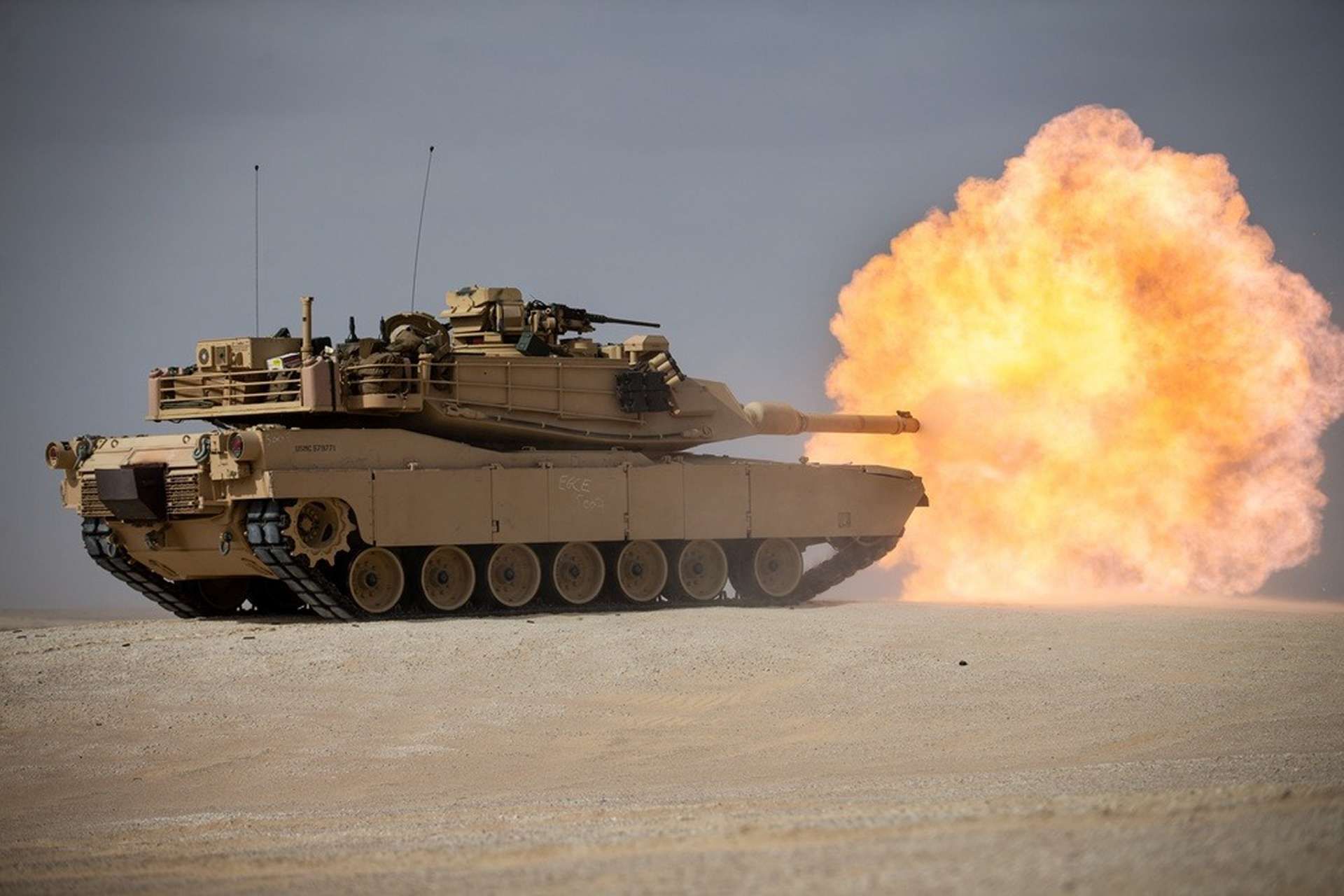
In theaters like Eastern Europe or the Indo-Pacific, where drone swarms and loitering munitions are becoming the norm, the U.S. Army’s decision to adapt its most iconic tank for an anti-drone role reflects an urgent recognition of gaps in its short-range air defense (SHORAD) capacity (Picture source: U.S. Army)
The new defense product at the heart of this doctrine is not a weapon system in itself, but rather the redefined operational use of the M1A2 Abrams’ 120mm main gun with M1028 canister rounds. Originally designed to shred infantry at close range, the M1028’s shrapnel dispersal effect is now envisioned as a countermeasure against small quadcopters and reconnaissance UAVs that increasingly stalk armored columns. By supplementing this with machine gun fire, the Abrams is expected to create a layered defensive bubble capable of swatting down low-flying drones before they can deliver explosive payloads.
Operationally, the Abrams tank’s transition from a purely ground-focused platform to a makeshift anti-drone node reflects the U.S. Army’s attempt to stretch the capabilities of its aging armored fleet. Historically, the Abrams had limited anti-air capacity through the M830A1 HEAT-MP-T round, which used a proximity fuze for low-flying aircraft, but countering nimble drones is a different challenge altogether. Development of this doctrine has emerged alongside broader modernization plans, including the anticipated M1E3 Abrams variant, designed to deliver more integrated electronic warfare and active protection systems, a logical evolution given the limitations of manually aimed shrapnel shells against agile FPV drones.
From a tactical perspective, the updated doctrine reflects an effort to adapt the Abrams tank’s capabilities to a changing threat environment. Firing M1028 canister rounds at short-range drones could help counter isolated threats in open terrain under certain conditions. However, engaging small, fast-moving drones with a tank’s main gun presents challenges, given the limited traverse and elevation range and the reliance on visual detection and manual targeting. This contrasts with dedicated counter-UAV systems that use radar-guided munitions or automated interceptors. In comparison, modern active protection systems such as Israel’s Trophy or Russia’s Arena-M are designed to detect and neutralize incoming threats autonomously, whereas the Abrams’ approach under this doctrine remains more manually operated and dependent on crew coordination.
Strategically, this doctrinal shift highlights the evolving geostrategic contest over air dominance at the tactical level. In theaters like Eastern Europe or the Indo-Pacific, where drone swarms and loitering munitions are becoming the norm, the U.S. Army’s decision to adapt its most iconic tank for an anti-drone role reflects an urgent recognition of gaps in its short-range air defense (SHORAD) capacity. It also underscores a critical vulnerability: without integrated drone defenses, even the most heavily armored formations are at risk of attritional attacks from small, cheap UAVs that can bypass traditional armored protection. In the broader geopolitical landscape, this signals a drive to maintain battlefield relevance of legacy platforms while newer counter-drone systems are fielded.
In terms of budget and contracts, this updated doctrine is more a doctrinal band-aid than a costly hardware upgrade. There is no new defense contract for a specialized anti-drone Abrams variant yet; instead, the investment continues to flow into the M1E3 modernization program and the Army’s larger push for advanced active protection systems. General Dynamics, the long-time Abrams manufacturer, remains the last primary contractor for these tanks, with the System Enhancement Package (SEP) upgrades gradually being replaced by more comprehensive redesigns to address modern threats, including drones. For now, crews will train under this doctrine while awaiting more sophisticated technological solutions.
The U.S. Army’s decision to elevate tank cannons to engage drones highlights an innovative approach to addressing the challenges of modern drone warfare. The effectiveness of this tactic in real combat will likely depend on the pace at which dedicated counter-drone systems are developed and deployed to protect armored formations. For now, the image of an Abrams platoon targeting quadcopters with 120mm rounds reflects the evolving battlefield, where even established platforms are adapting to new threats in an era increasingly shaped by unmanned systems.