






Breaking News






New Artillery and Missile Command Strengthens Vietnam’s Military Capabilities.
The Vietnamese Ministry of Defense has officially announced the establishment of the Artillery and Missile Command, as reported by Vietnamnet Global on August 20, 2025, during a ceremony chaired by General Nguyen Tan Cuong, Chief of the General Staff of the Vietnam People’s Army and Deputy Minister of Defense. This new structure is considered a key step in the evolution of Vietnam’s armed forces, addressing defense and security requirements in a shifting strategic environment.
Follow Army Recognition on Google News at this link
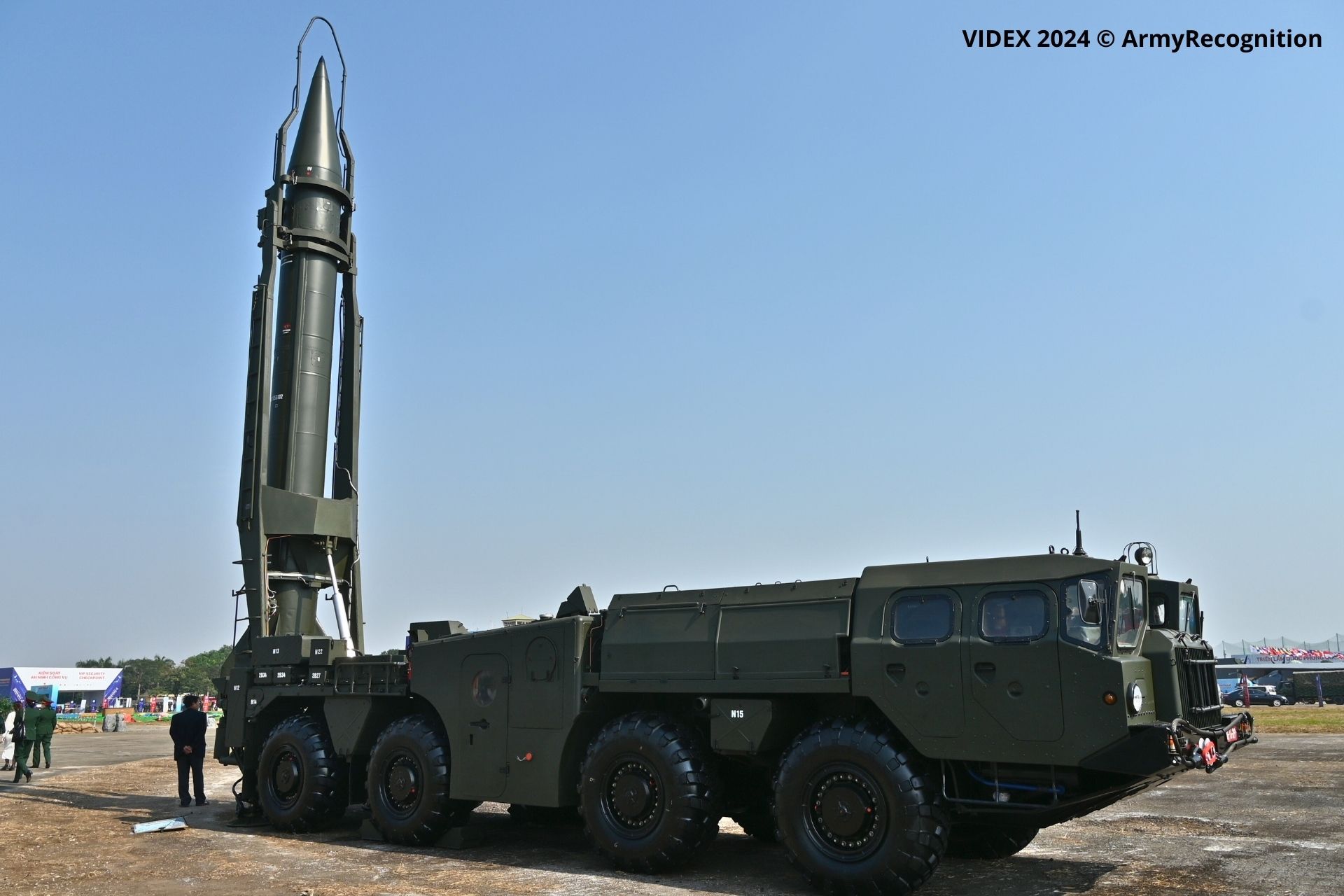
At the strategic level, artillery is reinforced by around 20 tactical ballistic missile launchers, including Scud B, C, and D systems, as well as North Korean Hwasong-5 and Hwasong-6 (Picture source: Army Recognition)
In his remarks, General Cuong emphasized that the creation of this command reflects a renewed vision of the Politburo and the Central Military Commission, aimed at reorganizing the forces to better adapt to current challenges. According to him, this decision demonstrates a political will to strengthen military capabilities while modernizing the command structure.
The Artillery and Missile Command inherits the legacy of the former Artillery Corps, which distinguished itself through decades of combat experience. This past remains tied to the “eight golden words” pronounced by President Ho Chi Minh to praise the resilience and precision of these units: “Bronze feet, iron shoulders, excellent in fighting, accurate in shooting.” In its new configuration, the institution is expected to be more compact, more efficient, and equipped with modernized means, including updated weapons systems and an expanded strategic deployment.
According to The Military Balance 2025, Vietnam’s artillery arsenal remains broad and diverse. In towed artillery, the army continues to operate Soviet-era systems such as the 76 mm ZiS-3, the BS-3 and T-12 100 mm anti-tank guns, as well as the 85 mm D-44, with more than 2,000 units still recorded. The inventory also includes American M101 105 mm howitzers, locally modernized, as well as the Soviet and Chinese-supplied 122 mm D-74 and D-30. Heavier systems such as the 130 mm M-46, of which Vietnam received more than 500 units, are also part of the arsenal, with some converted into self-propelled prototypes. The inventory is further complemented by the 152 mm D-20 and the Chinese Type 66. While some of these aging systems are gradually being retired, they still provide considerable firepower.
Vietnam also maintains a limited fleet of self-propelled systems, including 150 122 mm 2S1 Gvozdika, with a local version called PTH-01, and around 30 152 mm 2S3 Akatsiya. To these Soviet-origin systems is added a major modernization effort with the planned acquisition of 20 South Korean 155 mm K9 Thunder howitzers, a new-generation system that would help fill gaps in mobile artillery capabilities. With a range of over 40 km and a high rate of fire, the K9 is expected to enhance Vietnam’s artillery by combining mobility, precision, and extended firepower.
In addition, the Vietnamese army operates mortar carriers such as the American M106 and the Soviet MT-LB, both adapted and modernized to mount 100 mm systems. However, it is in the field of rockets and tactical missiles that Vietnam retains a notable capability. The country deploys approximately 350 122 mm BM-21 Grad multiple rocket launchers, upgraded with digital fire-control systems and produced locally, along with 400 140 mm BM-14 launchers supplied in the 1960s. At the strategic level, artillery is reinforced by around 20 tactical ballistic missile launchers, including Scud B, C, and D systems, as well as North Korean Hwasong-5 and Hwasong-6. These assets, some of which have been modernized to increase range and improve accuracy, constitute an important element of Vietnam’s deterrence posture.
General Cuong stressed the need for officers and soldiers to fully understand the mission entrusted to this new command. He urged party committees, unit commanders, and personnel at all levels to show determination and initiative in overcoming challenges and meeting assigned political objectives. The command’s central mission will be to provide strategic advice for the organization, deployment, and employment of artillery and missile forces, particularly within newly established units.
To ensure effectiveness, the command must quickly stabilize its organizational structure, clearly assign responsibilities within the Party Committee and command staff, and strengthen leadership bodies and mass organizations. All activities are expected to align with designated missions to build strong units capable of carrying out any assigned task. General Cuong also underlined the importance of rigorous personnel management, ideological oversight, and internal policy work, ensuring constant readiness and strict compliance with directives on assignments and transfers.
The creation of the Artillery and Missile Command is part of a broader military modernization strategy. It aims to reinforce Vietnam’s defensive posture in a regional environment marked by growing security challenges. The combination of a long-standing military tradition and a deliberate modernization effort places this new structure at the center of the transformation of the Vietnamese armed forces.