






Breaking News





New Armored Multi-Purpose Vehicle contract modification protects U.S. armored vehicle production.
The U.S. Army has awarded BAE Systems Land and Armaments a 198.4 million modification under contract W56HZV-23-C-0024, framed as support for a future 240 vehicle AMPV buy at the York, Pennsylvania, plant. Rather than a full vehicle order, the action is a bridge that protects the AMPV industrial base ahead of a larger production lot, keeping skills, tooling, and suppliers warm as demand for modern armored vehicles grows in the U.S. and Europe.
A new contract move out of Detroit Arsenal is quietly shaping the next phase of the Armored Multi-Purpose Vehicle program. On 5 December 2025, Army Contracting Command awarded BAE Systems Land and Armaments a 198.4 million modification to AMPV, contract W56HZV-23-C-0024, language that appears to support the purchase of 240 vehicles but in practice funds the engineering work, tooling, and long lead items needed to keep the York, Pennsylvania, production line stable until the next major lot is placed. The award lifts the cumulative contract value to about 2.48 billion dollars, building on earlier full rate production and follow-on AMPV orders that already positioned York as a core hub in the U.S. tracked vehicle industrial base.
Follow Army Recognition on Google News at this link
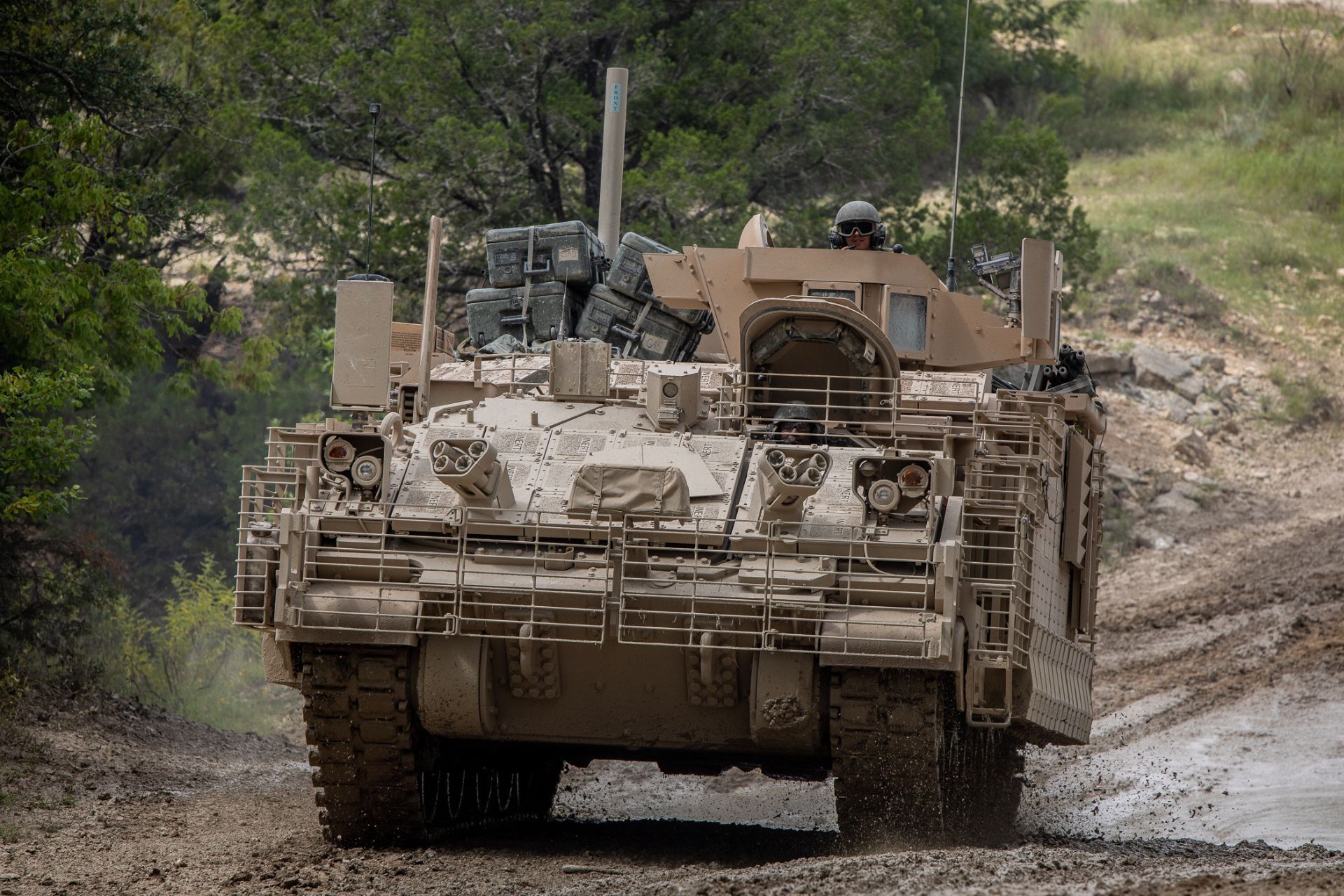
The Armored Multi Purpose Vehicle family, or AMPV, is gradually replacing the M113 within U.S. armoured brigades. (Picture source: US DoD)
The Armored Multi-Purpose Vehicle family, or AMPV, is gradually replacing the M113 within U.S. armoured brigades. The vehicle uses a chassis derived from the Bradley and a diesel engine of about 600 horsepower, providing mobility consistent with frontline tracked platforms and sufficient electrical capacity for current-generation sensors and radios.
Protection relies on a composite armour package reinforced with additional modules, able to withstand medium calibre fire and artillery fragments that are common on today’s battlefields. The internal layout is designed to offer a much larger usable volume than the M113, which makes it possible to integrate C4ISR suites, advanced medical stations or the components of a 120 mm mortar depending on the variant. The open architecture allows for the installation of future systems, whether new secure radios, reinforced computing resources, or autonomous solutions that have been tested in recent months.
The contractual modification announced in early December therefore, does not fund the complete manufacture of the 240 vehicles mentioned in the notice. The amount committed is too low to cover such a volume, since a fully equipped AMPV, including systems and support services, is usually priced between six and eight million dollars per vehicle depending on the variant.
The role of modification P00041 is instead to fund engineering activities, tooling, long lead orders, and the production flow required to keep the line operating. This is a common mechanism in U.S. armoured vehicle programs, where the Army secures critical elements before placing a larger production lot under contract. The notion of supporting the purchase of 240 vehicles refers here to preparation for that batch rather than to its firm acquisition. Once the main order is formalised, its value will naturally fall within a completely different budget range and will be financed under a separate decision.
The operational coherence sought by the U.S. Army explains the continuity of this effort. The first equipped brigades highlight the synchronised mobility of AMPVs with M1 Abrams and Bradleys, which reduces friction during tactical movements and improves column discipline in contested areas. The Mission Command variant provides greater coordination depth through resilient C4ISR systems and antennas protected against the repeated jamming observed on contemporary theatres. The medical variants improve extraction times in danger zones, while the Mortar Carrier variant delivers rapid indirect fire at ranges exceeding seven kilometres, supporting mechanised infantry units during phases of fixing or withdrawal. The reinforced chassis also contributes to crew survivability in environments saturated with drones and indirect fire, which has become a determining factor in planning land operations.
The industrial dynamic underlying modification P00041 has a strategic dimension for the United States and, by extension, for its allies. Maintaining the production rate at York prevents the loss of specialised skills and preserves the reliability of subcontractors, some of whom handle long lead components that condition the health of the program. In a context marked by growing demand for land capabilities, both in the United States and in Europe, uninterrupted production has become a key indicator of the ability of Western countries to rebuild stocks and conduct sustained modernisation. The approach adopted by Washington thus sends a concrete signal to its partners, underlining the importance of industrial continuity in an environment where regional tensions and operational cycles place sustained pressure on mechanised fleets.