







Breaking News




MSPO 2025: Poland's M-21 Feniks rocket allows 122mm rocket launchers to hit targets over 40 kilometers away.
At MSPO 2025, Mesko, part of Polska Grupa Zbrojeniowa (PGZ), displayed the 122 mm M-21 Feniks FHD rocket, which is considered the central element of Poland’s program to modernize and upgrade multiple launch rocket systems. The rocket is a ground-to-ground munition intended to destroy fortifications, military equipment, and personnel at distances of up to 41 kilometers. It is compatible with legacy launchers such as the BM-21 Grad and RM-70, as well as Poland’s WR-40 Langusta. The rocket is in serial production and is in service with the Polish Armed Forces.
Follow Army Recognition on Google News at this link
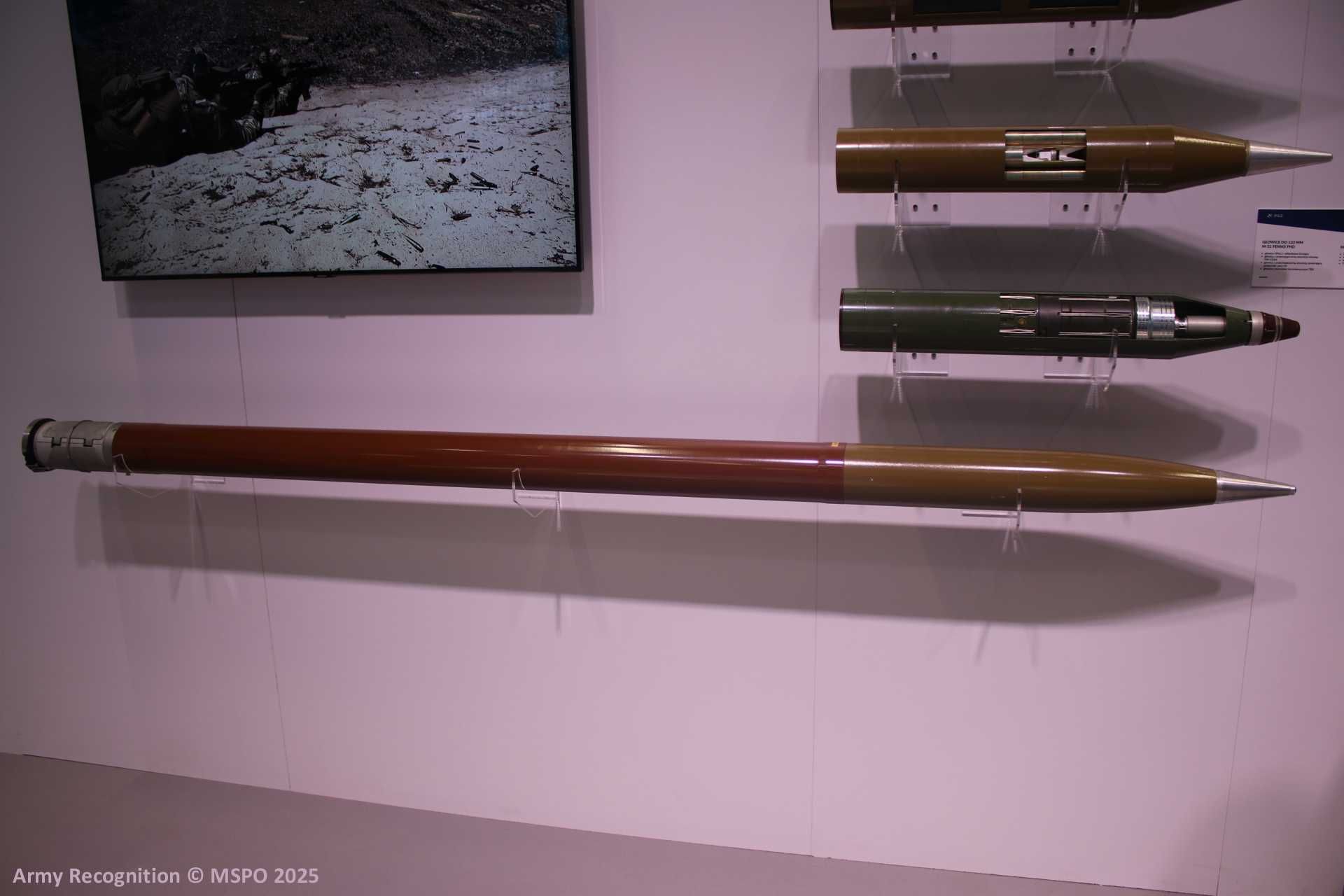
At MSPO 2025, four different warhead options were listed for the Feniks FHD: SPALL+ high-explosive fragmentation, an anti-tank mine ammunition type designated MN-121M, an anti-tank cluster version with GKO-35 submunitions, and a thermobaric explosive TBX warhead. (Picture source: Army Recognition)
The origins of the Feniks program date back to the late 1990s, when FPS Bolechowo, later absorbed into Mesko as part of its Kraśnik-Bolechowo division, began work on new 122 mm rockets. The objective was to provide significantly greater range and new warhead types compared to the Soviet-designed M-21OF (9M22U), which had a maximum range of about 20 kilometers. The program aimed at developing new propulsion systems and warheads, including cargo warheads that could carry thermobaric loads, electronic countermeasures payloads, or anti-tank mines such as the MN-121.
In cooperation with the French firm Celerg, later incorporated into Roxel, composite solid propellant engines were designed, which extended ranges to beyond 32 kilometers for the M-21FK and to 42 kilometers for the M-21 FHD. In 2001, both types passed Ministry of Defence qualification tests. In 2003, the military ordered the first batch of M-21FK with cluster warheads and submunitions, but production was stopped after France enforced its interpretation of the 2008 Oslo Convention on Cluster Munitions and blocked propulsion component deliveries. Poland, which did not ratify the convention, considered the weapons compliant due to self-destruct features, but was forced to pursue indigenous propulsion development.
As a result, in 2013, the Ministry of Defence directed Mesko to develop a fully domestic propulsion unit based on high-energy solid fuel. Test campaigns in 2014 and 2015 were conducted in Sweden because Poland did not have the facilities for firings at over 40 kilometers. These trials demonstrated ranges of 42.5 kilometers, and rockets were then issued to three artillery regiments for evaluation: the 3rd Masurian, 5th Lubusz, and 23rd Silesian. Development concluded in 2017, and Mesko launched serial production of the Feniks FHD. Alternative versions were tested during the program, including the M-21FHE with a high-explosive fragmentation warhead and electronic proximity fuze, and the M-21FK1 with scatterable anti-tank mines, but neither entered series production. In 2018, the Feniks received recognition at MSPO in Kielce through the Defender award.
The Feniks FHD’s specifications are consistent across official publications. It has a total length of 2,797 mm with fuze, a caliber of 122 mm, and a total mass of 65 kilograms. The propulsion is a composite solid fuel motor that provides a maximum velocity of about 1,150 meters per second. The maximum effective range is specified as at least 41 kilometers, with some trials reaching 42.5 kilometers, and the minimum range varies between 10 and 14 kilometers depending on documentation. The standard warhead is high explosive with an MRW-U/T fuze, although documentation also mentions the existence of submunition, mine, and thermobaric warhead options that remain at different stages of development or suspension.
The system entered service in the Polish Armed Forces with deliveries starting in 2019. Between 2019 and 2021, 3,140 rockets were delivered, followed by a second order signed on 29 April 2021 for 2,320 additional Feniks FHD rockets, scheduled for delivery between 2021 and 2023. The 2021 contract was valued at about 95.9 million PLN. Together with the first contract of September 2019, which covered 820 rockets for about 24.1 million PLN, these procurements established the Feniks FHD as the only 122 mm rocket type ordered and delivered to the Polish Army in recent years. Earlier pilot orders included 1,000 modified rockets based on the M-21OB for testing in 2013.
Further development focuses on the modernization of accuracy. The Warsaw University of Technology has developed a gas-dynamic steering module to enable precise course corrections, and this project reached Technology Readiness Level 6 in June 2024. Additional funding from the Ministry of Defence is awaited to continue testing and move toward readiness level 9. Reports also describe the possibility of integrating laser guidance modules originally designed for 155 mm AHS Krab and 120 mm Rak artillery shells, potentially providing cost-effective precision strike capabilities when adapted to 122 mm rockets. Supporting this work, PGZ has established a hardware-in-the-loop laboratory for guided rocket research. The Center for Innovation has confirmed that the Feniks is now fully Polish in design and production, manufactured by Mesko, and capable of further upgrades.
The Feniks has also been reported in operational use outside Poland. On 9 February 2024, Russian social media circulated photographs of debris attributed to Feniks rockets after a strike in Russia’s Belgorod region, claiming that they had been used by Ukrainian forces. The rockets’ compatibility with BM-21 and RM-70 systems in Ukrainian service, along with their longer range compared to legacy 20 km rounds, would make them suitable for such employment. The number of rockets transferred remains unspecified, and neither the scale nor the transfer mechanism has been independently verified.
In Poland, discussions continue about extending the Feniks range to 70 kilometers, as suggested by Major General Mirosław Spurek of the 15th Giżycko Mechanized Brigade, who noted the theoretical potential of the rockets. Mesko stated it is not working on such an upgrade, but could explore it if requested by the armed forces. Historical records confirm that a Fenix-Z variant capable of 65 kilometers was developed in the past but halted for technical and political reasons. Analysts caution that extending the range of 122 mm rockets would involve compromises in accuracy, warhead size, and cost, although proponents argue that increased distance could reduce the vulnerability of launchers to drone attacks.