







Breaking News




MSPO 2025: New Generations of US JAGM Air-To-Ground Missiles Strengthen Operational Flexibility.
Lockheed Martin’s Joint Air-to-Ground Missile (JAGM) was once again showcased at the MSPO defense exhibition in Poland, a particularly relevant setting as Warsaw received U.S. approval in 2023 for the procurement of 96 AH-64E Apache helicopters along with 460 JAGM missiles. The presentation reflects growing interest in Poland and other European countries for air-to-ground strike systems designed to operate effectively in increasingly complex environments. Already fielded by U.S. forces, the JAGM has now evolved into several variants adapted for fighter aircraft and extended-range engagements. These developments aim to enhance platform survivability, increase employment flexibility, and expand the range of target sets.
Follow Army Recognition on Google News at this link
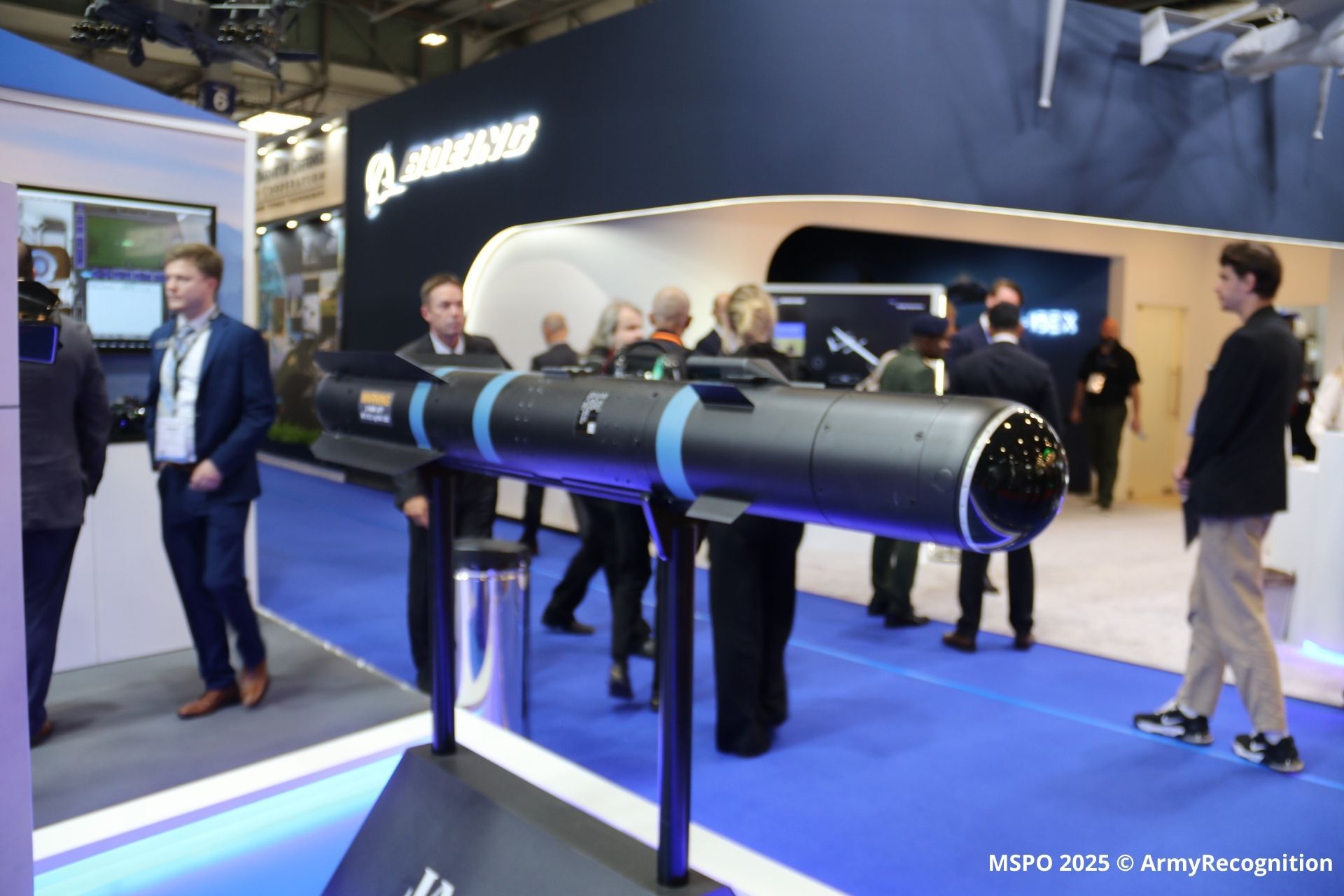
The entire JAGM family builds on the legacy of the Hellfire and Longbow missile lines, with more than 100,000 units produced and a reliability rate exceeding 97 percent (Picture source: Army Recognition)
The JAGM-F, also designated AGM-187A, is the version adapted for fixed-wing fighter and attack aircraft. Unlike the baseline rail-launched model, the JAGM-F is designed for eject-launch, making it compatible with platforms such as the F-16, F-15E, F/A-18, A-10C, and the F-35, both in internal and external carriage. Its lightweight configuration allows for an increased weapons load per sortie, improving the ability to engage multiple targets in a single mission.
The JAGM-F incorporates a multi-mode guidance system combining a semi-active laser (SAL) sensor for precision accuracy and a millimeter wave (MMW) radar sensor to counter electronic warfare and ensure performance in adverse weather. It also maintains fire-and-forget capability, enabling successive engagements without requiring continuous operator guidance, thus reducing exposure of the launch platform. The ability to conduct high off-axis launches increases responsiveness against moving and fleeting targets, while its maritime strike option allows engagement of fast attack craft with reduced collateral effects.
Technical specifications highlight its modular design and operational reach. Measuring 177.8 cm in length and weighing 93 kg, it carries a multipurpose warhead effective against a wide spectrum of targets, including armored vehicles, air defense systems, radar sites, command nodes, bunkers, and fast craft. With a range between 0.8 and over 24 km, it offers flexibility in contested environments, even under GPS-denied or communications-limited conditions.
In parallel, Lockheed Martin is developing the JAGM-MR (Medium Range) variant, intended to extend the reach of air-to-surface and surface-to-surface engagements while preserving the external dimensions of the baseline missile for compatibility with existing launchers such as the M299. This model incorporates a low-smoke, boost-sustain rocket motor paired with an electro-mechanical control system, providing ranges beyond 16 km when ground-launched and greater distances when released from altitude.
The JAGM-MR also integrates a third sensor, near-infrared (NIR), complementing the SAL/MMW combination and enhancing resistance to advanced countermeasures. This triple-mode seeker allows operators to select the most suitable sensor configuration for the tactical environment and ensures continued functionality even if one channel is disrupted.
Weighing 53.3 kg and retaining a multipurpose warhead, the JAGM-MR can engage multiple targets near-simultaneously under all weather and visibility conditions. Its extended performance addresses the growing requirement for increased standoff ranges and higher survivability in multidomain operations where mobility and rapid response are critical.
The entire JAGM family builds on the legacy of the Hellfire and Longbow missile lines, with more than 100,000 units produced and a reliability rate exceeding 97 percent. Its modular architecture supports industrial continuity while enabling incremental upgrades to meet emerging operational demands.
The JAGM-F and JAGM-MR extend the missile’s role beyond its original configuration. The former adapts the system to modern fighter aircraft with higher loadout and maritime strike capability, while the latter doubles effective range from surface launchers and introduces enhanced sensor options. The demonstration of JAGM at MSPO in Poland, following U.S. approval for Warsaw’s Apache and missile acquisition, underscores Lockheed Martin’s effort to present its systems to European allies and promote their adoption in a regional security context marked by ongoing tensions.