






Breaking News





MSPO 2025 Analysis: Rise of drone defense industry highlighted in Kielce in Poland.
According to information observed during the MSPO 2025 exhibition in Kielce, on 4 September 2025, the International Defence Industry Exhibition became a showcase for the drone revolution sweeping through Europe and beyond. The halls were filled with both established defence players and ambitious start‑ups all competing to capture the attention of armed forces in a rapidly evolving conflict environment. The proliferation of fighter, reconnaissance, amphibious, naval, and counter‑drone systems across the exhibition floor reflects how the war in Ukraine has reshaped the unmanned systems domain.
Follow Army Recognition on Google News at this link
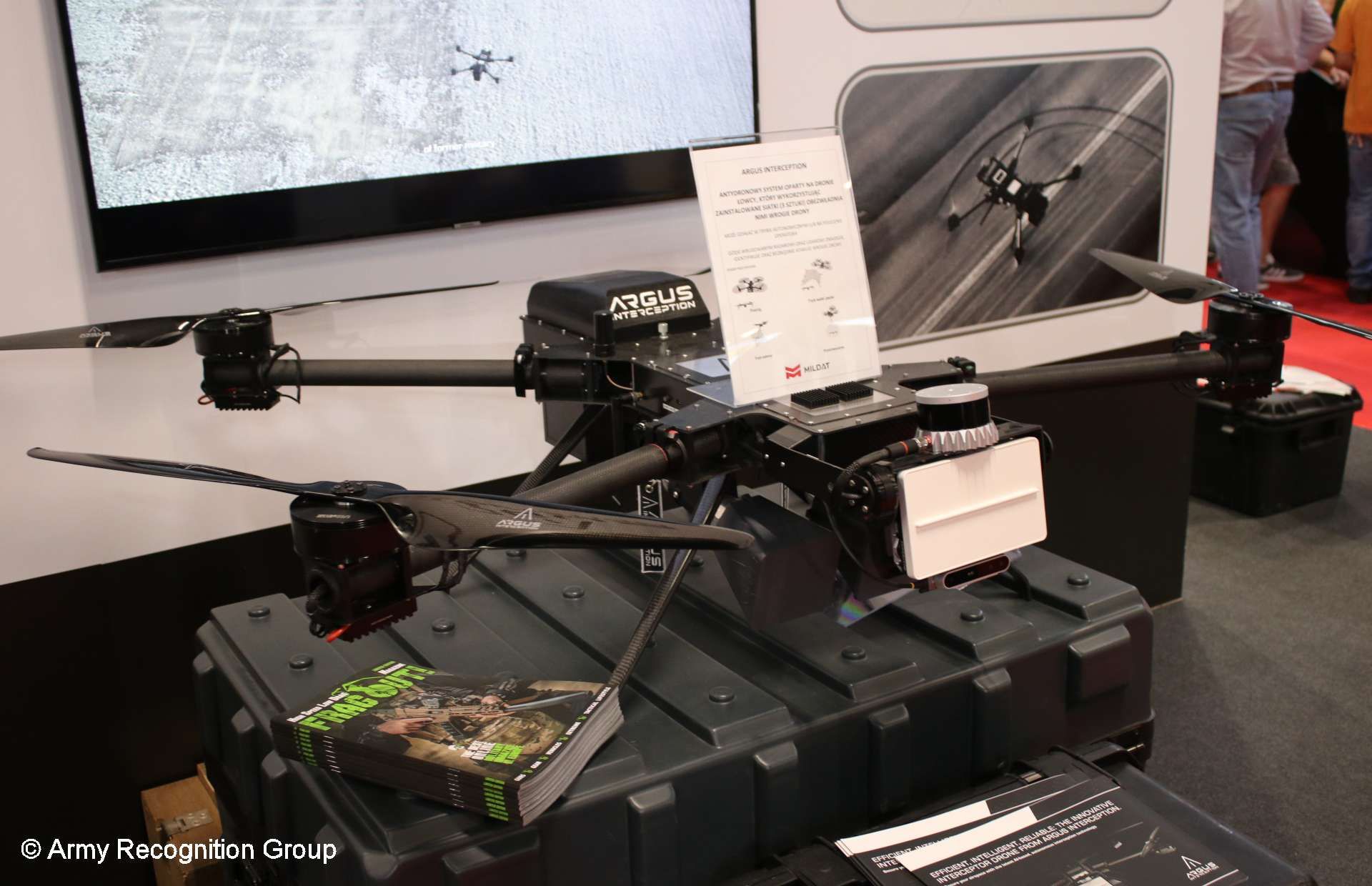
The Argus Interceptor showcased at MSPO 2025 reflects the rapid rise of counter-drone technologies, as nations adapt to evolving aerial threats on the battlefield (Picture source: Army Recognition Group).
Polish firms took center stage with innovative platforms. The Military Institute of the Land Forces presented the amphibious Kaczka drone, a land‑and‑sea vehicle with a singular forward-facing optical sensor, designed for stealth surveillance or precision strike operations. It has a 5 km control range and can carry a 10 kg explosive payload, offering tactical support in denied terrain. Meanwhile, WITU introduced the Haasta, a hybrid-powered UAV capable of long-endurance missions and equipped with specialized anti-drone missiles under its wings, giving ground forces an agile airborne interceptor for emerging aerial threats.
WB Group displayed the Stormrider unmanned surface vessel, designed and built in less than a year. Optimized for high-speed reconnaissance and naval strike missions, it embodies lessons learned from recent asymmetric maritime engagements. Its performance in Baltic sea trials positions it as a viable solution for coastal defense and special operations support.
Ukrainian defense manufacturers demonstrated how wartime necessity drives rapid innovation. One of the highlights was the THOR OPERATOR drone, designed to serve as a mothership for deploying smaller FPV drones and loitering munitions. With a 400 km range, four-hour endurance, and dual propulsion options, it adds flexible standoff capabilities to layered drone warfare strategies.
The Ukrainian drone industry has become a major player, with production capacity expected to reach 4.5 million FPV drones in 2025 alone. The country has also created a dedicated Unmanned Systems Forces branch to coordinate procurement, tactics, and integration of more than 170 drone system types. This structural evolution shows how deeply unmanned systems are now embedded in Ukraine’s force design.
Private and non-profit initiatives have also advanced Ukrainian capabilities. Among them, the Wild Hornets project has delivered a series of specialized drones, including stealth interceptors, heavy FPV bombers, and thermite delivery systems. In parallel, Ukrainian defense firm Fire Point unveiled two new ballistic systems at MSPO 2025. The FP-7 offers a 200 km strike range with a 150 kg warhead, while the FP-9 extends Ukraine’s reach to over 850 km with a significantly heavier payload. These developments signify a shift toward strategic drone-enabled firepower.
Across Europe, start-ups led by military veterans are redefining the defense innovation landscape. In response to evolving battlefield needs and growing national urgency, European defense technology investment has surged, supporting a new wave of unmanned solutions for land, air, and maritime domains. European policymakers have increasingly acknowledged drones as the most transformative weapons since gunpowder and nuclear arms, advocating fast-track procurement and indigenous production.
MSPO 2025 illustrates a new era where drones have moved from the margins to the center of military strategy. From amphibious systems like the Kaczka to aerial motherships, naval drones, and strategic strike platforms, the rapid expansion of drone warfare capabilities is reshaping defense priorities globally. For Army Recognition readers, it is clear that unmanned systems are no longer just tools of asymmetric warfare but critical assets for peer-state competition and full-spectrum operations.