






Breaking News






Lithuania drills layered air defenses to counter drones and strengthen Europe’s eastern flank.
Lithuania ran live fire at Pabradė on 20 October, pairing FPV drones, stabilized 12.7 mm remote weapon stations, and RBS 70 NG missiles against small aerial targets. The drills fit a broader push to densify short-range air defense with fresh BOLIDE stocks and JLTV-mounted MSHORAD units that tighten the sensor-to-shooter loop.
At the General Silvestras Žukauskas training area on 20 October, Lithuanian crews practiced an iterative kill chain for low, slow, small threats, using FPV teams to stalk targets, 12.7 mm CROWS-equipped stations to rake approach corridors, and RBS 70 NG sections to close the trap at range, including at night. The army described direct fire on “Gerbera-type” drone targets and live missile shots, a practical rehearsal that mirrors lessons from Ukraine about massed small UAVs and the need for quick, layered responses.
Follow Army Recognition on Google News at this link
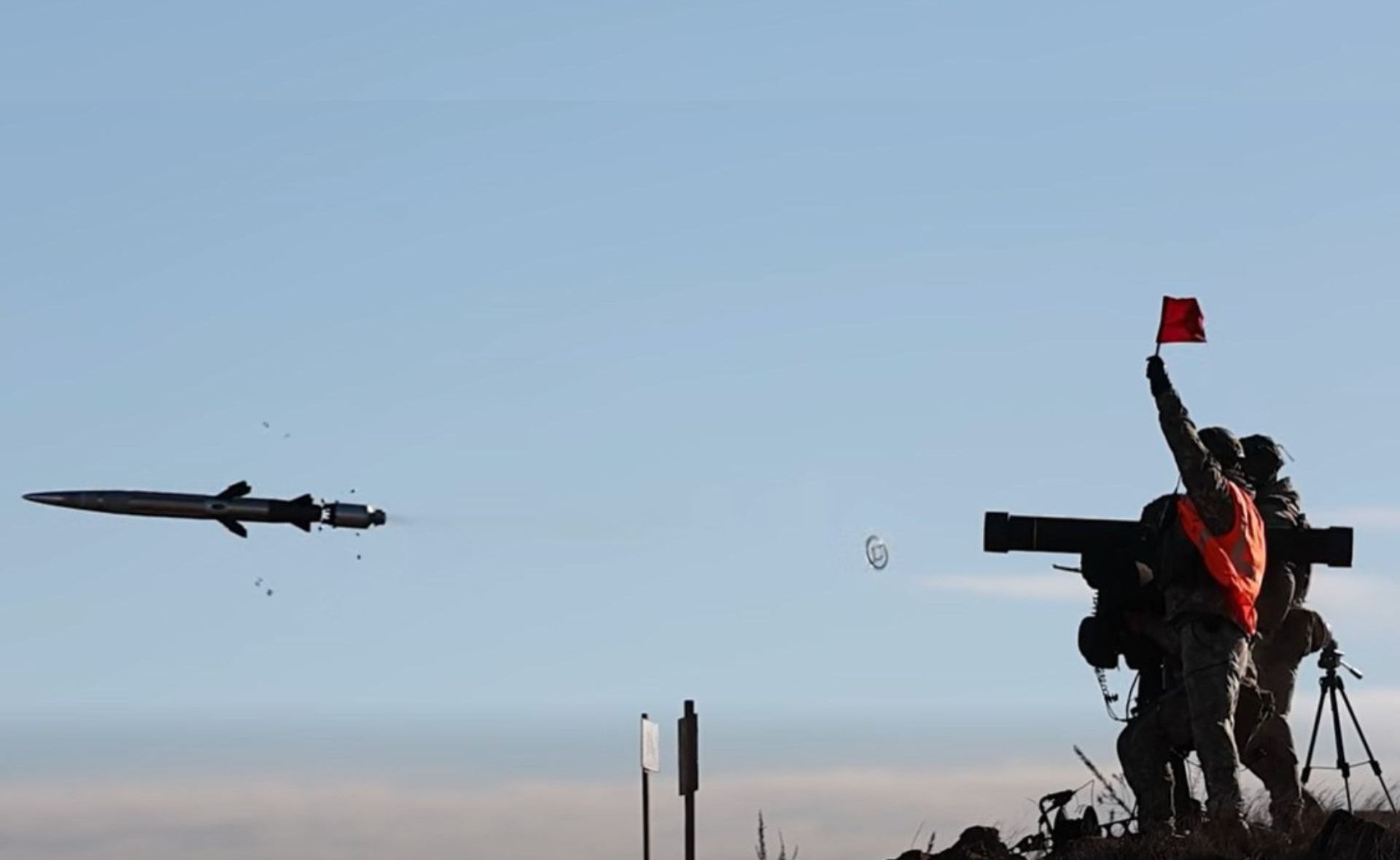
Screenshot from Lithuanian Armed Forces footage showing the use of the RBS 70 NG (Picture source: Lithuanian MoD)
Lithuania’s current anti-drone means rest on a medium-range air defense layer with NASAMS III and a close VSHORAD (very short range air defense) bubble provided by FIM 92 Stinger and RBS 70. The air force order of battle includes one air defense battalion with eight NASAMS III units for site protection and low to medium altitude coverage, complemented by Stinger and RBS 70 point defense systems for very short range interception, including mini UAVs.
Within this setup, the RBS 70 NG serves as a precision interceptor. Designed by Saab, it retains the tripod architecture with launcher and NG sight integrating a 24/7 thermal imager, auto tracker, and visual aids. Laser beam riding guidance, which does not rely on a seeker, limits vulnerability to radio frequency jamming and is suitable for small radar cross-section targets. The fourth generation BOLIDE missile offers an interception envelope up to 8 km and above 5,000 m in altitude, with a warhead combining shaped charge and prefragmentation that extends lethal effect to attack helicopters and some lightly armored ground targets. The software-based NG sight reduces tracking noise through auto tracking, improving end-of-range accuracy and enabling use in man-portable, remote, or vehicle-mounted configurations.
This capability base was reinforced in spring 2025 with a new delivery of BOLIDE missiles. On 27 May, Vilnius received a batch worth about €2 million under the contract signed in autumn 2022 for BOLIDE and Mk 2 missiles, with a cumulative value of around €34 million. The ministry reiterated that lessons from Ukraine require denser short-range air defense. BOLIDE missiles, compatible with RBS 70, are described as resistant to mechanical interference and electromagnetic jamming. In service with the air defense battalion, the system is valued for simple maintenance, mobility, and day night effectiveness, with some communications noting range up to 9 km and penetration up to 200 mm against lightly armored targets.
The buildup continues with the acquisition of Saab’s MSHORAD solution for 2025 to 2027. Lithuania has ordered mobile firing units based on RBS 70 NG, mobile radar units with Giraffe 1X, and a GBAD C2 command and control system, all integrated on Oshkosh JLTV vehicles. This format shortens the sensor-to-shooter cycle, provides the mobility required against loitering munitions and mini UAVs, and enables networking of weapon sections to protect facilities, areas, and critical infrastructure.
Operationally, the training observed in Pabradė illustrates the Baltic layered architecture. FPV teams stalk and harass at very short distance, 12.7 mm sections saturate approach axes at minimal cost per shot, and RBS 70 NG crews take over beyond the effective domain of guns, including at night. The whole fits into the modernization path outlined in planning documents, which place Lithuania within the European Sky Shield initiative and confirm a single air defense battalion built around NASAMS III, Stinger, and RBS 70.
In this context, the Lithuanian maneuver takes place in a pressured environment in which Russia remains the most direct threat to NATO’s northeastern flank, while the proximity of Belarus, an active military supporter of Moscow and a venue for joint exercises, including with a nuclear dimension, sustains a risk of drone provocations and incursions against infrastructure and deployed units. Hence, Vilnius’s effort to thicken a layered defense and accelerate deliveries, supported by the European Sky Shield initiative, the presence of a NATO multinational battlegroup, and the gradual deployment of a permanent German brigade by 2027, in order to harden deterrence and close the gaps exploited by slow, low, and discreet vectors.
Written By Erwan Halna du Fretay - Defense Analyst, Army Recognition Group
Erwan Halna du Fretay is a graduate of a Master’s degree in International Relations and has experience in the study of conflicts and global arms transfers. His research interests lie in security and strategic studies, particularly the dynamics of the defense industry, the evolution of military technologies, and the strategic transformation of armed forces.