






Breaking News






Japanese HVGP Ballistic Missile Revealed as Key to Long Range Precision Strike at Fuji Firepower 2025.
On June 8, 2025, the annual Fuji Comprehensive Firepower Exercise will serve as a significant display of Japan’s emerging defense technologies, as reported by the Telegram Channel @軍事日本. This year’s edition will include the first public demonstration of the Hyper-Velocity Gliding Projectile (HVGP), a next-generation hypersonic missile system, as well as the debut of the new Type 24 armored vehicles, comprising a self-propelled mortar and a reconnaissance combat vehicle. The event reflects a broader transformation within the Japanese armed forces, focused on strengthening regional deterrence and addressing evolving hybrid and conventional threats.
Follow Army Recognition on Google News at this link
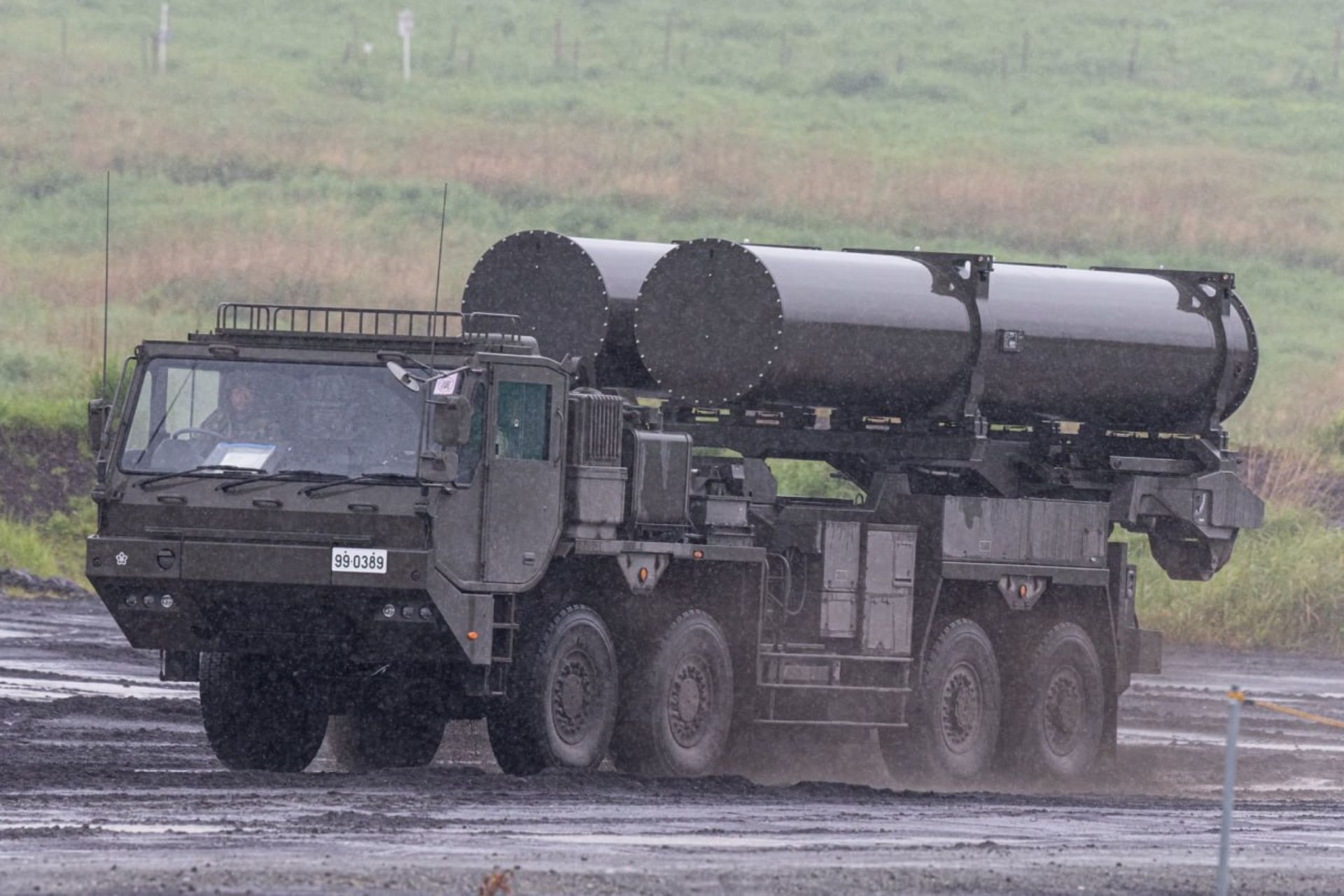
The HVGP is mounted on a mobile ground-based launcher, enhancing its survivability, tactical flexibility, and rapid redeployment capability (Picture source: Telegram Channel @軍事日本 )
The HVGP, developed by Mitsubishi Heavy Industries, is designed to fly at speeds exceeding Mach 5 while following a gliding trajectory, with terminal phase maneuverability allowing it to evade missile defense systems. Originally scheduled for operational deployment in 2029, the program has been accelerated, with initial fielding now expected in 2026. The missile is intended for long-range precision strikes, particularly in island defense scenarios. Its range is estimated at 900 km for the initial version, with future variants potentially exceeding 3,000 km. Two configurations are under development: Block 1, the early deployment model (approximately 8 to 9 meters long), using a boosted propulsion system derived from the Type 12 missile; and Block 2, a longer version (over 10 meters), incorporating a more advanced glider and a more powerful booster, designed for increased payload and extended range.
The HVGP is mounted on a mobile ground-based launcher, enhancing its survivability, tactical flexibility, and rapid redeployment capability. It is compatible with integrated fire control and command systems (FCCS), and uses both inertial and satellite navigation (GNSS), enabling high strike accuracy. The system is expected to be deployed primarily in the Kyushu and Hokkaido regions, with a primary mission of defending contested or remote islands in the East China Sea. The strategic aim is to provide Japan with a credible deterrent capability capable of countering adversary advances before they can establish a presence.
The exercise will also feature the first operational presentation of the Type 24 armored vehicle series, based on the chassis of the Type 16 Maneuver Combat Vehicle, already in service with rapid deployment units. The Type 24 Mobile Mortar (MM) is equipped with the Thales 2R2M 120 mm mortar system, integrated into a semi-automated turret and digital fire control suite, allowing for rapid deployment and shoot-and-scoot capabilities. It provides indirect fire support while maintaining mobility suited for island operations. The Type 24 Reconnaissance Combat Vehicle (RCV) is equipped with a manned turret mounting a Bushmaster Mk 44 30 mm cannon and a coaxial 7.62 mm machine gun, offering firepower against light armored threats and irregular forces. It also features advanced electro-optical sensors for long-range surveillance, target acquisition, and reconnaissance missions.
Fuji Firepower 2025 serves not only as a demonstration event but also as a full-scale platform for technological integration and tactical evaluation, where new systems are tested in simulated combat conditions. For the JGSDF, it represents an opportunity to enhance combined arms readiness, joint interoperability, and adaptability in high-intensity or multi-domain operational scenarios. The exercise also conveys a clear political signal: Japan is prepared to assume a more active military role in the Indo-Pacific, moving beyond its postwar defensive orientation. This shift is supported by increasing technological cooperation with the United States and a declared intent to secure regional stability amid strategic competition with China and ongoing provocations from North Korea.
With the introduction of the HVGP and Type 24 vehicles, Japan acquires advanced and operationally relevant tactical capabilities intended to deter potential incursions or destabilization of its territorial integrity. Fuji Firepower 2025 thus marks a key moment in the doctrinal and operational evolution of Japan’s defense forces and stands as a strategic development closely watched by regional security observers.