






Breaking News






Jackal 3 tactical vehicle to transform British Army mobility as deployment nears year’s end.
The British Army is preparing to receive the final two Jackal 3 vehicles from the first production tranche, marking an important step in a program which, while limited in scope, brings a long-anticipated modernization. In a statement published on August 12, 2025, Defence Equipment & Support (DE&S), an agency of the UK Ministry of Defence, announced that the last vehicles of the first tranche had rolled off Babcock’s production line and would be delivered to the Army by the end of the year. The statement also confirmed that the second tranche is already underway, with production of 53 six-wheeled “Extenda” variants assigned to Babcock and Supacat.
Follow Army Recognition on Google News at this link
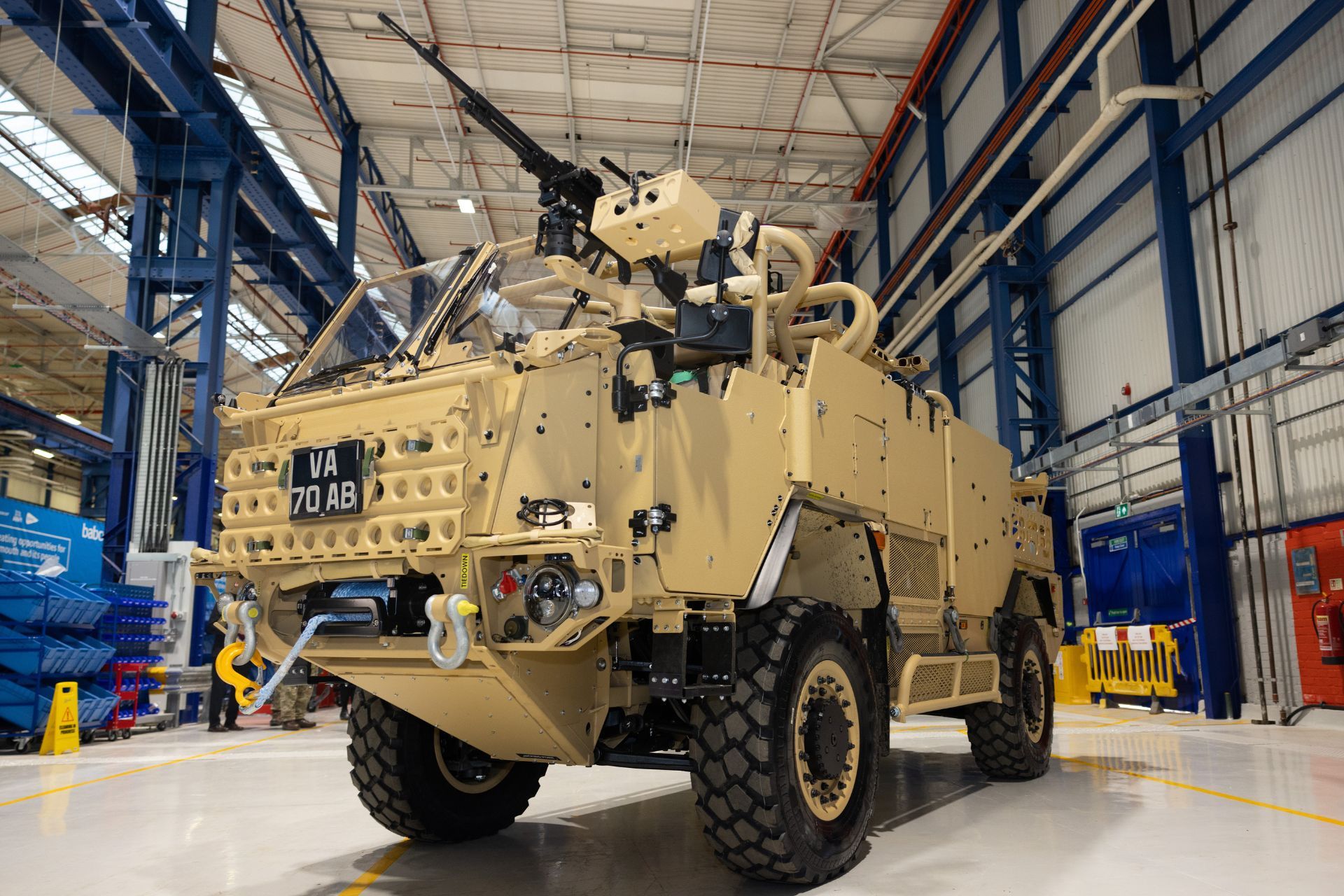
The new Jackal 3 high mobility vehicle on display at Babcock’s Devonport facility ahead of delivery to the British Army in 2025 (Picture source: British MoD)
The Jackal 3, designed by Supacat and produced by Babcock, is intended for a wide range of missions including tactical reconnaissance, rapid assault, and logistical support. Part of the HMT 400 series, it provides enhanced crew protection and increased payload capacity with a gross vehicle weight of 7.6 tons. The vehicle can carry 2.1 tons of payload, reach a top speed of 120 km/h, and has a road range of up to 800 km. Its modular design allows it to be configured from a 4x4 into a 6x6 through a new suspension system, effectively doubling load capacity and improving off-road performance.
The Jackal 3 has also been designed to accommodate a wide range of mission-specific systems. It can be equipped with communications, intelligence, or surveillance modules and fitted with ISTEC mounts that allow for the installation of both light and heavy machine guns. Optional equipment includes a ballistic and mine-protection kit, smoke grenade launchers, a remote weapon station, run-flat tires, and a self-recovery winch. From a technical standpoint, the vehicle is powered by a 6.7-liter Cummins diesel engine generating 180 horsepower, coupled with an Allison automatic transmission. It also incorporates an ABS-equipped braking system and is fitted with military infrared lighting provided by Venta to improve operational efficiency in demanding environments.
The Jackal 3 program was formally launched in February 2023 with an initial order of 70 units, alongside a clause allowing for the acquisition of up to 240 vehicles depending on operational requirements. The British Army currently operates around 700 vehicles from the Jackal family, first introduced in 2008 and considered a core element of its tactical mobility. However, the introduction of these new models takes place within a broader rationalization effort, as the Ministry of Defence seeks to reduce the current 16 types of vehicles in service to approximately five under the Land Mobility Programme. This includes protected vehicles such as the Wolfhound, Mastiff, and Ridgeback, the Panther and Foxhound 4x4s, the tracked Bulldog FV430, as well as utility platforms such as the Coyote, Land Rover, and Pinzgauer.
This consolidation has become more pressing as a large amount of equipment has been transferred to Ukraine in recent years, including the entire fleet of AS90 155 mm self-propelled howitzers. Protected mobility vehicles such as the Mastiff and Ridgeback are also reported to have been donated, creating further capability gaps. In this context, the gradual introduction of the Jackal 3 cannot by itself compensate for the loss of heavy equipment, but it contributes to maintaining a degree of consistency in the modernization of the British Army’s vehicle fleet.
The official DE&S announcement confirms that the delivery of the last two Jackal 3 vehicles from the first tranche will take place by the end of 2025, while production of the Extenda variants is already underway. With its increased capacity, modularity, and technical updates, the Jackal 3 adds operational value to the British Army, though it remains insufficient to fully address the structural gaps created by recent equipment transfers and the ongoing need to streamline the land mobility fleet.