






Breaking News






IDEF 2025: Roketsan’s New EREN Loitering Munition Combines Anti-Drone Defense with Long-Range Strike Capability.
At the 17th edition of the International Defense Industry Fair (IDEF) 2025, held in Istanbul, Turkish company Roketsan unveiled a new set of weapon systems, among which is EREN, a high-speed, jet-powered, multi-role loitering munition. Previously teased ahead of the event, the system had already drawn the attention of military analysts for its expected ability to engage both ground and aerial targets. Its official presentation at IDEF confirmed this dual capability, positioning EREN as a distinct system within the current landscape of loitering munitions.
Follow Army Recognition on Google News at this link
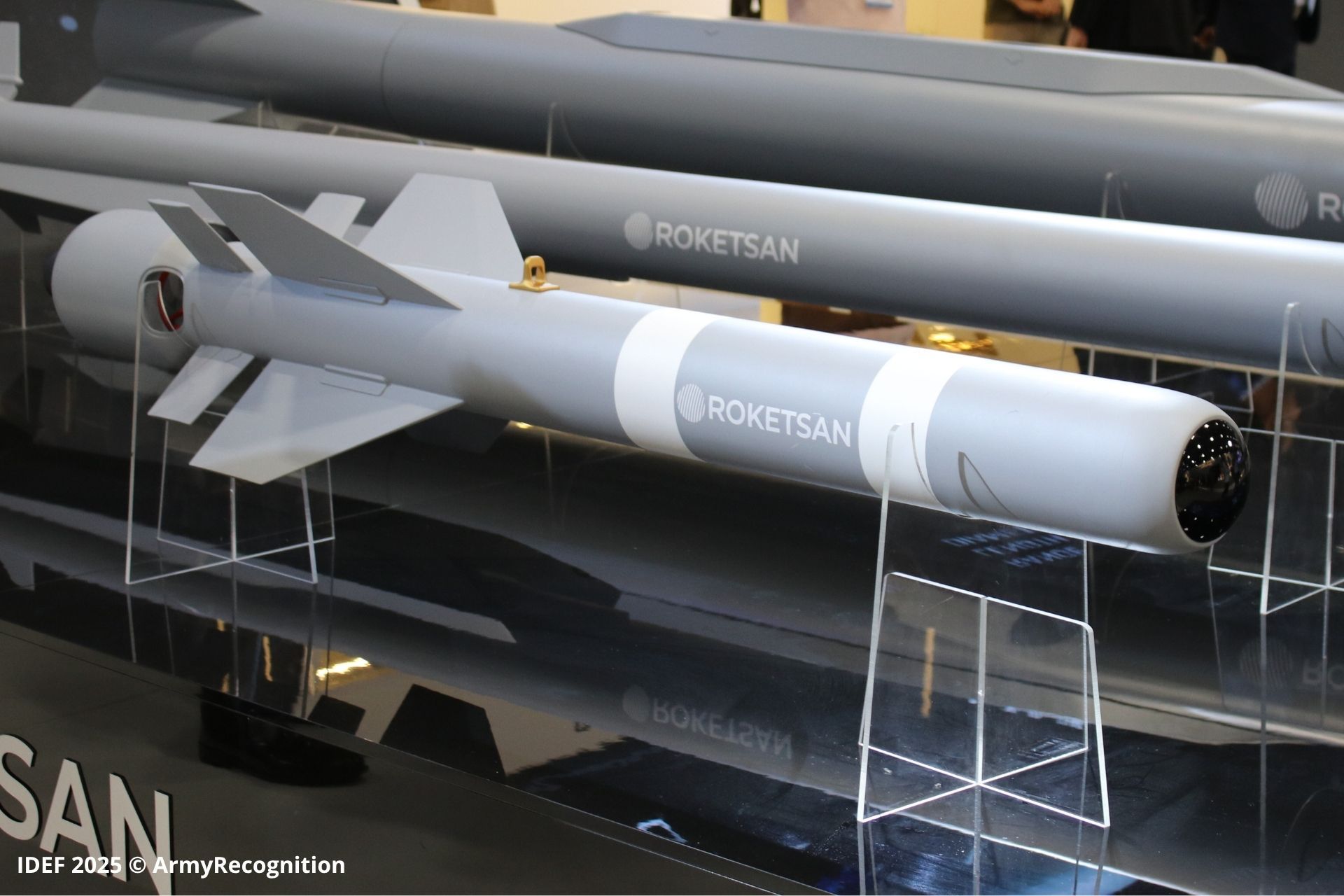
Compared to heavier systems like the UMTAS anti-tank missile, EREN's relatively light weight offers mobile units a means of long-range strike and defense (Picture source: ArmyRecognition)
Weighing 35 kilograms and offering a range exceeding 100 kilometers, EREN features an endurance of over 15 minutes and uses an optical seeker for terminal guidance. Rather than emphasizing prolonged loitering time, the system prioritizes speed and the ability to strike at the optimal moment, enhancing tactical flexibility. It can be launched from a variety of platforms, including armed UAVs, helicopters, land vehicles, naval platforms, and ground-based systems. This multi-platform compatibility supports its integration in diverse and complex operational environments.
Compared to heavier systems like the UMTAS anti-tank missile, EREN's relatively light weight offers mobile units a means of long-range strike and defense. Its dual-role architecture enables it to engage both slow aerial targets, such as drones, and ground targets, whether armored, unarmored, or personnel, meeting emerging operational requirements where the distinction between offensive and defensive systems is increasingly blurred. As such, EREN addresses a growing tactical gap by reducing logistical burden while expanding the set of available combat options for deployed units.
Its integration into the Turkish Armed Forces reflects an effort to align the national arsenal with evolving battlefield dynamics, characterized by the rise of low-altitude aerial threats and more agile combat formations. From an industrial standpoint, EREN follows an optimization logic, delivering scalable strike effects, reduced logistical demands, and multi-scenario usability. Its potential for export also appears significant, as military seek compact, adaptable, and cost-effective systems suited for hybrid or asymmetric operations.
More broadly, Roketsan's participation in IDEF 2025 is marked by the introduction of six newly developed systems, all presented for the first time. In addition to EREN, the company revealed the Tayfun Block-4, Türkiye’s first hypersonic missile; the Gökbora beyond visual range air-to-air missile; the encapsulated submarine-launched variant of the Atmaca missile (AKATA); the air-launched ballistic missile 300 ER; and the Şimşek-2 space launch vehicle. These developments illustrate Roketsan’s strategic aim to secure Türkiye’s technological autonomy across the full spectrum of defense domains, from ground-based operations to outer space.
EREN stands out as one of the most indicative systems of this trajectory, combining technological integration, tactical modularity, and cross-domain applicability. Developed by a central actor within Türkiye’s defense-industrial base, EREN reflects the shift of loitering munitions toward a new generation of hybrid systems designed to respond to the simultaneity of threats across modern battlefields. The likely proliferation of such systems, both within Turkish forces and on the export market, underscores current doctrinal shifts and the expanding role of high-utility tactical munitions in future conflict scenarios.