







Breaking News




IDEF 2025: Roketsan’s Alpagut loitering munition enhances Turkish operational flexibility with long-range capabilities.
At IDEF 2025, Roketsan displayed the Alpagut loitering munition, a system designed for precision strikes in various operational environments, which was unveiled during the Saha Expo 2022. The system is effective against a wide range of targets, including mobile and stationary land and sea vehicles, radar and communication systems, command centers, critical infrastructure, and personnel. The Alpagut is capable of operating both day and night, with an operational radius of over 60 kilometers and an endurance of more than 60 minutes. It can be deployed individually or in swarm configurations, providing flexibility in tactical operations.
Follow Army Recognition on Google News at this link
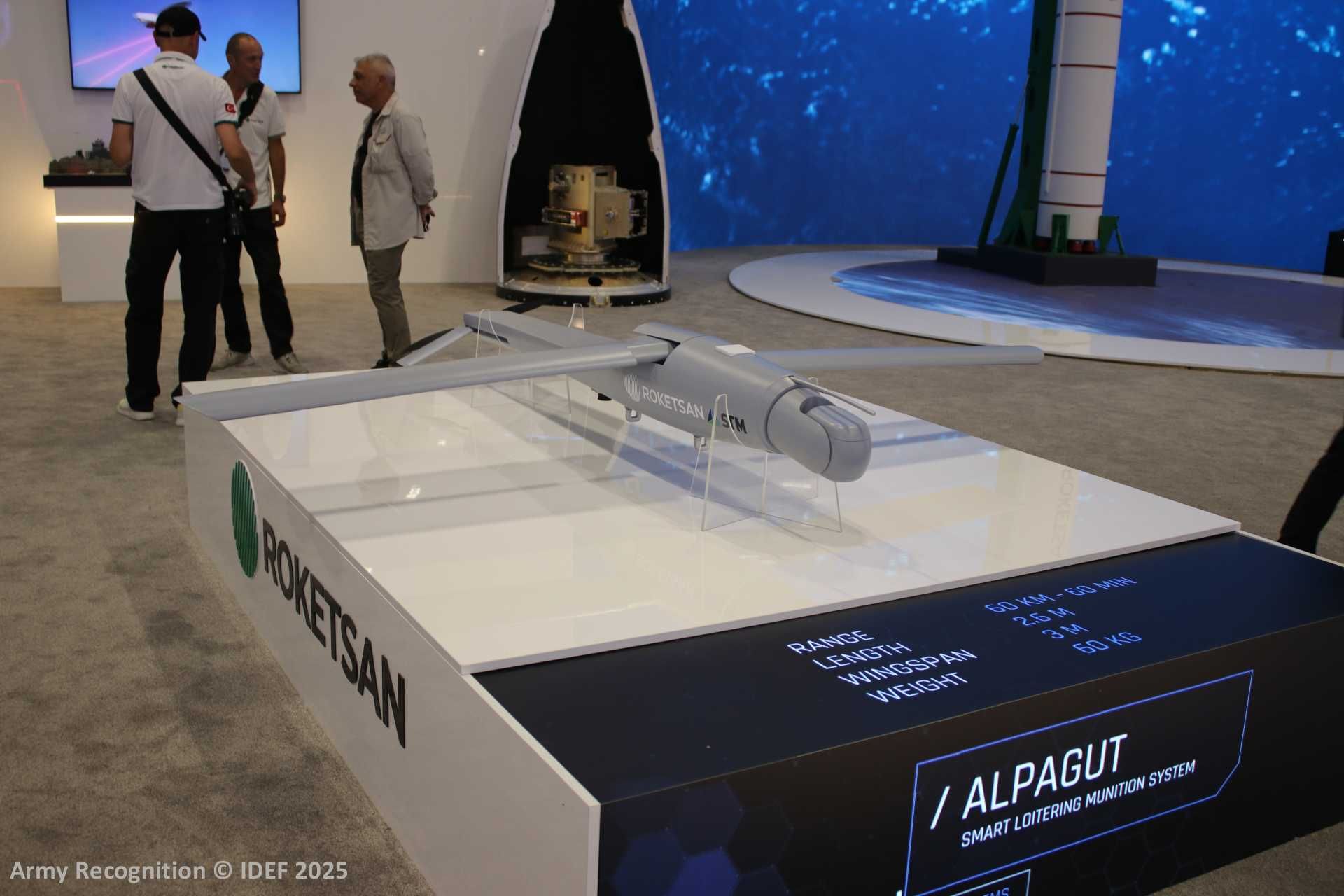
The Alpagut can carry different warheads, including high-explosive blast fragmentation, armor-piercing, and thermobaric types, offering versatility for various mission profiles. (Picture source: Army Recognition)
Once launched, the Alpagut enters a target detection, tracking, and evaluation mode, where it hovers and continuously transmits real-time video to the operator. The operator can then approve the target for engagement. After receiving the approval, the Alpagut autonomously dives to strike the identified target, ensuring a precise and timely attack. The system’s dual-mode seeker allows it to detect and recognize targets without being detected or affected by jamming systems. Additionally, the guidance-control system provides precise targeting, ensuring that the munition accurately hits its intended target. This autonomy and precision make the Alpagut effective in contested environments, where electronic warfare and countermeasures are often deployed.
The Alpagut’s design allows for integration into both manned and unmanned platforms, such as fixed- and rotary-wing aircraft, UAVs, ground vehicles, and unmanned surface vessels (USVs). The system is compact, weighing 45 kilograms, with a length of 2.3 meters and a wingspan of 3 meters, making it suitable for a wide range of deployment platforms. Its electric motor-driven propulsion system enables it to operate with reduced noise, minimizing the risk of detection during flight. This design also allows it to loiter quietly in the air for extended periods, which is crucial for its effectiveness in tactical operations. The system’s ability to integrate with various platforms increases its operational flexibility, making it adaptable to different military scenarios.
Developed in collaboration between Roketsan and STM, the Alpagut addresses the need for cost-effective and flexible loitering munition solutions within Türkiye’s defense industry. The system is designed to meet the operational requirements of the Turkish Armed Forces, while also offering export potential. The collaboration combines Roketsan’s expertise in missile and rocket production with STM’s experience in producing tactical UAV systems. This partnership has resulted in the development of a system capable of engaging high-value targets, such as mobile air defense systems and armored vehicles, with high precision. The system’s integration into unmanned combat aerial vehicles (UCAVs) like the AKINCI enhances Türkiye’s ability to carry out precision strikes without risking manned aircraft.
The Alpagut system is designed for both tactical and strategic operations, providing military forces with an advanced tool for engaging critical targets in contested environments. Its ability to operate in swarm configurations increases its effectiveness by allowing multiple munitions to coordinate autonomously during operations. This feature is particularly valuable in complex combat scenarios where overwhelming enemy defenses are necessary. The Alpagut’s integration with UCAVs such as the AKINCI and TB3 offers additional capabilities for long-range strikes, enabling the system to target strategic elements from a safe distance. The system’s flexibility and autonomous targeting capabilities make it a useful asset for modern military operations.
The technology behind the Alpagut is enhanced by its advanced sensors, including electro-optical (EO) and infrared (IR) capabilities, which allow it to detect and track targets in a variety of conditions. These sensors ensure that the Alpagut can effectively engage both visible and hidden targets, increasing its operational range and effectiveness. With a cruising altitude between 300 to 1,500 meters, the system can engage targets from a safe distance while minimizing the risk of detection. The operational range of over 60 kilometers, combined with its endurance, allows the Alpagut to remain in the air long enough to monitor enemy movements and strike at the right moment.
The Alpagut loitering munition is part of a growing category of weapons known as loitering munitions, which have become increasingly integral to modern military operations. Loitering munitions, also referred to as kamikaze drones, combine the reconnaissance capabilities of unmanned aerial vehicles (UAVs) with the destructive power of a guided missile. These systems are designed to loiter over a target area for an extended period before striking, allowing for precise engagement of time-sensitive or fleeting targets. The use of loitering munitions has expanded in recent conflicts due to their cost-effectiveness and ability to carry out precision strikes without the need for high-cost platforms. Initially developed for specific roles such as the suppression of enemy air defenses (SEAD), their capabilities have been broadened to include targeting radar systems, air defense units, armored vehicles, and other high-value assets. Their use is particularly advantageous in asymmetrical warfare, where conventional strike platforms may not be as effective or available.
Loitering munitions like the Alpagut are distinguished by their ability to operate autonomously for extended periods, providing continuous surveillance and immediate strike capability once a target is identified. The system’s fire-and-forget functionality allows it to autonomously seek out and engage targets, reducing the need for operator intervention once the target is designated. This autonomy makes loitering munitions highly valuable in complex and rapidly changing combat environments, where speed and precision are critical. While challenges such as vulnerability to electronic warfare, detection by advanced sensors, and the need for replenishment in prolonged operations remain, the advantages of loitering munitions are significant. They offer a relatively low-cost alternative to traditional missile systems, enabling forces to conduct targeted strikes without risking manned aircraft or relying on expensive cruise missiles. As these technologies evolve, loitering munitions are expected to become an essential tool for modern militaries, complementing existing strike capabilities and offering new tactical options for engaging high-value or hard-to-reach targets.