






Breaking News





IDEF 2025: Aselsan’s GÖKDENİZ CIWS Strengthens Capabilities Against Modern Aerial Threats.
Presented at the IDEF 2025 exhibition, the GÖKDENİZ 100/35 close-in weapon system (CIWS), developed by the Turkish company Aselsan, represents a naval point-defense solution intended to counter modern aerial threats, particularly anti-ship missiles. Developed in parallel with the 35 mm airburst ammunition system ATOM, also part of Aselsan’s portfolio, GÖKDENİZ integrates capabilities for detection, tracking, engagement, and interception, and can operate in either autonomous or manual mode. It may be integrated into a ship’s combat management system or deployed independently, depending on the operational configuration of surface vessels.
Follow Army Recognition on Google News at this link
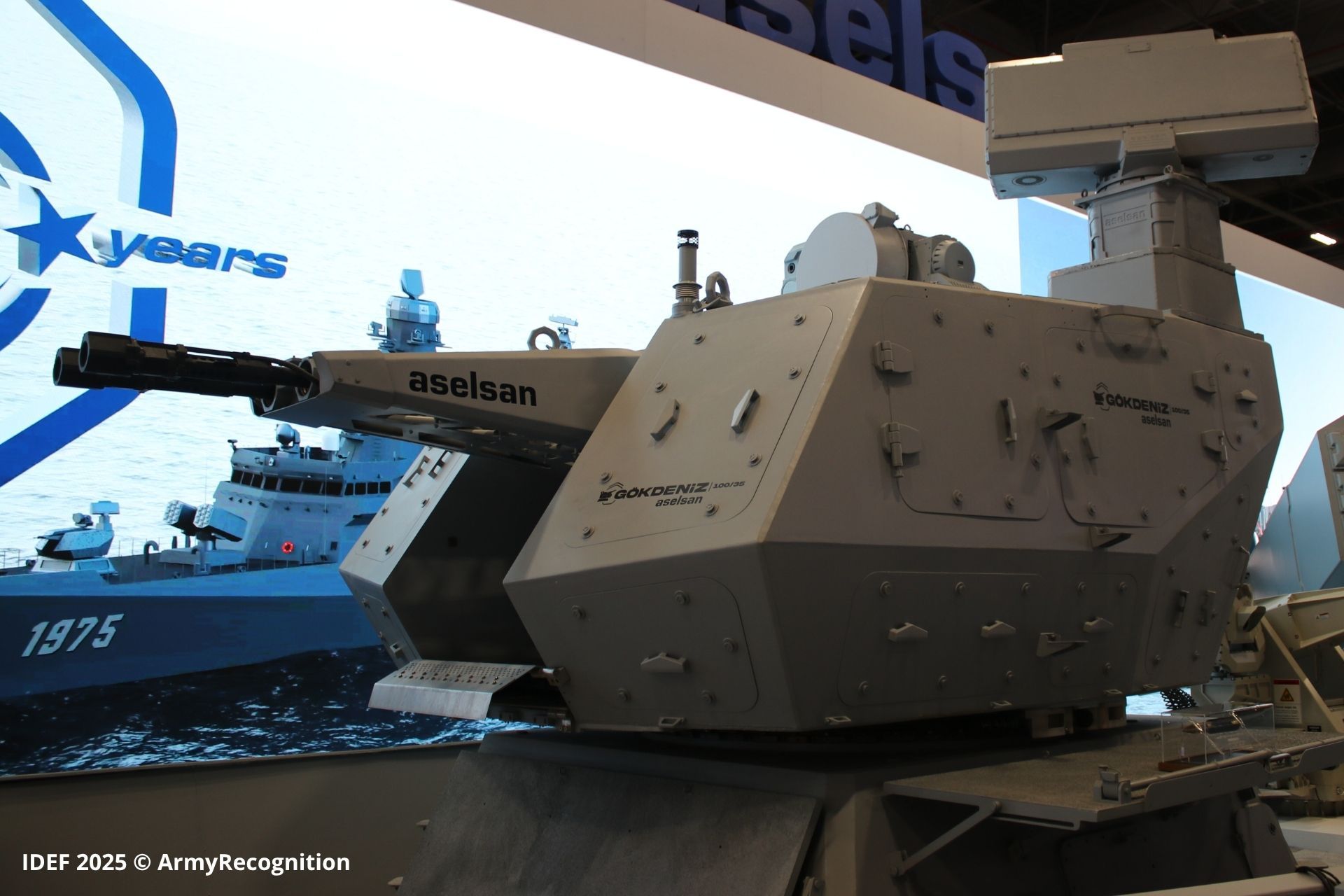
Equipped with a twin gun firing at a rate of 1,100 rounds per minute, the GÖKDENİZ 100/35 has an effective range of 4 km against aerial targets when used with ATOM ammunition (Picture source: Army Recognition)
The system employs an automatic linkless ammunition feed mechanism, enabling simultaneous loading of high-explosive incendiary (HEI) and airburst ammunition, with the ability to switch between types according to the nature of the threat. Primarily designed for intercepting anti-ship missiles, it is also capable of engaging helicopters, fighter aircraft, unmanned aerial vehicles (UAVs), and asymmetric surface threats. In its 100/35StA version, the system includes a three-dimensional search radar.
Equipped with a twin gun firing at a rate of 1,100 rounds per minute, the GÖKDENİZ 100/35 has an effective range of 4 km against aerial targets when used with ATOM ammunition. During qualification trials, the system demonstrated fully autonomous detection, tracking, and firing capabilities under realistic scenarios, including the interception of sea-skimming targets simulating supersonic cruise missiles flying at speeds over 180 m/s.
Manufactured by Aselsan, a key defense electronics provider in the Republic of Türkiye, the GÖKDENİZ 100/35 fits into a broader national strategy focused on industrial development and the enhancement of Türkiye’s naval defense capabilities. Its increasing deployment across Turkish Navy surface units, combined with interest from several foreign navies in a modular, stand-alone CIWS, indicates an intent to expand the system’s reach beyond the domestic context. It reflects a regional and international dissemination approach within the naval defense sector.
The GÖKDENİZ 100/35 is designed to meet evolving requirements for close-in protection of naval platforms facing an increasingly dense, fast, and diverse array of threats. In the current maritime environment, characterized by the proliferation of low-flying anti-ship missiles, low-cost attack drones, mini-UAV swarms, and asymmetric threats from fast boats or hostile actions in littoral zones, point-defense systems have become essential to ship survivability. GÖKDENİZ operates at the critical interface between medium- or long-range area defense layers and the vessel itself, countering threats that breach initial defenses.
Its ability to engage targets at short range in saturated environments and respond within seconds through fully automated functions makes it suited for tactical contexts where human reaction time may be insufficient. This includes multiple, simultaneous attacks by sea- or air-launched cruise missiles maneuvering at high speeds with unpredictable flight paths, often combined with electronic deception tactics. Moreover, the system’s flexibility to alternate between stand-alone operation and coordinated management via the ship’s combat system allows integration across a range of platforms, from major warships such as frigates and corvettes to smaller or specialized vessels like amphibious ships and offshore patrol vessels operating in contested or grey-zone maritime spaces. This tactical positioning, bridging autonomy and system interoperability, aims to align the system with the operational demands of contemporary naval warfare, whether in symmetrical engagements or hybrid and asymmetric scenarios.