






Breaking News





HAVOC Robotic Combat Vehicle Combines Firepower and Protection with Protector 30 mm Turret and C-UAS missiles.
At DSEI 2025 in London, Milrem Robotics has officially presented in Europe its new HAVOC 8×8 Robotic Combat Vehicle (RCV). The presentation follows the model’s first unveiling earlier this year at IDEX 2025 in Abu Dhabi. For the European debut, the HAVOC is displayed with Kongsberg’s PROTECTOR Medium Calibre Turret and a set of counter-UAS missiles from Frankenburg Technologies. Together, these systems give the vehicle a 30 mm automatic cannon and a cost-effective anti-drone solution, combining direct firepower with defensive capability against aerial threats.
Follow Army Recognition on Google News at this link
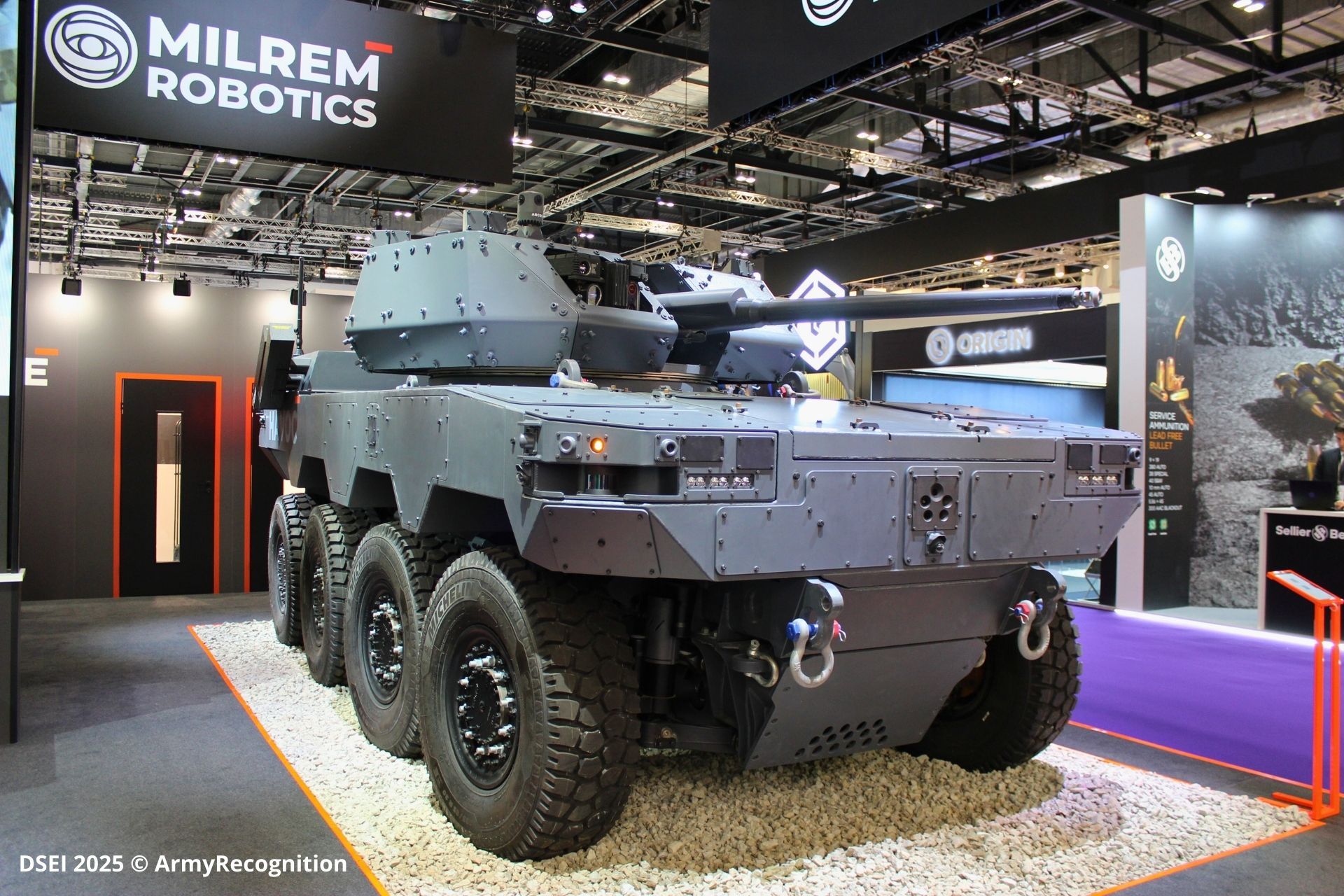
At DSEI, the HAVOC RCV is presented with Kongsberg’s PROTECTOR turret armed with a 30 mm cannon and Frankenburg counter-UAS missiles, combining ground firepower with air defence against drones. (Picture source: Army Recognition)
The HAVOC has been designed to operate in demanding conditions and to answer the current requirements of European armies. Its propulsion is based on a hybrid electric system, which is paired with advanced autonomy software that Milrem has been developing across its product line. On paved roads the HAVOC can reach speeds of up to 110 km/h, while on rough terrain it sustains about 50 km/h. Range is another important factor: Milrem states that the vehicle can travel up to 600 km on a single load of fuel and batteries, allowing extended operations without immediate resupply. At 15 tons empty weight, the HAVOC is not a light system, yet its architecture is built to negotiate gradients, vertical obstacles and water crossings, elements common on European terrain. Its pivot steering enhances agility in confined areas, while a unified autonomy package means the vehicle is compatible with other Milrem robotic systems. This approach is meant to simplify logistics and reduce overall life-cycle costs for operators.
The vehicle’s armament is one of its most notable features at DSEI. The PROTECTOR Medium Calibre Turret from Kongsberg brings a 30 mm high-rate cannon, able to deliver accurate fire across varied scenarios. The turret is already in use with several armed forces, which eases potential integration for European customers. To complement the gun, Frankenburg Technologies provides counter-UAS missiles, addressing the growing threat posed by small drones and loitering munitions on modern battlefields. These missiles offer a relatively low-cost solution for air defence, giving the HAVOC a dual role: reconnaissance and offensive firepower on one side, protection of manoeuvre units against aerial threats on the other.
Beyond the weapons and mobility, the HAVOC benefits from Milrem’s prior experience in Ukraine, where its THeMIS unmanned ground vehicle has been deployed. Feedback from those operations has shaped the HAVOC’s design. Lessons learned include the need for more intuitive controls, robust communication links resistant to jamming, and electronic warfare protection. In practice, this means the HAVOC is not only a showcase of technology but also a system refined by battlefield demands. Its communications architecture, for instance, has been reinforced to maintain connectivity in contested electromagnetic environments.
Operationally, the HAVOC fills several potential roles. It can be sent ahead of manned formations to scout hostile areas, reducing the exposure of soldiers in reconnaissance tasks. Thanks to its speed and range, it can accompany mechanised infantry or armoured units as a mobile fire support platform. Its hybrid drive gives it a lower acoustic signature than conventional vehicles, an advantage in ambush or rapid reaction missions. The presence of counter-UAS missiles adds further value, since drone swarms have become a constant factor in both conventional and irregular conflicts. In an escort role, the HAVOC could secure convoys or supply routes, protecting them from both ground and aerial ambushes.
The context in which Milrem launches this vehicle is not limited to technology. European armed forces are currently investing in new unmanned and hybrid systems. The war in Ukraine has accelerated demand for platforms that can operate autonomously, carry heavy payloads, and support forces in environments saturated with drones and electronic warfare. NATO exercises have also shown the growing importance of integrating unmanned vehicles with existing manned structures. A system like HAVOC, with its modular architecture and compatibility with other Milrem products, can be plugged into multinational frameworks more easily. This is particularly relevant for European states that operate together under NATO or EU security initiatives.
Geopolitically, the timing of the HAVOC’s introduction in Europe is significant. European countries are seeking to strengthen their ground forces in the face of Russian rearmament and continued instability in regions surrounding the continent. The hybrid nature of the HAVOC, combining mobility, autonomy, and air defence, aligns with a trend toward more adaptable combat vehicles able to operate across multiple mission sets. For smaller armies with limited budgets, one vehicle that can provide reconnaissance, fire support, and anti-drone defence represents an attractive option. For larger armies, HAVOC could serve as an auxiliary platform in high-intensity combat or as a testbed for future robotic doctrines.
Milrem Robotics positions itself as one of the few European companies fully dedicated to robotic ground systems. With HAVOC, the company is moving from lighter unmanned ground vehicles like the THeMIS to a heavier, more heavily armed class of combat robots. Its debut at DSEI shows the company’s ambition to expand its footprint on the European defence market, where demand for hybrid and autonomous vehicles is increasing. The wider adoption of such systems would not only reshape the tactics of ground operations but could also alter procurement priorities, as armies balance manned and unmanned assets. Whether HAVOC becomes a widely adopted platform or remains a niche system will depend on how European governments view the balance between cost, survivability, and capability in the years ahead.
Written By Erwan Halna du Fretay - Defense Analyst, Army Recognition Group
Erwan Halna du Fretay is a graduate of a Master’s degree in International Relations and has experience in the study of conflicts and global arms transfers. His research interests lie in security and strategic studies, particularly the dynamics of the defense industry, the evolution of military technologies, and the strategic transformation of armed forces, with a strong focus on multilateral cooperation and geopolitics.