






Breaking News






Germany equips Boxer 8x8 armored vehicle with Trophy active defense system to counter RPGs and drone strikes.
On September 9, 2025, KNDS Deutschland and EuroTrophy announced the successful integration of the Trophy Active Protection System (APS) onto the Boxer armored personnel carrier in a pre-serial prototype APC configuration. This process involved detailed design reviews, platform surveys, and the creation of a new mission module specifically engineered to host the Trophy without interfering with its radar coverage or launcher arcs.
Follow Army Recognition on Google News at this link
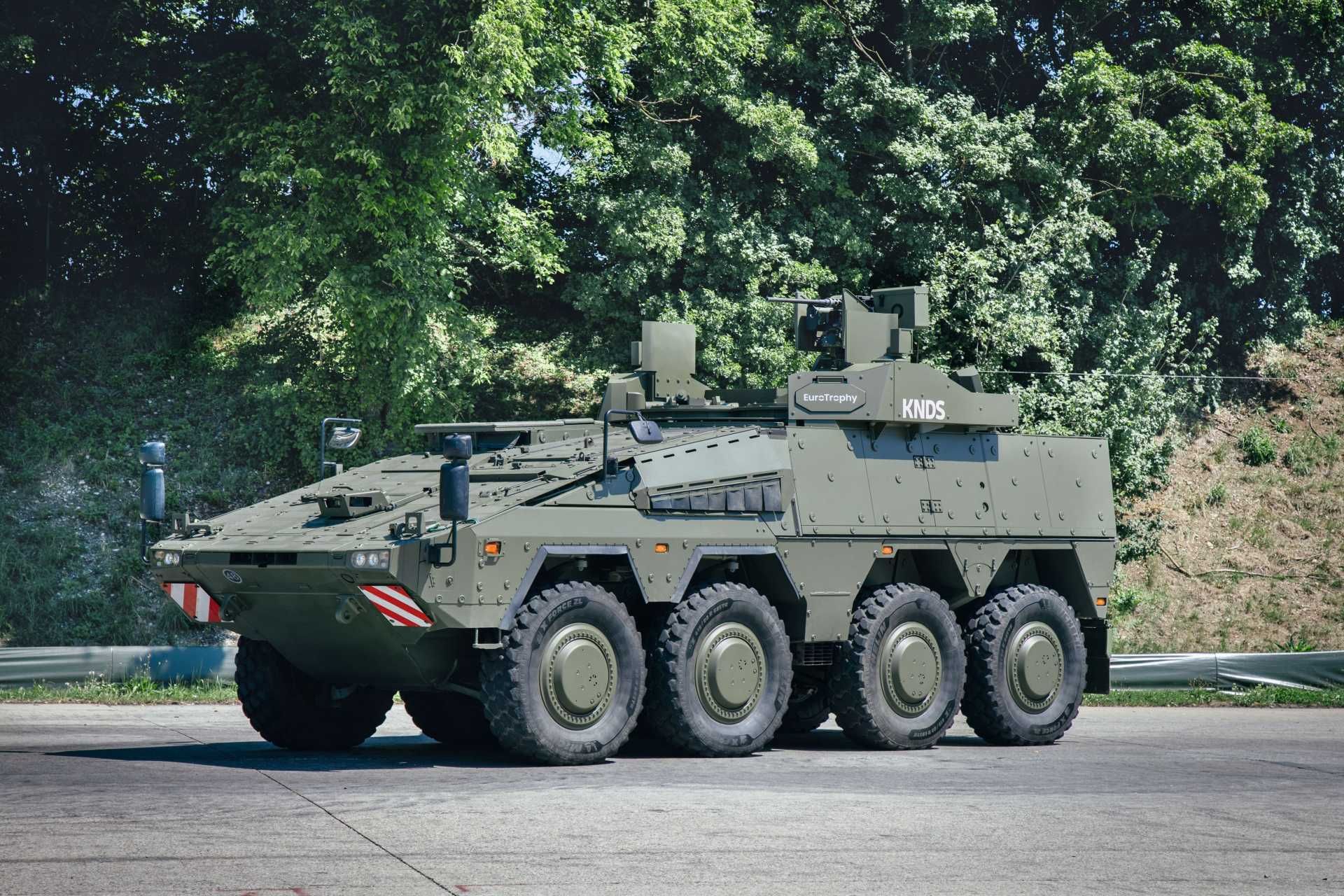
The immediate effect of this announcement for Boxer users is that a pathway now exists to field a factory-engineered APS configuration without redesigning the base vehicle. (Picture source: KNDS Deutschland)
System-level tests were carried out successfully, including calibration of the APS, which validated the integration work and prepared the prototype for the next stage of evaluation. According to both companies, live-fire trials are scheduled to take place in Germany in the coming months, with the aim of gathering firing data for use in doctrine development and technical verification. These activities are intended to reduce risk for current and future Boxer users who are evaluating options to improve survivability against evolving threats such as guided missiles, drones, and rocket-propelled grenades (RPGs). For the Boxer platform, the immediate result is the availability of an integrated APS solution based on an existing combat-proven design, tested on heavy tracked platforms but now configured for an 8×8 wheeled vehicle.
The engineering adaptation required the development of a first-of-its-kind Boxer mission module, showing that the modular design can support additional subsystems beyond traditional troop transport or command roles. By completing all system checks and calibration procedures, engineers established that the APS can be operated safely on the Boxer chassis without degrading mobility or interfering with crew systems. The next step, consisting of live-firing, will measure intercept effectiveness against real munitions while mounted on a wheeled vehicle in APC configuration, an environment different from the tracked tanks where Trophy has previously been deployed. The companies emphasize that results from these tests will inform not only technical integration but also tactical considerations, such as safety distances for nearby infantry and multi-vehicle formations.
The Trophy Active Protection System (APS) itself, which was created by the Israeli company Rafael Advanced Defense Systems, is structured around the Elta EL/M-2133 radar system, which uses four flat-panel F/G-band antennas mounted around the host platform to provide 360-degree hemispheric surveillance. Once a projectile, such as an anti-tank guided missile or RPG, is detected, the radar tracks its trajectory and relays the data to a central computer, which calculates time-to-impact and defines an intercept zone. The countermeasures are explosively formed penetrators fired from side-mounted launchers, designed to disrupt the shaped-charge jet or destroy the missile body at a safe standoff distance. This process is fully automated, requiring no crew input beyond enabling or disabling the system, and can operate both when the vehicle is stationary and when moving. In addition to interception, Trophy provides hostile fire detection, offering bearing information on the origin of the attack that can be transmitted to other vehicles through digital networks.
Several versions of Trophy exist to suit different vehicle classes. Trophy HV is the full-size configuration for main battle tanks, with an approximate system weight of 820 kilograms. Trophy MV or VPS is intended for medium-weight vehicles, weighing about 480 kilograms, while Trophy LV provides a solution for light vehicles under 8 tons with a weight of around 200 kilograms. All versions share the same engagement logic and radar architecture, but differ in mounting requirements, weight, and effector dimensions. In 2024, Rafael and EuroTrophy introduced a software upgrade that added the ability to intercept top-attack weapons and small unmanned aerial systems/drones without requiring new hardware. This enhancement allows existing operators to upgrade capabilities during maintenance cycles without changing installed weight or radar/launcher layout. Field reports indicate that the system has engaged Kornet-class ATGMs and RPG-29s successfully, though vulnerabilities remain against top-down attacks from drones dropping munitions and against close-range or multiple sequential strikes.
By 2017, Trophy-equipped platforms had already accumulated around 50,000 operational hours, and by 2023, production reached about 40 systems and 500 countermeasures per month. It has been fitted to Israeli Merkava Mk 3 and Mk 4 tanks, Namer APCs, U.S. M1A2 Abrams, Germany’s Leopard 2A7A1 and 2A8, and it is planned for integration on the British Challenger 3. The system can determine whether an incoming round will impact or miss, withholding countermeasures in the latter case but sharing data with other platforms to improve situational awareness and targeting. Despite this capability, limitations remain: Trophy cannot counter kinetic-energy penetrators, its radar can filter out very slow or vertical threats such as grenades dropped by drones, and its use of explosively formed penetrators creates a hazard zone for nearby infantry. Reports also show that adversaries have attempted to exploit these limits with very short-range RPG fire, rapid multiple missile launches, or supersonic projectiles.
The Boxer is well-suited for Trophy integration due to its modular drive-and-mission module concept, which separates the vehicle into two main sections. This architecture allows operators to install specialized mission kits for troop transport, command, ambulance, fire support, and now active protection, without redesigning the drive module. Under field conditions, swapping a Boxer mission module takes about one hour, while replacing the MTU/Allison powerpack (engine/transmission assembly) can be done in roughly 30 minutes under similar conditions. The Boxer family has undergone several upgrades across configurations designated A0 to A3, with improvements to armor protection, suspension systems, and powerpacks, based on operational feedback from deployments such as Afghanistan. The program is managed by OCCAR, with ARTEC GmbH responsible for production and parent companies KNDS Deutschland and Rheinmetall providing design authority, while local production lines exist in the Netherlands and Australia. By early 2025, confirmed deliveries and orders totaled approximately 1,866 vehicles across Germany, the Netherlands, Lithuania, Australia, the UK, Ukraine, and Qatar, making the Boxer one of NATO’s most widely adopted 8×8 vehicles.
The Boxer armored vehicle program began in the early 1990s as a multinational collaboration intended to produce a modular 8×8 platform adaptable to multiple battlefield roles. Initially launched as a joint effort between Germany and France, the program expanded to include the United Kingdom in 1996 and the Netherlands in 2001. France withdrew in 1999 to pursue its own Véhicule Blindé de Combat d’Infanterie (VBCI), while the UK left in 2003 to focus on its Future Rapid Effect System before later rejoining as a customer. Despite delays, production deliveries started in 2009 after prototypes completed more than 90,000 kilometers of reliability and durability trials. The modular concept allows interchangeable mission modules mounted on a common drive module, enabling configurations such as armored personnel carrier, infantry fighting vehicle, command post, ambulance, engineer support, reconnaissance, mortar carrier, artillery fire support, and air defense variants. Each user has tailored mission modules to their national requirements, reflecting the program’s intent to cover a broad spectrum of applications ranging from troop transport to specialized combat and support functions.
Unit costs vary with configuration, with the APC version estimated between €4 and €5 million and the IFV version between €7 and €9 million. Crew and passenger capacity depend on the mission module, but APC versions typically accommodate a driver, gunner, and up to eight dismounts, while IFV and command post versions alter this layout. Armament options range from remote weapon stations mounting 7.62 mm or 12.7 mm machine guns to turrets with 30 mm autocannons, anti-tank guided missiles, or specialized indirect-fire systems. Mobility is delivered by an MTU diesel engine coupled with an Allison automatic transmission, giving a maximum road speed of about 103 kilometers per hour and an operational range of over 1,000 kilometers. The suspension and driveline have been adapted to support weight increases from additional armor and mission-specific equipment, ensuring that the vehicle maintains performance across varied terrain. Integration of advanced subsystems such as the Trophy APS highlights how the Boxer design can incorporate active protection alongside passive armor, extending survivability against anti-tank guided missiles, RPGs, drones, and top-attack munitions.
Written by Jérôme Brahy
Jérôme Brahy is a defense analyst and documentalist at Army Recognition. He specializes in naval modernization, aviation, drones, armored vehicles, and artillery, with a focus on strategic developments in the United States, China, Russia, Türkiye, and Belgium. His analyses go beyond the facts, providing context, identifying key actors, and explaining why defense news matters on a global scale.