







Breaking News




Germany and UK sign €450 million deal for new M3 amphibious bridge systems under NATO program.
Germany and the United Kingdom have signed a €450 million contract through OCCAR to acquire new M3 amphibious bridging and ferry systems from General Dynamics European Land Systems. The move restores a critical NATO river-crossing capability not modernized since 1999, enhancing European land mobility and allied interoperability.
General Dynamics European Land Systems confirmed on October 30, 2025, that Germany and the United Kingdom have jointly ordered a new fleet of M3 amphibious bridging and ferry systems valued at more than €450 million. The contract, managed through the Organization for Joint Armament Cooperation (OCCAR) under the Wide Wet Gap Crossing (WWGC) program, will replace aging platforms first delivered in 1999. Defense analysts describe the upgrade as a pivotal step for NATO’s European land forces, ensuring rapid river-crossing and heavy equipment mobility across operational theaters.
Follow Army Recognition on Google News at this link
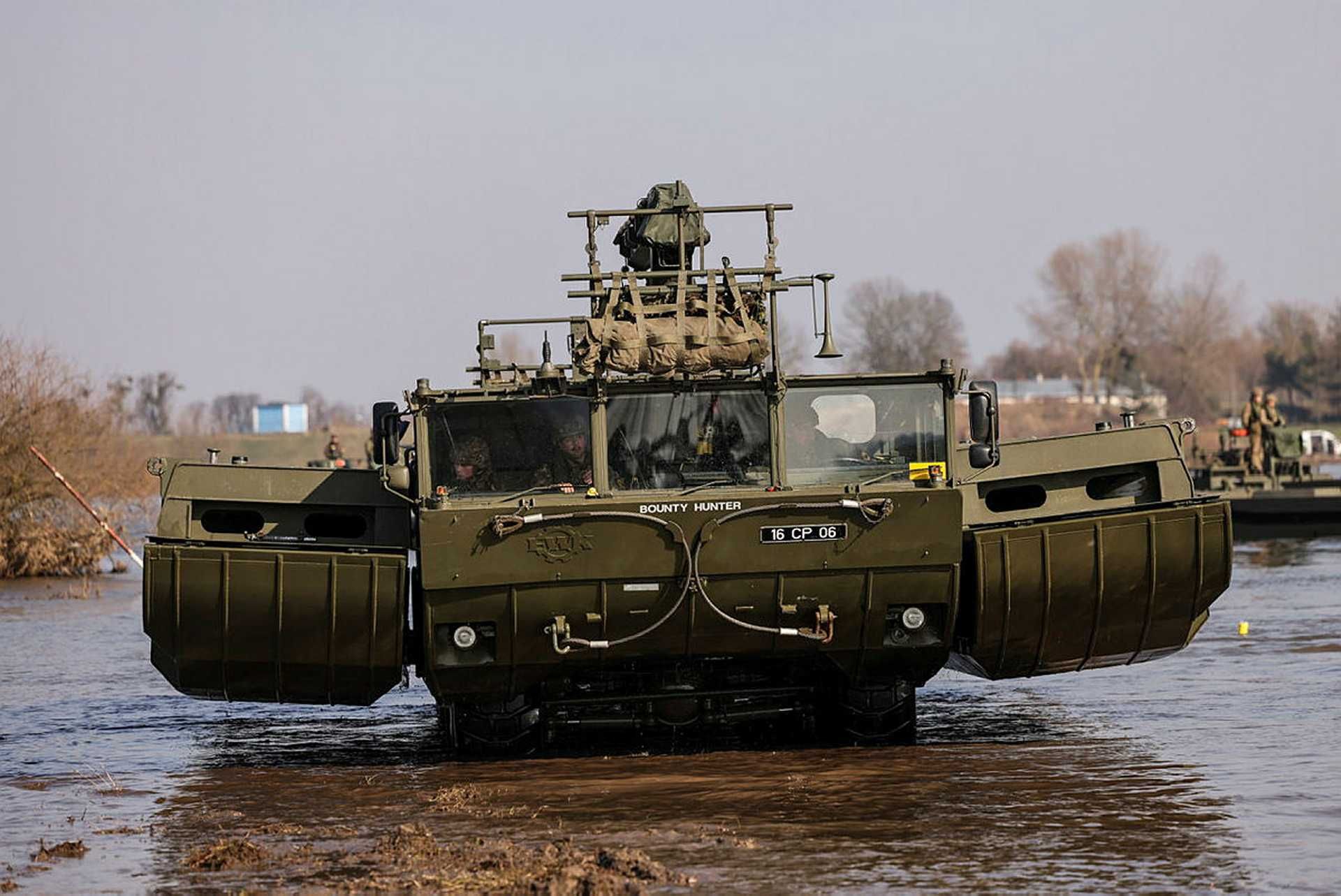
British Army M3 amphibious vehicle deploying in ferry mode during a river crossing exercise, demonstrating rapid wet gap bridging capability with full combat load under NATO operational standards. (Picture source: British MoD)
This bilateral procurement does not merely renew legacy equipment. It represents a major leap in enabling force projection and maneuverability across Europe’s river networks and flood-prone terrains. The newly ordered variant, called M3S, most actively advances GDELS’ amphibious bridging technology. It introduces significant enhancements in deployability, digitization, crew survivability, and cross-national interoperability.
The M3S is designed to perform a dual role, functioning as either a self-propelled ferry or as a bridge segment. In ferry mode, a single M3 can carry payloads up to 70 tonnes, including NATO main battle tanks. When used in bridge configuration, up to eight M3 units can be rapidly connected to span water obstacles up to 100 meters in length. Under tactical conditions requiring longer bridging solutions, up to 12 vehicles can be coupled to form a continuous structure reaching 150 meters, capable of supporting heavy armor and logistical traffic under combat conditions.
This operational flexibility is essential to NATO’s mobility posture, particularly in Eastern Europe, where large river systems and infrastructure degradation threaten the rapid deployment of forces. With the M3S, combat engineers can establish a fully functional bridge in under 30 minutes, using minimal personnel and without needing complex support equipment. The platform is road-mobile and air-transportable by C-17 or A400M aircraft, making it highly suitable for expeditionary operations.
Structurally, the M3S relies on a high-strength aluminum monocoque hull. Two steerable pump-jets allow precise navigation, even in fast currents. The vehicle features an upgraded human-machine interface, digital diagnostics, automated bridge-coupling systems, and enhanced float stability sensors. These features reduce crew workload, increase deployment speed, and enhance survivability on the modern battlefield.
Another defining feature of the M3S is its full interoperability with other NATO-standard bridging systems. These include the Standard Ribbon Bridge (SRB), Improved Ribbon Bridge (IRB), and Folding Float Bridge (FFB). This compatibility allows British and German units to operate jointly with other NATO forces in multinational scenarios and to exchange bridge sections during complex operations.
The WWGC contract also demonstrates how GDELS pursues its long-term industrial strategy in Germany. The company is expanding its Kaiserslautern facility to produce M3 systems as part of the German Growth Strategy 24/500. This initiative aims to strengthen local manufacturing capabilities and ensure secure supply chains for high-demand NATO platforms.
As the strategic environment in Europe becomes more volatile and military planners emphasize operational mobility (the ability of forces to move quickly and efficiently), the ability to cross wet gaps (rivers or flooded areas) quickly and securely has gained renewed importance. Amphibious bridging is no longer viewed as a secondary engineering task. It is now recognized as a core enabler of fast, decisive operations and theater-wide logistics (supply and transport across a combat zone).
Germany and the United Kingdom are sending a clear signal with this contract. Mobility is now a priority, alongside firepower and protection. With the M3S, both nations equip their forces with bridging systems. These provide speed, interoperability, and resilience across many mission profiles. These bridges are not simply engineering assets. They are strategic tools that enable forward movement, reinforce deterrence, and ensure freedom of maneuver in NATO’s most challenging operational theaters.
Written by Alain Servaes – Chief Editor, Army Recognition Group
Alain Servaes is a former infantry non-commissioned officer and the founder of Army Recognition. With over 20 years in defense journalism, he provides expert analysis on military equipment, NATO operations, and the global defense industry.