






Breaking News






France’s Second Missile Artillery Regiment Signals Shift to Stronger NATO Fire Support by 2030.
On, July 9th, 2025, General Pierre Schill, Chief of Staff of the French Army, presented to the National Assembly’s Defense Committee an ambitious plan to create a second missile artillery regiment, as reported by Assemblee Nationale de France. This announcement comes amid growing NATO requirements and evolving threats that outpace the French Army’s current rocket artillery capabilities. With only nine LRU (M270 MLRS) systems in service, France’s single regiment is seen as insufficient for credible deterrence and modern high-intensity warfare. The formation of an additional regiment is intended to strengthen long-range fire support for the new combat corps France aims to deploy by 2030, marking a pivotal moment in the country’s defense posture within the Alliance.
Follow Army Recognition on Google News at this link
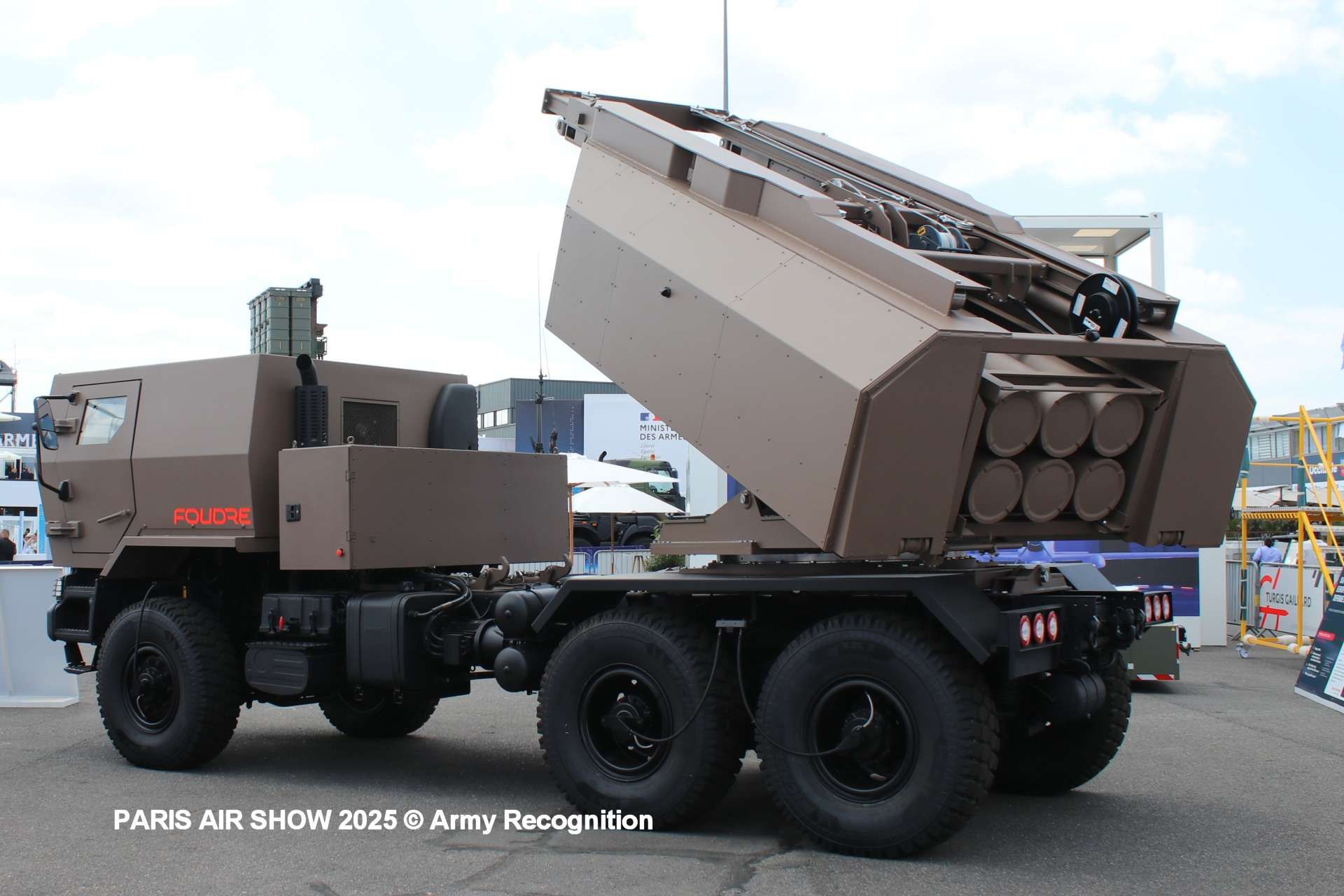
Strategically, reinforcing long-range rocket artillery capabilities through the Foudre system significantly strengthens France’s credibility as a core pillar of NATO’s deterrence posture on the eastern flank (Picture source: Army recognition Group)
To meet its objectives, the French Army is weighing several procurement paths, notably the introduction of the Foudre system developed by Turgis & Gaillard. First showcased at Le Bourget, Foudre is positioned as a fully French multiple launch rocket system in the same niche as the American HIMARS, offering NATO interoperability with the advantage of national industrial autonomy. Other leading defense companies, including Thales, are also expected to present solutions that can deliver the required 15 to 30 new launchers and compatible guided munitions, all within the Ministry of Defense’s €600 million budget envelope for long-range ground strikes under the FLPT program.
The French Army’s operational doctrine is clearly evolving towards stronger long-range precision strike capabilities, moving beyond its limited legacy fleet of nine LRU systems. By 2030, the goal is to have 13 launchers operational, ramping up to 26 by 2035, yet this still falls short of the 48 units some parliamentary reports deem necessary for credible deterrence. Historically, France has underinvested in this segment compared to NATO peers, but the pivot reflects lessons from recent conflicts highlighting the decisive role of rocket artillery in high-intensity operations. The Army’s plans also include extending the life of its current LRU launchers to avoid a capability gap before next-generation systems are fielded.
Compared to systems like the American HIMARS, the future Foudre launcher is expected to provide France with a more sovereign and flexible solution, tailored to national operational concepts and European theatres. Designed for rapid deployment, precision strikes, and modularity, the Foudre stands out by integrating fully French-made components, including its command and control systems, fire-control network, and chassis. As reported by Army Recognition, its compatibility with a broad range of guided munitions, from standard 227 mm rockets to future long-range cruise missiles, gives it a clear advantage for deep-strike missions within NATO frameworks. While HIMARS has demonstrated its combat effectiveness on the Ukrainian battlefield, the Foudre promises to deliver similar capabilities without the export restrictions or dependence on foreign supply chains, reinforcing France’s industrial base and securing critical technology sovereignty.
Strategically, reinforcing long-range rocket artillery capabilities through the Foudre system significantly strengthens France’s credibility as a core pillar of NATO’s deterrence posture on the eastern flank. By fielding a second regiment equipped with modern, mobile, and precise launchers, the French Army enhances the Alliance’s capacity for corps-level fire support and rapid deep fires, a capability gap highlighted by recent high-intensity conflicts. This also carries substantial geopolitical and geostrategic weight, sending a strong signal of France’s determination to invest in collective security and adapt its force structures to evolving threats. Ultimately, the deployment of a sovereign system like Foudre underpins France’s vision of greater European strategic autonomy while remaining firmly embedded in NATO’s integrated defense framework.
The planned expansion is underpinned by a significant financial commitment: a €600 million budget for new launchers and ammunition. While Turgis & Gaillard’s Foudre system remains a strong contender, no contract has yet been finalized, leaving room for competition among national defense suppliers. The last major contract in this domain was the modernization and limited life extension of the current LRU systems, which are managed by the SIMMT to bridge the gap until 2030. Personnel recruitment is another key factor, as the new regiment will require about 800 trained artillerymen, a challenge given the ongoing reform of the French Army and the pressing need to retain technical specialists.
This decision to double France’s missile artillery regiments reflects a profound adaptation to the realities of modern warfare and NATO’s collective defense needs. By reinforcing its long-range strike capability with a credible second regiment and a sovereign launcher solution, France is positioning itself to play a pivotal role in the Alliance’s future corps-level operations while safeguarding national industrial interests.