






Breaking News






FEINDEF 2025: Nammo Presents Ramjet-Propelled 155mm Artillery Shell Enabling Supersonic Precision Strikes at 150 km.
On May 12, 2025, at the FEINDEF defense exhibition in Madrid, Norwegian company Nammo unveiled the 155 mm Ramjet artillery shell, an innovative blend of artillery and missile technologies. This 155mm shell uses a solid fuel ramjet propulsion system to achieve ranges up to 150 kilometers, exceeding the capabilities of traditional artillery systems. The 155 mm Ramjet artillery shell represents a major evolution in artillery design. Compatible with NATO-standard artillery systems, including L39, L52, and L58 barrels, it features a propulsion system that activates post-launch, sustaining high-speed flight over extreme distances. Its integrated guidance system ensures pinpoint accuracy, allowing strikes on both stationary and mobile targets far beyond the reach of legacy systems. This significantly reduces exposure to enemy counter-battery fire and provides forces with a substantial tactical advantage in high-threat environments.
Follow Army Recognition on Google News at this link
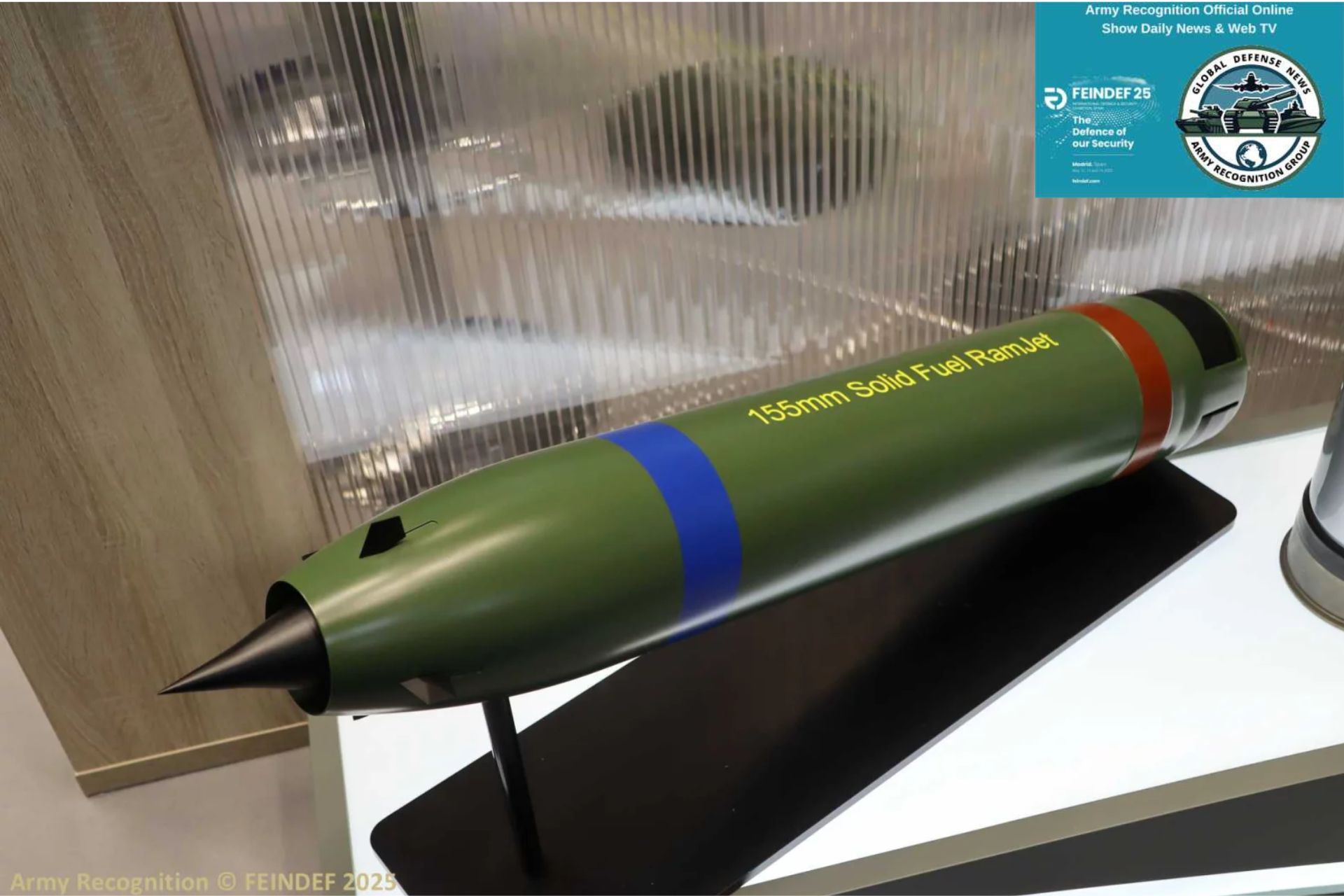
The 155 mm ramjet artillery shell is the centerpiece of Nammo’s broader push to extend artillery range (Picture source: Army Recognition)
At FEINDEF 2025, Nammo presented a tactical illustration showcasing the operational versatility of its 155 mm ramjet artillery shell in a northern theater. The scenario covered Lapland, northern Finland, and extended into Norwegian and Russian border zones, emphasizing long-range strike capabilities. A red circle depicted a 100 km strike radius, an area of approximately 31,415 km², highlighting key operational scenarios. These included a precise strike at 90 km to the east, a saturation fire zone at 40 km to the southeast, a naval target to the northwest, and an F-35 aircraft designating targets from the air. The presentation underscored the system’s seamless integration across land, sea, and air domains, reinforcing its role in future multidomain operations.
The 155 mm ramjet artillery shell is the centerpiece of Nammo’s broader push to extend artillery range. Alongside this flagship system, Nammo is also developing two additional 155mm artillery shells: the HE-LR, a guided, rocket-assisted projectile with a range of 70–85 km, and the HE-ER, an extended-range round with a base bleed unit enabling strikes beyond 40 km. The HE-ER has already been approved for use by the Norwegian Armed Forces and selected by Finland for its K9 Thunder systems. While less ambitious than its siblings, the HE-ER has the potential for widespread adoption, effectively doubling the range of standard 20 km shells without any platform modification.
Nammo’s Vice President for Large Caliber Ammunition, Thomas Danbolt, emphasizes the strategic implications of range superiority: “If you can shoot much farther than your opponent, you negate the threat of counter-battery fire. Your own artillery remains safe, while you strike enemy positions with impunity. This kind of overmatch can significantly shift battlefield dynamics.” He adds that Western armies are rediscovering the importance of land-based fires, especially in light of advances made by Russian artillery systems. The U.S. Army, in particular, is prioritizing the modernization of its artillery capabilities, seeking solutions that combine long range, precision, and operational affordability.
Nammo’s legacy in tactical propulsion provides a robust foundation for these developments. Since the early 1960s, Nammo has specialized in rocket motors for short- and medium-range air-to-air missiles and boosters for naval missiles, both with and without thrust vector control (TVC). Its product portfolio includes propulsion systems for key NATO missile programs such as: AMRAAM and ESSM (Raytheon), IRIS-T, IRIS-T SLM, IDAS, and AIM-9L Sidewinder (Diehl Defence), Exocet MM40 Block 3 (MBDA), etc.
The 155 mm ramjet artillery shell exemplifies this technological depth. With a range up to 150 km, it surpasses conventional artillery by a factor of five to eight, offering guided precision that offsets its smaller payload with greater lethality. Danbolt describes it as “a hybrid between an artillery shell and a missile,” capable of striking a target with the accuracy of hitting the center of a football field. According to Danbolt, “Our two longest-range products, the 80 km and 150 km shells, are specialized tools. But the 40 km+ HE-ER round might have the greatest battlefield impact, because it is easy to adopt across existing systems and can instantly double strike range.”
From a strategic perspective, such capabilities are particularly relevant to NATO member states in the Nordic and Baltic regions. These countries require rapid-response, long-range firepower that can operate independently of air support, particularly in sparsely populated or Arctic zones where air coverage may be limited. Long-range precision artillery offers a credible deterrent against territorial incursions and supports persistent presence in remote areas, while enabling deep fires as part of a NATO-integrated multidomain operations architecture.
Although specific budgetary figures for the the 155 mm ramjet artillery shell have not been disclosed, the U.S. Army’s continued investment in ERAMS and related technologies highlights a broader commitment to regaining overmatch in artillery. Following successful test campaigns and growing international interest, the 155 mm ramjet artillery shell is approaching operational readiness. As it transitions from development to deployment, it is poised to redefine NATO’s artillery doctrine, offering an unprecedented combination of reach, precision, and strategic versatility.