










Exclusive Report: Could Hard Landing of French Made Tiger Attack Helicopter Push Australia to Accelerate U.S. AH-64 Acquisition?.
On July 16, 2025, during the multinational Exercise Talisman Sabre, an Australian Army Tiger Armed Reconnaissance Helicopter (ARH) conducted a hard landing at the Bradshaw Training Area in the Northern Territory. Although both crew members were unharmed, the incident resulted in the immediate grounding of the remaining Tiger fleet and triggered a comprehensive safety investigation by the Defence Flight Safety Bureau. The event has reignited long-standing concerns over the platform’s structural integrity, maintainability, and operational reliability in tropical and austere environments.
Follow Army Recognition on Google News at this link

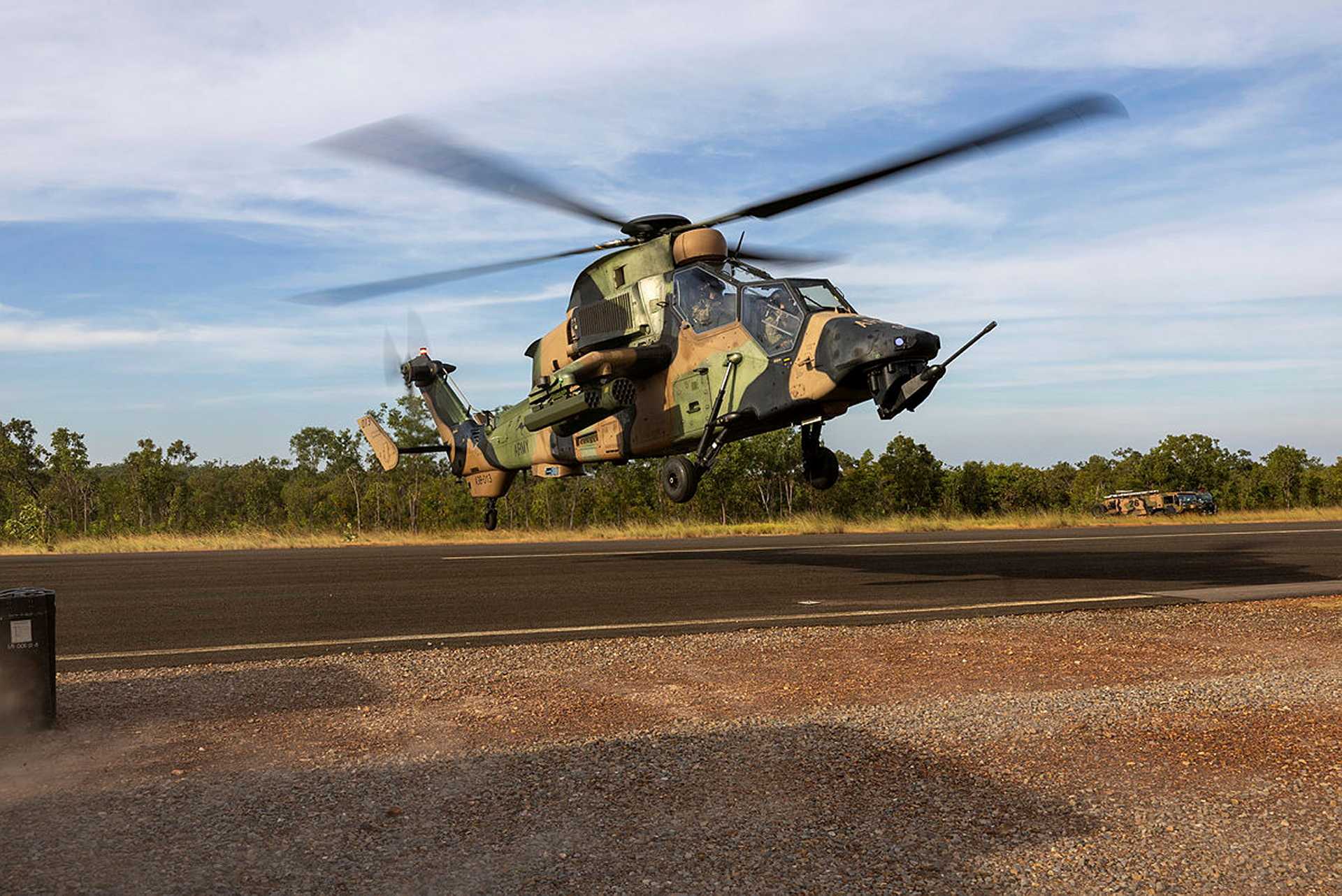
An Australian Army Eurocopter Tiger ARH attack helicopter in flight during a training mission, illustrating the platform currently under review following a hard landing incident at Bradshaw Training Area during Exercise Talisman Sabre 2025. (Picture source: Australia MoD)
Australia originally acquired 22 Tiger ARH helicopters in a 2001 contract under Project AIR 87 Phase 2 from the Franco-German manufacturer Eurocopter, now Airbus Helicopters. The aircraft, based on the Tiger HAP variant used by France, was adapted to meet Australian Army operational requirements. Modifications included integration of the Lockheed Martin AGM-114 Hellfire II missile system, a roof-mounted laser designator, improved datalinks, and the Mistral air-to-air missile. Powered by twin MTR390 turboshaft engines producing over 2,000 shp, the Tiger ARH has a top speed of 290 km/h and a combat radius of approximately 800 km. Its primary armament includes a 30mm Nexter cannon, 70mm rockets, and guided missiles suitable for anti-armor and close air support missions.
Despite its sophisticated configuration, the Tiger ARH has faced persistent performance, sustainment, and upgradeability challenges. The aircraft was originally expected to reach Final Operational Capability by 2009, but delays in software development, systems integration, and logistical support pushed that milestone back to 2016. The platform suffered from recurring issues such as cockpit instability, flight software faults, and a reliance on overseas support for critical maintenance, especially for powertrain components. The lack of sovereign repair authority and logistical autonomy limited its operational availability throughout its service life.
Following the Bradshaw incident, technical teams have launched detailed inspections focusing on potential stress damage in the rotor mast and landing gear assemblies. The Tiger's composite airframe, while lightweight and stealth-enhancing, may be vulnerable to fatigue stress and microfractures in high-tempo or rugged operational environments. These concerns are not new, having been raised after a 2019 emergency landing in Queensland and the 2024 fatal crash of a German Tiger in Mali, which led to temporary grounding of the platform across several allied forces.
This hard landing coincides with the Australian Defence Force's transition to the American-made Boeing AH-64E Apache Guardian under the LAND 4503 Armed Reconnaissance Capability program. Valued at 4.5 billion dollars, the contract will see 29 Apache helicopters delivered beginning in late 2025, along with weapons, simulation systems, and a long-term sustainment package managed by Boeing Defence Australia. The Apache brings a mature, battlefield-proven platform with advanced digital avionics, sensor fusion, and superior survivability. Its Longbow radar, manned-unmanned teaming, and robust support infrastructure offer significant advantages in tropical and maritime environments.
The AH-64E Apache Guardian represents the latest and most advanced generation of the Apache attack helicopter family. Developed by the American Company Boeing, it features upgraded GE T700-GE-701D engines, advanced composite rotor blades, and a fully integrated open systems avionics architecture. The AH-64E is equipped with the AN/APG-78 Longbow fire control radar, Manned-Unmanned Teaming (MUM-T) capability allowing control of UAVs from the cockpit, and advanced data networking for real-time battlefield awareness. With improved survivability, range, and payload capacity, the AH-64E is optimized for multi-domain operations and is currently the U.S. Army’s frontline attack helicopter, widely exported to allied forces seeking a mature and combat-proven platform.
Rotary-wing operations in the Northern Territory and Indo-Pacific regions demand high environmental resilience. Conditions such as extreme heat, salt-laden air, and abrasive dust increase mechanical wear on airframes and degrade electronics faster than in temperate regions. The Tiger ARH, designed for European climates, has consistently demonstrated limitations under these conditions. The Apache, by contrast, is engineered to withstand harsher climates and high-operational tempo deployments, aligning better with Australia's strategic posture and future readiness objectives.
The Bradshaw incident serves as both a cautionary episode and a validation of Australia’s rotary-wing modernization strategy. With Apache integration accelerating and Tiger flight hours likely to be curtailed, the Australian Army is poised to complete a generational transformation of its armed reconnaissance capability, focused on interoperability, combat durability, and sustained availability in high-threat and expeditionary operations.
The timing of the Bradshaw incident raises a key question for Australian defence planners: could this hard landing of the Tiger helicopter accelerate the delivery schedule of the AH-64E Apache Guardian? While the current LAND 4503 timeline sets initial deliveries for late 2025, the grounding of the Tiger fleet and operational gaps emerging during exercises such as Talisman Sabre may force an expedited acquisition path. Discussions within Defence and industry sources suggest that contingency options for earlier airframe availability, additional U.S. Foreign Military Sales support, or the temporary assignment of U.S.-based aircraft for training purposes are being evaluated. An acceleration would reduce the strategic risk of capability shortfalls and ensure that Army Aviation remains fully mission-ready during the transition period.
.