






Breaking News






Egypt’s EIFDS installs anti-drone mesh on Rhino Guard GXR-BR7 armored personnel carrier.
EIFDS presented the Rhino Guard GXR-BR7 armored personnel carrier at EDEX 2025 with a complete anti-drone mesh installation covering the roof, sides, turret ring, and external components.
At EDEX 2025, the Egyptian company Eagles International for Defense Systems (EIFDS) presented a Rhino Guard GXR-BR7 armored personnel carrier that had been completely covered with anti-drone mesh, creating a structure around the vehicle similar to those seen in Ukraine. The Rhino Guard GXR-BR7 exhibited a full standoff grid around the roof, sides, windows, turret opening, and external components, likely to illustrate how armored vehicles are increasingly vulnerable to first-person-view (FPV) drones and small loitering munitions that approach from above or at shallow angles.
Follow Army Recognition on Google News at this link
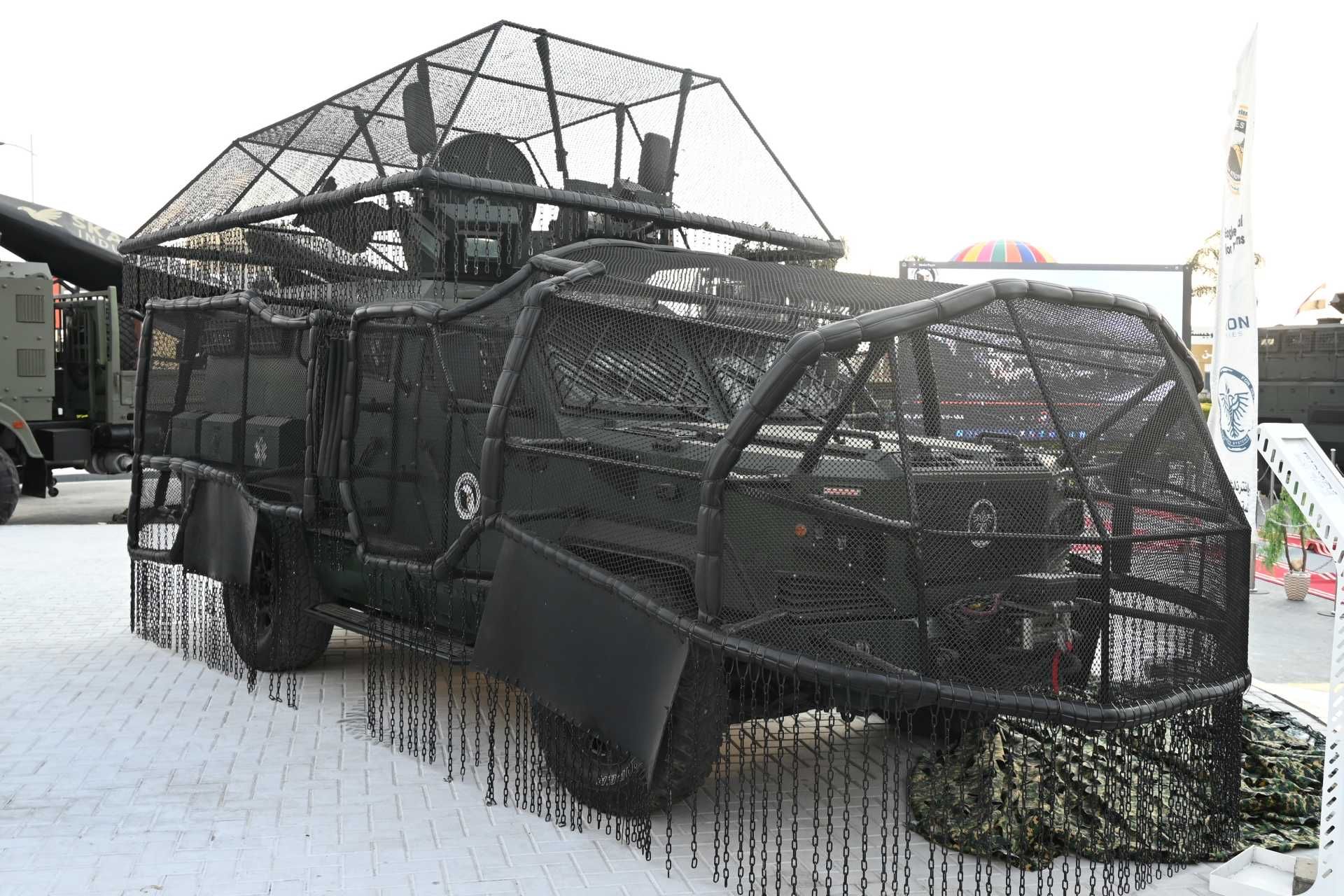
The intensification of drone attacks in Ukraine has led to a rapid expansion in the use of anti-drone mesh and cope cages to force incoming kamikaze drones to detonate or malfunction before reaching the vehicle’s most vulnerable surfaces. (Picture source: Army Recognition)
The Rhino Guard GXR-BR7 that appeared at EDEX 2025 is a light armored personnel carrier based on a Toyota Land Cruiser 300 chassis and equipped with an open-top rotary turret intended for a 7.62 mm PKT machine gun, with the option to mount a 12.7x108 mm DShK heavy machine gun in the same turret ring. The GXR-BR7 features five doors, two front crew seats, and two anti-blast seats in the rear, accompanied by side gun ports, rear gun ports, and a front glass gun port for firing from inside the armored compartment. The anti-drone mesh encircled the entire upper structure and extended around the turret opening, the armored glass panels protected by steel frames, the radiator area, the engine compartment, and the sidewalls of the vehicle to serve as a physical barrier against incoming FPV drones or munitions. The APC also integrated cameras at the rear, at the front, and inside the cabin, which were connected to a 10-inch LCD display, together with a military dashboard control unit, heavy-duty bumpers, LED flashers, strobe lights, search lights, fuel tank protection, and an electric 12,000 lbs winch.
EIFDS specifies that the Rhino Guard GXR-BR7 provides ballistic protection levels compliant with European CEN 1522/23 and CEN 1063 standards, rated at FB7 for opaque parts and BR7 for transparent areas, covering 7.62x51 mm NATO ball at 830 mps plus or minus 10 mps and multiple armor piercing threats at several oblique angles. This ballistic protection also includes resistance to 5.56x45 mm SS109, 5.45x39 mm Kalashnikov, 7.62x39 mm Kalashnikov, 7.62x51 mm NATO ball, and 7.62x51 mm AP rifle ammunition. Transparent sections are described as able to withstand 7.62x39 mm AK-47 soft core, 5.45x39.5 mm AP, 5.56x45 mm SS109 or M855 from M16A2, and 7.62x51 mm NATO rifle ammunition, with the glass installed in ballistic steel frames to prevent angled penetration. The Rhino Guard GXR-BR7 is also rated to survive the simultaneous detonation of two DM51 hand grenades above or beneath the vehicle, two HG85 fragmentation grenades under the front and rear passenger seats, and two DM31 anti-personnel land mines under the same seating positions. The anti-blast floor is fitted with at least 4.5 mm 400 BRN steel sheet attached with continuous welds to provide additional resistance. The armored grille located at the front protects the radiator to B7 level while allowing airflow, with added fans installed to prevent overheating during operations.
The manufacturing approach described for the Rhino Guard GXR-BR7 emphasizes the use of a complete self-supporting armored structure grafted onto the Toyota Land Cruiser 300 chassis to replace the original bodywork, forming a single protective cell around the crew and passengers. All opaque surfaces, including the roof, are protected with ballistic steel plates, and all pillars are reinforced so that the weight of the armored doors is transferred directly into armored structural elements rather than lightweight factory sheet metal. Hinges are replaced with engineered heavy-duty hinges that connect armor to armor, combined with check straps designed to limit door travel under heavy loads. Welding techniques are applied, specifically to minimize heat transfer to surrounding armor steel, and overlapping seams are added to maintain ballistic integrity. The vehicle includes a reinforced suspension system composed of upgraded springs, shock absorbers, and steering dampers sourced from Australian or German manufacturers, with reinforced anchoring points intended to support the mass of the armor and the cage mesh, when present. The Rhino Guard GXR-BR7 is delivered with run-flat tires rated to operate for approximately 50 km at speeds near 80 km/h after air loss, and the engine bay configuration allows the use of either diesel or petrol engines of 4.0 L or 4.5 L, paired with a six-speed automatic transmission. Additional radiator fans and upgraded electrical components are fitted to maintain the engine's functionality.
The standard equipment list for the Rhino Guard GXR-BR7 displayed at EDEX includes four side gun ports, one rear facing gun port, one front glass gun port, anti blast seating in a 2+2 configuration, run-flat wheels, jerry cans, heavy duty jack, tool kit, fire extinguisher, PA system and multiple lighting elements such as LED flashers, strobe lights and search lights. The APC incorporates front and rear cameras, as well as an interior camera for close-range awareness in environments where direct visibility may be obscured by armor or mesh. Additional features include a rear logistic area, fuel tank protection, a rear step, side steps, heavy-duty bumpers at front and rear, and an upgraded battery to sustain electrical systems. The open-top rotary turret is centered on a 360-degree ring mount capable of supporting machine guns in both 7.62 mm and 12.7 mm calibers, while a roof escape hatch provides an auxiliary exit. Optional equipment ranges from windshields with gun ports to remote-controlled weapon stations, additional hatches, alternative seating layouts, Hutchinson 16x8 split rim wheels, various communication systems covering VHF, UHF, and satellite bands, RF jammers for electronic countermeasures, surveillance and recording equipment, and further blast protection features.
The anti-drone mesh displayed around the Rhino Guard GXR-BR7 corresponds to techniques widely adopted in Ukraine since 2022 on military vehicles exposed to FPV drones, dropped munitions, and small loitering strikes, where metal cages, nets, or lattices are used to create spaced armor that induces premature detonation or prevents direct contact. Similar structures have appeared on Russian and Ukrainian tanks, self-propelled guns, multiple rocket launchers, Challenger 2, M1 Abrams, Leopard 2, and PT-91 tanks, M109A4 howitzers, and various lighter vehicles. Other countries have adopted comparable grids, including Israel on Merkava Barak tanks, India, China, the United Kingdom during Challenger 2 trials in January 2025, and Japan on Type 90 and Type 10 tanks in May 2025. Anti-drone meshes have also been installed above encampments, on airfields, over roads, and on fixed strategic sites such as oil refineries, with a recorded appearance even on a Russian Delta IV-class submarine in 2024. While such meshes introduce trade-offs in visibility, mobility, and evacuation speed, they continue to spread because they provide a measurable reduction in vulnerability against drone-delivered munitions, and the presence of a full cage on the Rhino Guard GXR-BR7 suggests that this type of protection is shifting from improvised adaptation to planned integration in vehicle development.
Written by Jérôme Brahy
Jérôme Brahy is a defense analyst and documentalist at Army Recognition. He specializes in naval modernization, aviation, drones, armored vehicles, and artillery, with a focus on strategic developments in the United States, China, Ukraine, Russia, Türkiye, and Belgium. His analyses go beyond the facts, providing context, identifying key actors, and explaining why defense news matters on a global scale.