






Breaking News





EDEX 2025: New K10EGY resupply vehicle to allow faster reloading for Egypt's artillery units.
Egypt publicly introduced the K10EGY resupply vehicle at EDEX 2025 alongside a complete K9A1EGY battery, providing the first full exhibition of its new artillery system.
At EDEX 2025 in Cairo, Egypt presented the first K10EGY ammunition resupply vehicle (ARV) as part of a full K9A1EGY artillery battery, marking a tangible stage in the implementation of its agreement with South Korea, showing a total of six K9 howitzers supported by K10 and K11 vehicles configured for Egyptian requirements. The K10EGY was displayed to allow a complete public view of the key system that will accompany the K9A1EGY in the Egyptian Army and Navy units.
Follow Army Recognition on Google News at this link
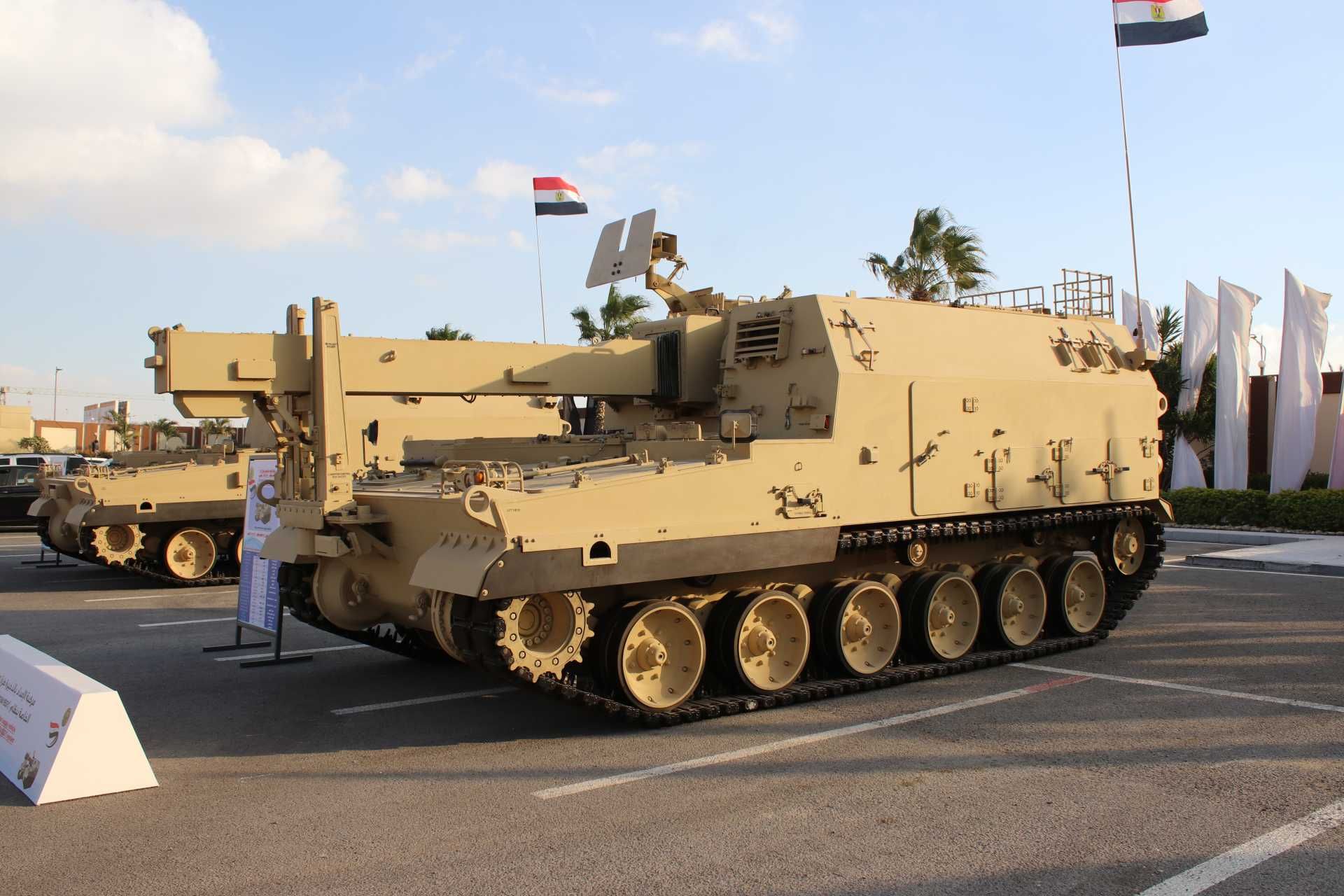
Within a K9 battery, the K10 can connect its conveyor arm to the rear of the howitzer, send ammunition automatically at a rate that exceeds manual methods, and complete the process quickly enough to allow the battery to displace before the enemy artillery can respond. (Picture source: Army Recognition)
Egypt’s path to the K10EGY included evaluations of the K9 in 2010, postponements during the Arab Spring, renewed testing in 2017 against France's CAESAr, Russia's 2S35 Koalitsiya-SV, and China's PLZ-45, and successive engagements between Egyptian and Korean industry and government officials from 2021 onward. A contract valued at about $1.6 billion was signed in February 2022 for K9A1EGY howitzers, K10EGY resupply vehicles, and K11 systems, accompanied by training and industrial cooperation. Updated figures reported later indicated 216 K9A1EGY units, 39 K10, and 51 K11, with early vehicles to be produced in Korea and later series in Egypt at a localization rate expected to exceed 60 percent. Production roles include Military Factory 200 for assembly, Military Factory 100 for cannons and armored steel, and Helwan Casting Company for SMV1000 engines, with Egyptian authorities linking this effort to ambitions to export systems to regional partners.
The K10EGY is based on the South Korean K10 ARV and adapted to operate alongside Egypt’s K9A1EGY howitzers in desert and coastal environments, with an empty weight of 41.5 tons and a combat weight of 48 tons. Its hull measures 8.5 meters in length, 3.4 meters in width, and 3.7 meters in height, with 41 centimeters of ground clearance and a tracked layout optimized for mixed terrain. A 1,000 hp diesel engine powers the vehicle, while a total track contact length on the ground of 10.4 meters improves stability and mobility on soft surfaces. The K10EGY carries 104 rounds and 504 charges, reloads itself in 50 minutes, supplies a K9EGY within 40 minutes, and transfers ammunition automatically under armor, with a top speed of 60 km/h, a controlled low speed of 24 km/h, and an operational range of 360 km, while a fording depth of 1.0 meter, and the ability to negotiate vertical slopes of 60 percent and lateral slopes of 30 percent make it suitable for mixed terrain from Sinai to the Western Desert.
The original K10 entered service in South Korea in the mid-2000s on the K9 chassis and uses an MT881Ka 500 diesel engine, hydropneumatic suspension, and an X1100 5A3 transmission with four forward and two reverse gears. It has a combat weight of about 47 tons, a three-person crew, a top speed of roughly 67 km per hour, and a range of about 360 km, while carrying the same ammunition load and transferring up to 12 rounds per minute via an automated conveyor that connects to the K9 turret. It can load ammunition in about 37 minutes and supply it in roughly 28 minutes, allowing sustained fire missions without exposing crews to external hazards. The family includes the modernized K10 AARV, the AS10 version for Australia, the AS10C2 command proposal, the K10 VIDAR for Norway, and the K11 fire direction control vehicle used by Egypt, which combines sensors, communications, and digital fire control on the same chassis to coordinate multi-battery operations.
Current operators of the K10 include South Korea with several hundred units across army and marine formations, Norway with K10 VIDAR, Turkey with 71 Poyraz vehicles derived from the K10 under the T-155 Fırtına program, and Australia with AS10 units linked to the AS9 howitzer program. Romania has ordered 36 K10 vehicles, and Egypt and its navy are acquiring K10 and K11 as part of the K9A1EGY structure. Variants such as Turkey’s Poyraz include an auxiliary power unit, the ability to run the ammunition transfer system without the main engine, a capacity of 96 shells, transfer of 48 shells in 20 minutes, and a 360 km range. South Korea also created the K56 ammunition resupply vehicle for the upgraded K55A1, replacing the earlier K66 transport approach and integrating a more automated loading arrangement to address manual limitations.
Before automated resupply vehicles like the K10, crews used 5-ton trucks and loaded heavy 155 mm shells and propellant charges manually, which required lifting more than 40 kg per shell to the height of truck beds or howitzer breeches, limiting endurance and slowing rearming cycles. Experience in South Korea, including the absence of armored resupply during the 2010 Yeonpyeong incident, showed the vulnerability of manual resupply and led to deployment ratios of one K10 per two or three K9 Thunder howitzers. In operation, the K10 connects its conveyor arm directly to the howitzer and transfers ammunition automatically, allowing the unit to fire, rearm, and displace quickly, while its armored hull and 12.7 mm machine gun support movement in contested areas and allow additional functions such as casualty transport, equipment transfer, or limited defense against nearby threats.
Worldwide, few armies field fully automated tracked ammunition resupply vehicles for 52 calibre howitzers, as earlier concepts associated with systems like XM2001 Crusader or AS90 did not progress to serial production, and some countries still use trucks or semi-automated cranes. Efforts in the United States to improve ammunition vehicles for the M109A7 and Russian work on resupply options for Koalitsiya SV indicate broader interest, but these remain at a limited scale compared to the number of fielded 52 calibre guns. Egypt’s decision to adopt the K9A1EGY, K10EGY, and K11 together, assemble them domestically, localize components such as engines, cannons, fire control systems, and armored steel, and present a complete battery at EDEX 2025 highlights its intent to integrate these systems into national artillery doctrine, border security, and coastal defense roles.
Written by Jérôme Brahy
Jérôme Brahy is a defense analyst and documentalist at Army Recognition. He specializes in naval modernization, aviation, drones, armored vehicles, and artillery, with a focus on strategic developments in the United States, China, Ukraine, Russia, Türkiye, and Belgium. His analyses go beyond the facts, providing context, identifying key actors, and explaining why defense news matters on a global scale.