






Breaking News






DSEI 2025: Roshel Senator Pickup offers counter-UAS capability in armored and modular platform.
Roshel presents at DSEI 2025 the Senator Mine Protected Pickup, a multipurpose armored vehicle developed to combine protection, modularity and mobility for modern battlefield requirements. Based on a Ford F-series heavy-duty chassis, the platform has been adapted to carry specialized payloads ranging from grenade launchers to advanced counter-uncrewed aerial systems. This new configuration positions the vehicle as a flexible solution for military and security forces that increasingly face drone-borne threats alongside conventional ambushes and improvised explosive devices.
Follow Army Recognition on Google News at this link
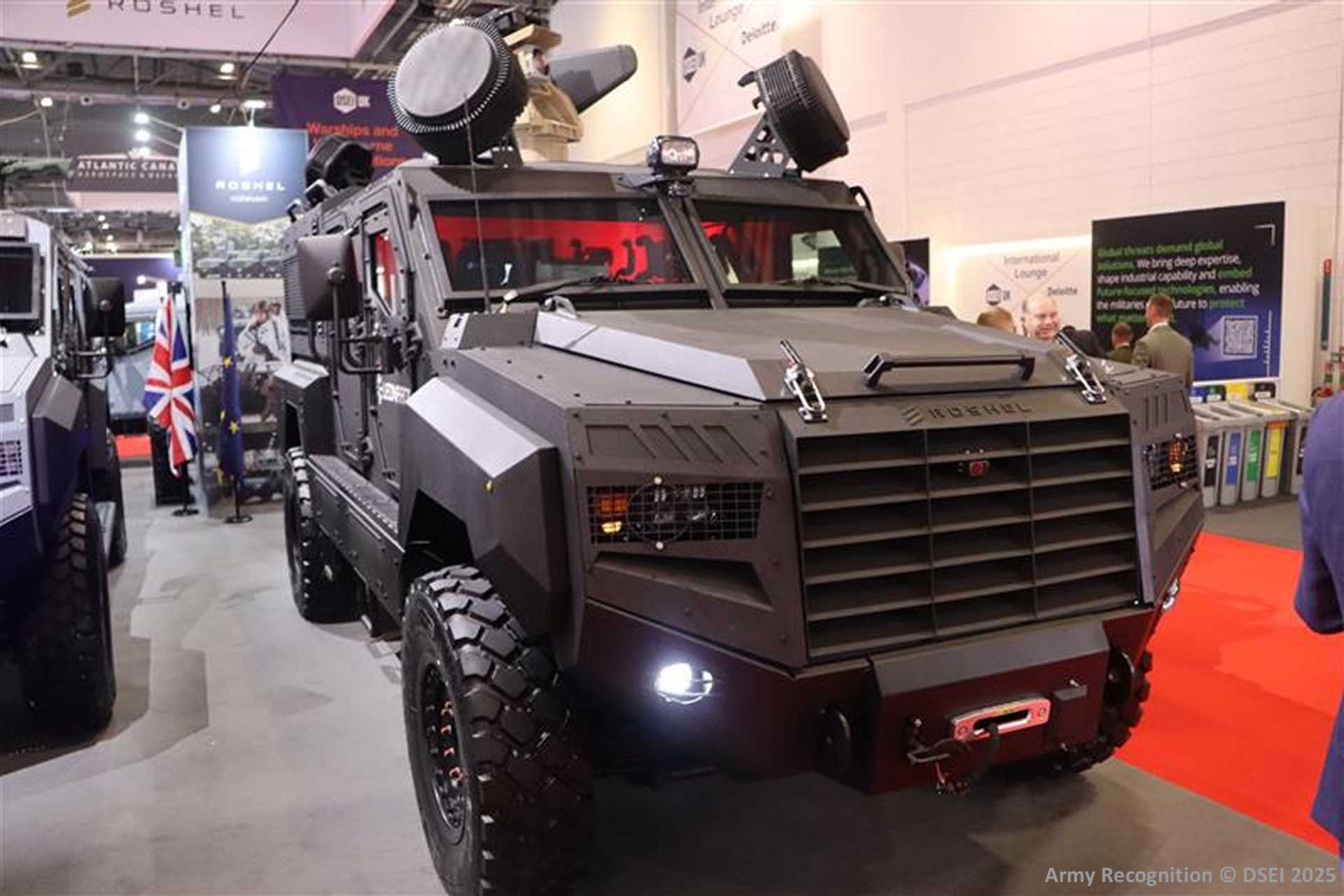
Roshel equips the Senator platform with modern electronic systems, including smart access control, fleet management, and remote connectivity features. (Picture source: Army Recognition)
The Counter-UAS variant builds upon the Senator family, which includes APC, MRAP and EOD versions, by integrating detection, tracking and neutralization systems dedicated to uncrewed aerial threats. According to Roshel, the vehicle accommodates a range of sensors and effectors designed to counter swarming drones, reconnaissance UAVs, and weaponized systems. The open architecture allows rapid integration of new equipment and effectors, making it interoperable with NATO command-and-control frameworks. In practice, this enables the Senator to function as a mobile counter-drone node within broader joint operations, providing sensor fusion, electronic disruption and kinetic response capabilities depending on mission requirements.
The protection suite remains in line with NATO STANAG 4569 AEP 55 standards, with Level 2 ballistic and Level 3 blast certification validated by Oregon Ballistic Laboratories. This certification confirms resistance against 7.62×39 mm API BZ projectiles, mine blasts of 6 kg TNT equivalent under wheel or center, a 25 kg TNT side blast, and artillery fragments from 155 mm high explosive rounds at 80 meters. The National Research Council Canada also evaluated its rollover stability, confirming the vehicle’s ability to maintain performance on steep slopes and challenging terrain.
The Senator Pickup is available in 4- and 5-seat versions, with payload capacity up to 3,500 kg supported by reinforced axles. It is powered by a 6.7L turbo diesel V8 producing 330 horsepower and 750 Nm of torque, connected to a 10-speed automatic transmission and four-wheel drive. With a length of 6,000 mm, width of 2,400 mm, and height of 2,500 mm, the vehicle’s compact but robust profile is tailored for both urban and off-road operations. Operators can request alternative petrol or high-sulfur diesel engines depending on theater of deployment.
Roshel equips the platform with modern electronic systems, including smart access control, fleet management, and remote connectivity features. Global parts availability through the Ford chassis and Roshel’s production capacity of up to 140 units per month ensure the vehicle can be supplied and maintained on a large scale.
Headquartered in Brampton, Ontario, with facilities in Canada and the United States, Roshel continues to expand the Senator family with mission-specific variants. The Counter-UAS Pickup is tailored for frontline operations where hostile drone activity is a daily challenge, combining survivability with modular integration of drone defense systems. Current applications include convoy escort under drone threat, protection of critical infrastructure against aerial surveillance, and deployment in peacekeeping missions where small UAVs have increasingly been used for reconnaissance and attacks. By providing a mobile and NATO-compliant counter-drone capability in a protected pickup format, Roshel seeks to position the Senator Pickup as a bridge between heavier MRAPs and lighter tactical vehicles, offering forces a practical tool against one of today’s fastest-growing threats.
Written by Matt Delvoye - Defense Analyst, Army Recognition
Matt Delvoye holds degrees in political science from the University of Liège and the University of Brussels, with a specialization in international relations as well as defense and security policy. He works as a defense analyst at Army Recognition, where he covers international defense events and provides daily reporting on military equipment and industry developments.