






Breaking News





DSEI 2025: NMS UK Presents Dragon Vehicle As Mobile Counter UAS Platform And Survivability Hub For Frontline Forces.
During DSEI UK 2025 in London, NMS UK presents the latest Dragon configuration as a coherent answer to the drone-saturated and EW-contested battlefield, combining a proven protected-mobility chassis with a UK-led package of sensors, effectors and signature management. The integration of KONGSBERG’s PROTECTOR RS4, MBDA’s Sky Warden, Ultra PCS’s GVA backbone and Wescom Defence’s ATMIS mobile camouflage turns a familiar workhorse into a platform that can both hide and hunt. For land forces rearming under budget pressure, the proposition is timely because it delivers layered counter-UAS effects and reduced detectability without sacrificing payload, protection or mobility. This is relevant to commanders seeking organic protection for dispersed units, convoy escorts and patrols that cannot rely on static SHORAD cover.
Follow Army Recognition on Google News at this link
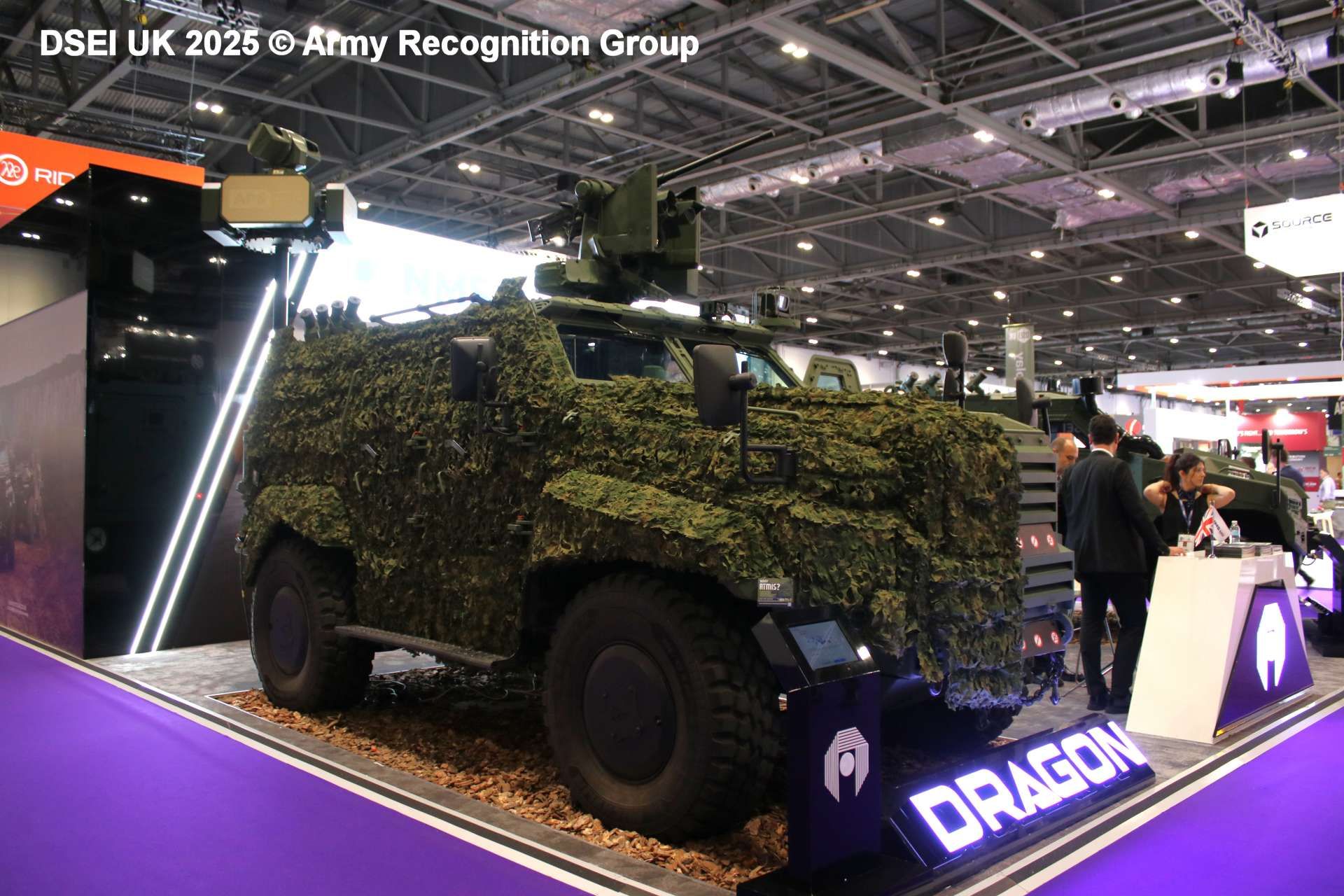
The Dragon’s ability to self-protect and form part of a mobile air-defence network allows brigades to maneuver more freely under constant aerial surveillance (Picture source: Army Recognition Group)
The Dragon base vehicle retains its hallmark of operationally proven protection and high mobility, but the step change at DSEI is systems-driven. A stabilized RS4 remote weapon station, a modular Sky Warden counter-UAS suite and an open-architecture GVA digital backbone are packaged on a single 4×4 hull and wrapped in multispectral camouflage. The result is a patrol-ready platform able to detect, classify and defeat small UAS while remaining harder to find across the visible, infrared and radar bands, preserving tempo in complex terrain and against massed aerial scouts.
KONGSBERG’s PROTECTOR RS4 adds day/night target acquisition, laser ranging and stabilized fire-on-the-move with common small- and medium-calibre weapons, giving the crew a precise kinetic response to drones, loitering munitions and ground threats. Because RS4 is widely fielded, users gain training and sustainment benefits while retaining options for growth, coaxial mounts, non-lethal modules or integration cues from the C-UAS suite. Coupled to the Sky Warden system manager, RS4 becomes the hard-kill endpoint of a layered counter-drone kill chain rather than an isolated RWS.
MBDA’s Sky Warden provides the detection-to-defeat spine for counter-UAS operations on the move. It fuses radar, EO/IR and passive RF sensors to build an air picture at vehicle level, then orchestrates soft-kill (jamming, deception) and hard-kill responses with minimal operator burden. On Dragon, this enables convoy and troop-escort profiles where the vehicle contributes to a mobile C-UAS bubble, cues its own RWS for kinetic shots, and shares tracks with nearby nodes. The practical effect is a self-contained ability to find, disrupt and, if necessary, destroy small UAS, closing an urgent gap for maneuver units.
Ultra PCS’s implementation of the Generic Vehicle Architecture underwrites the integration. Power distribution, data, human-machine interface and safety functions are standardized, allowing sensors, jammers, radios and mission computers to plug-and-play with reduced bespoke wiring and faster software spirals. This same digital backbone supports future additions, extra RF channels, new effectors, battle-management apps, without re-engineering the entire vehicle. The configuration also reflects the development pathway: a mature Dragon chassis from Nurol Makina combined with NMS UK’s local integration, test and support, leveraging a parent-subsidiary relationship to speed certification and through-life upgrades for UK and export users.
Wescom Defence’s ATMIS mobile camouflage completes the survivability layer. Designed to break up the vehicle shape and disrupt thermal and radar returns, ATMIS reduces the probability of detection by EO/IR sensors and UAS-borne seekers while helping to mask heat signature from the engine bay and exhaust. In practice, Dragon can both conduct counter-UAS operations and protect itself from detection, forcing adversary drones to work harder to acquire and hold a track. Compared with many peer 4×4 protected vehicles that add C-UAS via trailers or mission-specific variants, this Dragon fit brings signature management and layered effects onto the same mobile, patrol-ready platform.
Against similar protected-mobility offerings, the advantage here is not a single headline metric but integration depth. Many vehicles match baseline protection and off-road performance; fewer field a mature RWS tied into a modular C-UAS manager over a standards-based GVA, and then add multispectral camouflage as a default fit. That combination shortens sensor-to-shooter timelines, eases training and sustainment, and preserves growth paths for new sensors or effectors, an important discriminator as drone threats evolve faster than traditional procurement cycles.
Strategically, the partnership between NMS UK and Nurol Makina combines a combat-proven Turkish 4×4 design with UK-based integration and support, ensuring NATO compatibility and meeting European requirements. The Dragon’s ability to self-protect and form part of a mobile air-defence network allows brigades to maneuver more freely under constant aerial surveillance. Units can stay dispersed yet protected, logistics convoys reduce exposure by avoiding static halts for cover, and commanders gain a flexible tool for operating in contested electromagnetic environments without relying entirely on scarce SHORAD assets.
Written by Teoman S. Nicanci – Defense Analyst, Army Recognition Group
Teoman S. Nicanci holds degrees in Political Science, Comparative and International Politics, and International Relations and Diplomacy from leading Belgian universities, with research focused on Russian strategic behavior, defense technology, and modern warfare. He is a defense analyst at Army Recognition, specializing in the global defense industry, military armament, and emerging defense technologies.