







Breaking News




DSEI 2025: MBDA equips a Mercedes Unimog with its Sky Warden system to better protect mobile forces from drone attacks.
At the Defence and Security Equipment International (DSEI) 2025 exhibition in London, held from September 9 to 12, MBDA presented the Sky Warden system mounted on a Mercedes Unimog 4x4 as part of its broader air defence portfolio, highlighting its adaptability to different platforms. MBDA stated that Sky Warden reflects over twenty years of experience in ground-based air defence, incorporating operational feedback from multiple users.
Follow Army Recognition on Google News at this link
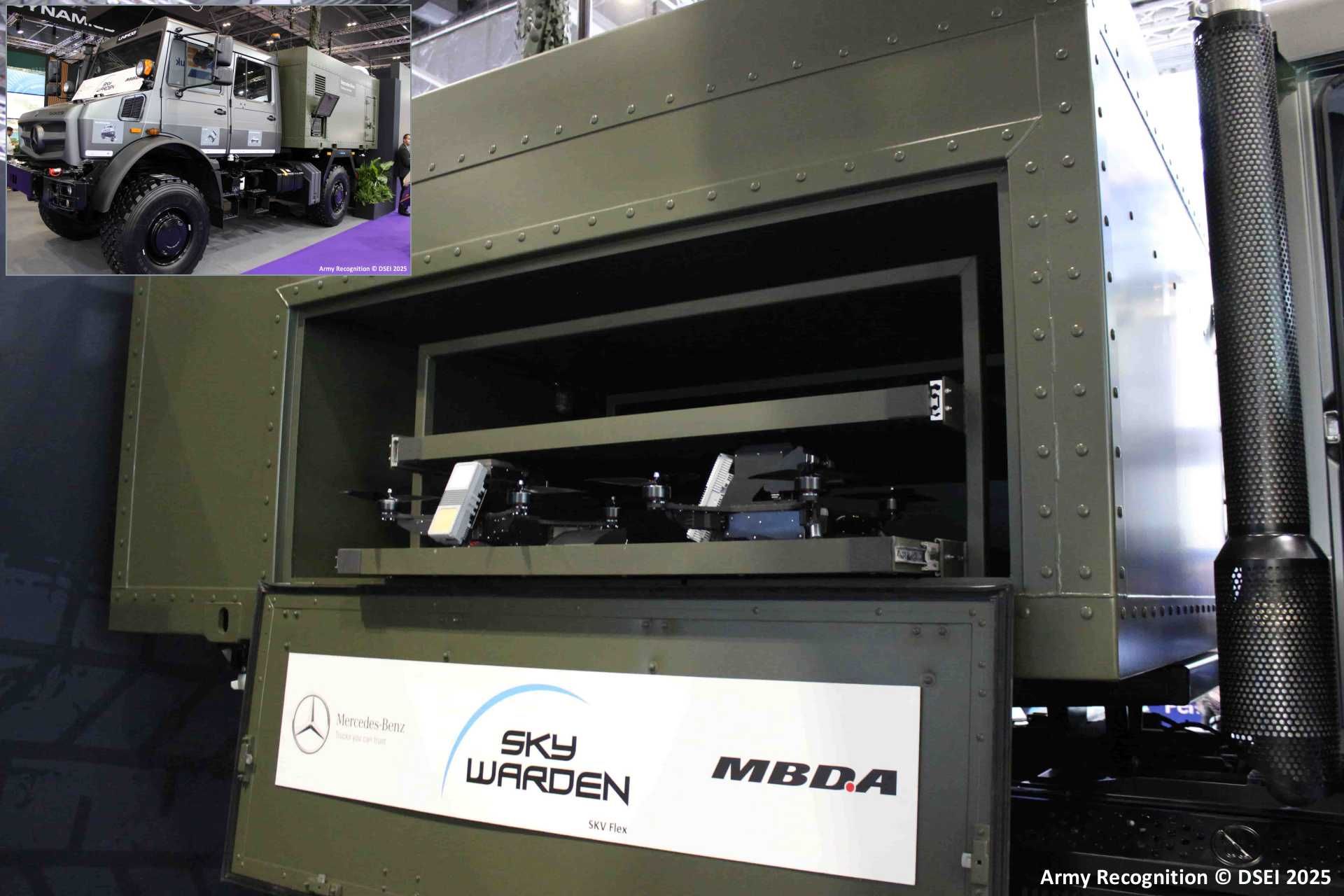
Earlier Sky Warden configurations have been shown integrated on land platforms with a mix of sensors and effectors to illustrate the system’s modularity and integration pathways. (Picture source: Army Recognition)
The Sky Warden system is designed for deployment in diverse environments, including urban, maritime, mountainous, and desert settings, and can be used to protect fixed sites, mobile and high-value assets, deployed units, and air defence formations. According to the company, Sky Warden may be deployed as a standalone capability or integrated into layered air defence networks, demonstrating flexibility for different operational contexts.
Sky Warden is built around a modular and scalable architecture that integrates a wide range of sensors and effectors to manage the full counter-uncrewed aerial system (C-UAS) kill chain. Sensors include radars, electro-optical systems, and passive radio-frequency localisers, with data fused to create a comprehensive air picture. Artificial intelligence is employed to reduce false alarms and assist with threat detection, classification, and response selection. Effectors available within the system include electronic jammers, net launchers, directed-energy lasers, hit-to-kill drones, machine guns, and the Mistral 3 very short-range air defence missile. The system manages its engagements through a Threat Evaluation and Weapons Assignment process, and it is compatible with ASTERIX and SAPIENT protocols as well as tactical datalinks such as JREAP-C or national networks, allowing integration with NATO and allied air defence structures.
Recent trials in Europe, observed by delegations from seventeen customer nations, were used by MBDA to demonstrate the operational capacity of Sky Warden. In these demonstrations, the system neutralised a variety of offensive drones with different flight profiles and kinetic characteristics. The responses included jamming communications to disable drones, deploying hunter drones to physically capture hostile UAVs, employing laser weapons for rapid engagements, and launching a Mistral 3 missile to destroy a Shahed-type drone at long range. MBDA emphasised that Sky Warden was the only system to date that has demonstrated the ability to manage the full spectrum of drone threats, from micro and reconnaissance UAVs to loitering munitions and larger Class 3 drones when equipped with Mistral missiles. The system was also presented at the Counter UAS Summit 2025 at Air Base 701 in Salon-de-Provence, where MBDA exhibited Sky Warden alongside the HELMA LP man-portable laser from CILAS, underlining its availability for both stand-alone and integrated air defence roles.
To expand the range of effectors, MBDA developed a ground-launched anti-air munition in collaboration with Fortem Technologies, incorporating Fortem’s DroneHunter technology. This concept consists of a drone carrying an independent warhead that intercepts and neutralises Class 1 and smaller Class 2 drones, as well as loitering munitions, at a lower cost than missile interceptors. The munition weighs under three kilograms and is designed to detonate directionally in close proximity to its target, with guidance assisted by onboard radar. Demonstrations of the concept have been completed, and MBDA has positioned it as a complement to Sky Warden’s existing effector suite, offering improved cost-effectiveness for engagements against low-cost or swarming drone threats. The company noted that the modular system allows rapid integration of such effectors, providing operators with more options to configure their systems for specific missions.
Another development incorporated into Sky Warden is the Hit-to-Kill (HTK) effector, created through a partnership with the French company Novadem. This solution is a compact hexacopter drone designed to intercept and destroy hostile UAVs by direct kinetic impact. The design includes a reinforced carbon-fibre structure at impact points and can achieve speeds of around 200 kilometres per hour, delivering sufficient force to neutralise small drones. It is guided by the launch vehicle in the mid-phase of engagement and transitions to autonomous terminal guidance at a distance of 200 to 300 metres from its target. The HTK drone has a range of approximately two kilometres and a short endurance of a few minutes, consistent with its high-speed interception profile. Stored in hexagonal containers with up to three drones per container and two containers per vehicle, the system allows up to six ready interceptors for rapid employment. Demonstrations of the HTK system at Technology Readiness Level 6 have been conducted for the French Defence Innovation Agency.
Sky Warden has been shown in multiple configurations to underline its modularity and ability to integrate subsystems from different suppliers. An Arquus Sherpa 4x4 vehicle-based demonstrator carried four RADA MHR RPS-42 active electronically scanned array antennas providing 360-degree coverage, detecting nano UAVs at up to five kilometres and medium-sized UAVs at up to twenty-five kilometres. Saab’s Giraffe 1X radar was also proposed as an alternative option, mounted on a telescopic mast. Other effectors integrated included the HELMA-P directed-energy laser by CILAS, with an effective range beyond one kilometre, Openworks’ SkyWall net-based capture system, and a separate vehicle carrying Mistral surface-to-air missiles. These demonstrations also included a Hornet Lite remotely controlled weapon station armed with a 7.62 mm machine gun, indicating potential evolution into C-UAS applications. Sky Warden’s command and control suite provides centralised subsystem monitoring, mission planning, rules of engagement management, embedded training, and post-mission analysis tools, with a human-machine interface designed to minimise operator workload and allow both containerised and vehicle-based deployments.
The Sky Warden programme has been involved in both national and European development initiatives. In France, MBDA partnered with Naval Group and Hologuarde in the PARADE programme launched by the Direction Générale de l’Armement, a competition valued at €350 million over eleven years to deliver counter-drone systems for the protection of national territory and major events such as the 2024 Olympic Games in Paris. Parliamentary reports noted that the number of civilian drones in France rose from 400,000 in 2017 to 2.5 million in 2021, underlining the scale of the challenge. At the European level, MBDA has been a contributor to the JEY-CUAS programme, a two-year design effort under the European Defence Industrial Development Programme 2020 with a budget of €15,003,473.08 and a maximum EU contribution of €13,500,000. The project involves thirty-eight European companies, with MBDA identified as the third-largest contributor after Leonardo and Indra, and focuses on developing a modular counter-drone system with plug-and-play reconfiguration options. Additionally, MBDA has extended the concept into the maritime domain with the Sea Warden system, first presented at Euronaval 2024. Sea Warden adapts the Sky Warden model for naval use, integrating sensors and effectors such as HELMA-P, hunter drones, jammers, Mistral 3, Akeron MP, and loitering munitions to provide layered protection against aerial and surface uncrewed threats.
Written by Jérôme Brahy
Jérôme Brahy is a defense analyst and documentalist at Army Recognition. He specializes in naval modernization, aviation, drones, armored vehicles, and artillery, with a focus on strategic developments in the United States, China, Russia, Türkiye, and Belgium. His analyses go beyond the facts, providing context, identifying key actors, and explaining why defense news matters on a global scale.