






Breaking News






Denmark signs GDELS M3 Amphibious Bridge deal to strengthen gap-crossing capability.
According to information published by General Dynamics European Land Systems (GDELS) on September 8, 2025, the Danish Ministry of Defence Acquisitions and Logistics Organisation (DALO) has signed a contract for the delivery of the M3 amphibious bridge and ferry system. The acquisition provides the Royal Danish Army with a modern, mobile solution to conduct rapid wet-gap crossings, one of the most complex and critical functions in 21st-century land warfare.
Follow Army Recognition on Google News at this link
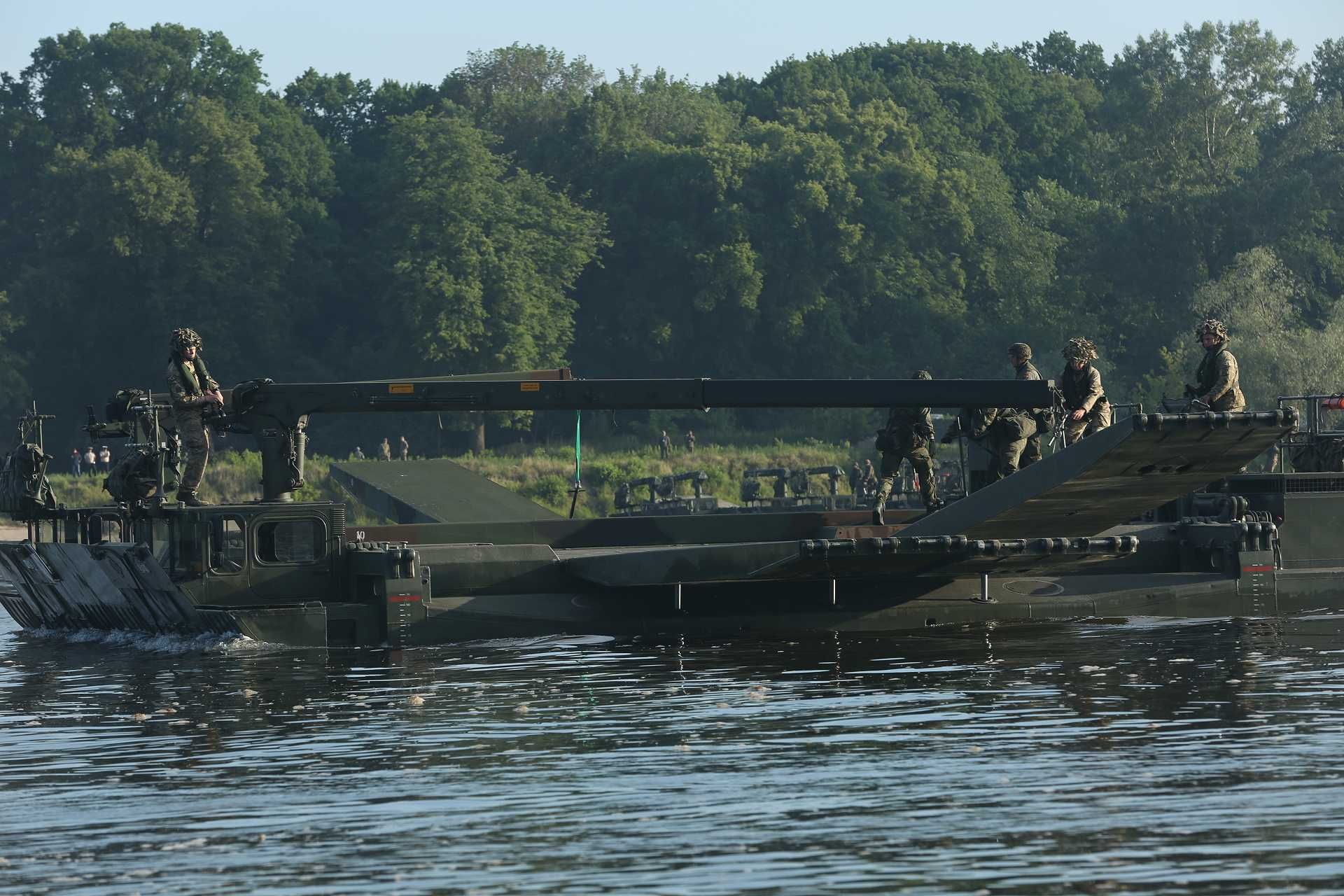
The GDELS M3 is a fully amphibious bridge and ferry system designed to rapidly transport heavy armored vehicles across water obstacles. It offers high mobility, quick deployment, and full NATO interoperability for modern combat engineering operations. (Picture source: U.S. Department of War)
Denmark’s decision to procure the GDELS (General Dynamics European Land Systems) M3 amphibious bridge and ferry system is directly tied to the evolving operational demands of NATO’s northern flank. As the alliance enhances its forward posture in the Baltic region, the ability to conduct autonomous wet-gap crossings has become a priority for armored and mechanized units. Denmark’s terrain features extensive waterways, fjords, and inland river systems, and future expeditionary operations, whether on its own soil or in support of allies, will likely involve crossing natural obstacles under time pressure and threat of interdiction. Traditional bridging assets, often dependent on static infrastructure or slow deployment, no longer meet the requirements for high-tempo, high-survivability operations in contested environments.
The M3 amphibious bridge system addresses these challenges with unmatched mobility, modularity, and interoperability. Each M3 unit operates as a 4x4 amphibious vehicle equipped with fold-out pontoons and dual water jet propulsion, capable of driving into water bodies and rapidly transitioning from road to ferry or bridge mode. Two to four units can be coupled to ferry main battle tanks and tracked infantry fighting vehicles, while up to eight units can deploy a 100-meter bridge in under ten minutes without external support vehicles or heavy cranes.
The system offers rapid on-road speeds up to 80 km/h, ensuring fast repositioning across large areas of operation. Its robust cross-country mobility and advanced suspension allow it to operate in snow, mud, and uneven terrain, supporting Denmark’s commitment to Arctic operations and northern European deployments. Operational survivability is enhanced by short deployment windows and minimal setup time, allowing units to cross and clear obstacles before enemy artillery or drone threats can concentrate on a bridging site.
Crucially, the Danish M3 fleet will be fully interoperable with NATO allies. In addition to plug-and-play compatibility with German, British, and Swedish M3 units, the Danish systems will include adapters allowing connection to NATO’s SRB, FSB, and IRB bridge families. This provides Danish engineers with flexibility during multinational operations and joint exercises, eliminating integration bottlenecks and ensuring synchronized maneuver across mixed-force deployments.
The contract also reflects Denmark’s commitment to force modernization and its role within NATO’s High Readiness Forces. By investing in fast bridging systems, Denmark increases its operational independence and reduces reliance on host-nation support or pre-positioned infrastructure. It also strengthens the Royal Danish Army’s ability to lead or support rapid reinforcement missions under NATO’s Graduated Response Plans (GRPs), especially in the event of crisis scenarios affecting the Baltic states or Northern Poland.
While delivery of the first systems is scheduled for 2026, the procurement represents more than a tactical improvement. It marks a structural shift in Denmark’s combat engineering doctrine, replacing legacy systems with highly mobile, NATO-standard equipment designed to operate in dynamic, contested theaters. The M3 enhances not only movement and maneuver but also strategic deterrence by enabling faster, more flexible force projection across Europe’s most vulnerable terrain.
Written by Alain Servaes – Chief Editor, Army Recognition Group
Alain Servaes is a former infantry non-commissioned officer and the founder of Army Recognition. With over 20 years in defense journalism, he provides expert analysis on military equipment, NATO operations, and the global defense industry.