






Breaking News





DEFEA 2025: Tactical Loitering Munition From KETAK Highlights Greece’s Focus on Short-Range Strike Capability.
At the DEFEA 2025 exhibition in Athens, the Hellenic Inter-Branch Center for Research, Technological Development, and Innovation (KETAK), which operates under the Hellenic National Defence General Staff (GEETHA), has unveiled a domestically developed loitering munition. Presented to the public for the first time, this system reflects Greece’s broader efforts to develop autonomous lethal technologies as part of its growing pursuit of strategic autonomy.
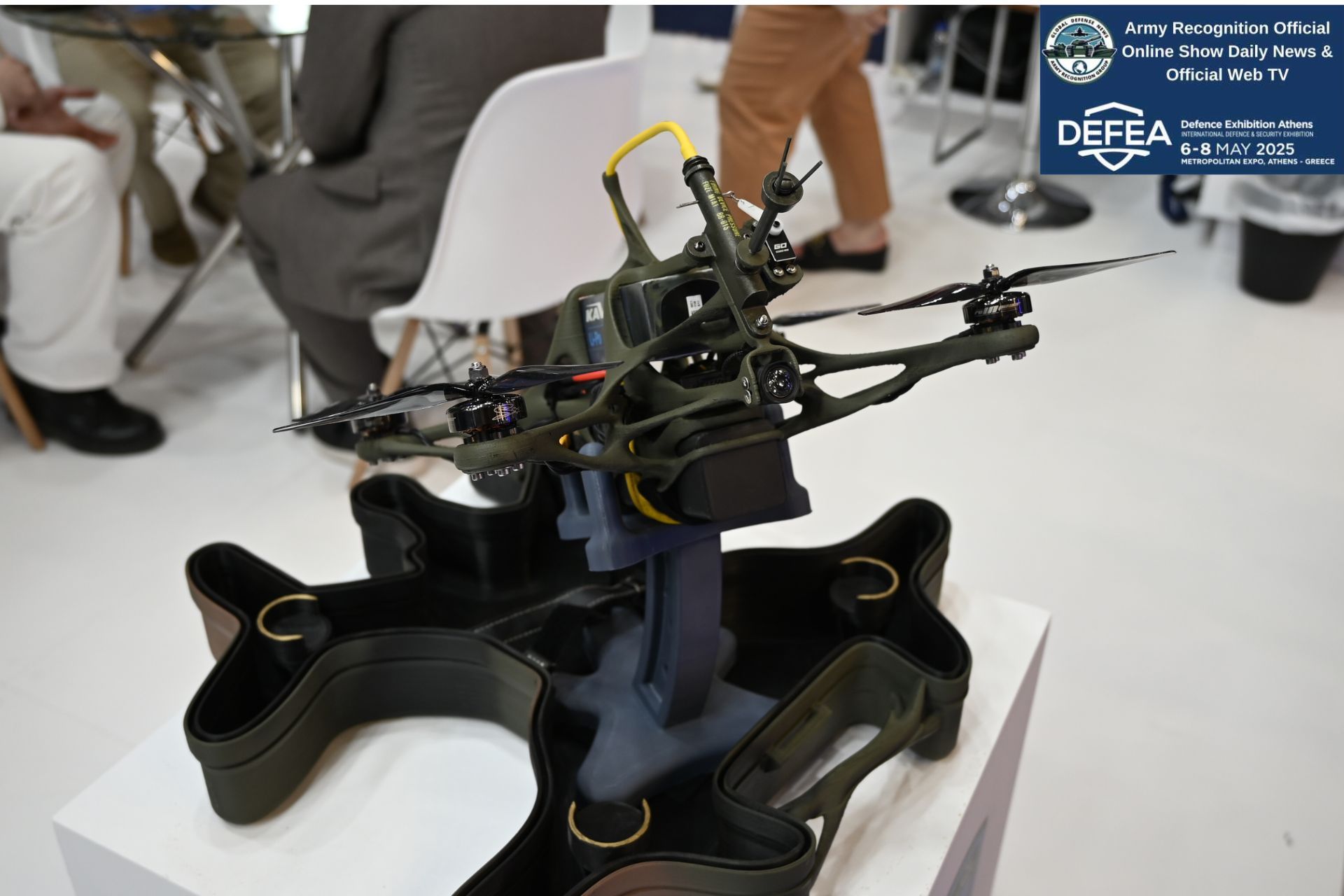
The drone carries an explosive charge mounted at the center of its frame, indicating its ability to accurately engage enemy positions or light vehicles. (Picture source: Army Recognition)
The munition showcased at DEFEA 2025 takes the form of a compact quadcopter drone designed for precision strikes on specific short-range targets. According to the technical specifications displayed at the event, the system has a flight endurance of 15 minutes, a maximum operational range of 7 kilometers, and can reach speeds of up to 120 km/h. It is a single-use "One-Way Attack" (OWA) munition, intended to be destroyed upon impact. The drone carries an explosive charge mounted at the center of its frame, indicating its ability to accurately engage enemy positions or light vehicles. It is electrically powered, uses a vertical take-off and landing (VTOL) mode, and can be rapidly deployed from forward positions without requiring heavy infrastructure.
This public unveiling at DEFEA follows several months of development conducted by KETAK, whose projects had already been presented in January 2024 during a closed demonstration attended by Minister of Defence Nikos Dendias at the KEoAX test center. During that visit, various prototypes of surveillance, reconnaissance, and strike drones were shown, highlighting Greece's renewed interest in building national capabilities in the unmanned systems domain. However, the presence of this particular model at DEFEA marks its transition into the public domain, potentially indicating a move toward industrial production or integration into the armed forces.
The development of this loitering munition aligns with a broader global trend driven by the widespread use of such systems in contemporary conflicts. In Ukraine, for instance, improvised or semi-industrial loitering munitions have become central elements of tactical combat, allowing light units to strike armored or fortified targets at low cost. This transformation of the battlefield has prompted several European countries to seek their own solutions to reduce reliance on foreign suppliers. The fact that this system is being developed by a state-run entity such as KETAK illustrates Greece’s intent to contribute to this emerging landscape through sovereign innovation.
By exhibiting this munition at DEFEA 2025, KETAK demonstrates its capacity to design offensive aerial systems suited to the demands of modern warfare. While the model has not yet been officially named, it represents a concrete step toward the structured militarization of Greece’s drone sector. The proliferation of such systems, now accessible to a growing number of states, may also create opportunities for technological cooperation or exports to regional partners facing comparable asymmetric threats.