






Breaking News






DEFEA 2025: Greece Turns to MEDUSA System for Protection Against Drone Threats to Key Infrastructure.
At DEFEA 2025 in Athens, Greek company AKMON S.A. unveils its MEDUSA system, developed to address one of today’s most pressing security challenges: the growing threat posed by Class 1 drones, increasingly used for espionage, sabotage, or targeted attacks. MEDUSA is a modular and responsive system designed to detect, jam, and neutralize lightweight drones, primarily aimed at securing critical infrastructure, sensitive military sites, airports, strategic locations, and high-value industrial facilities.
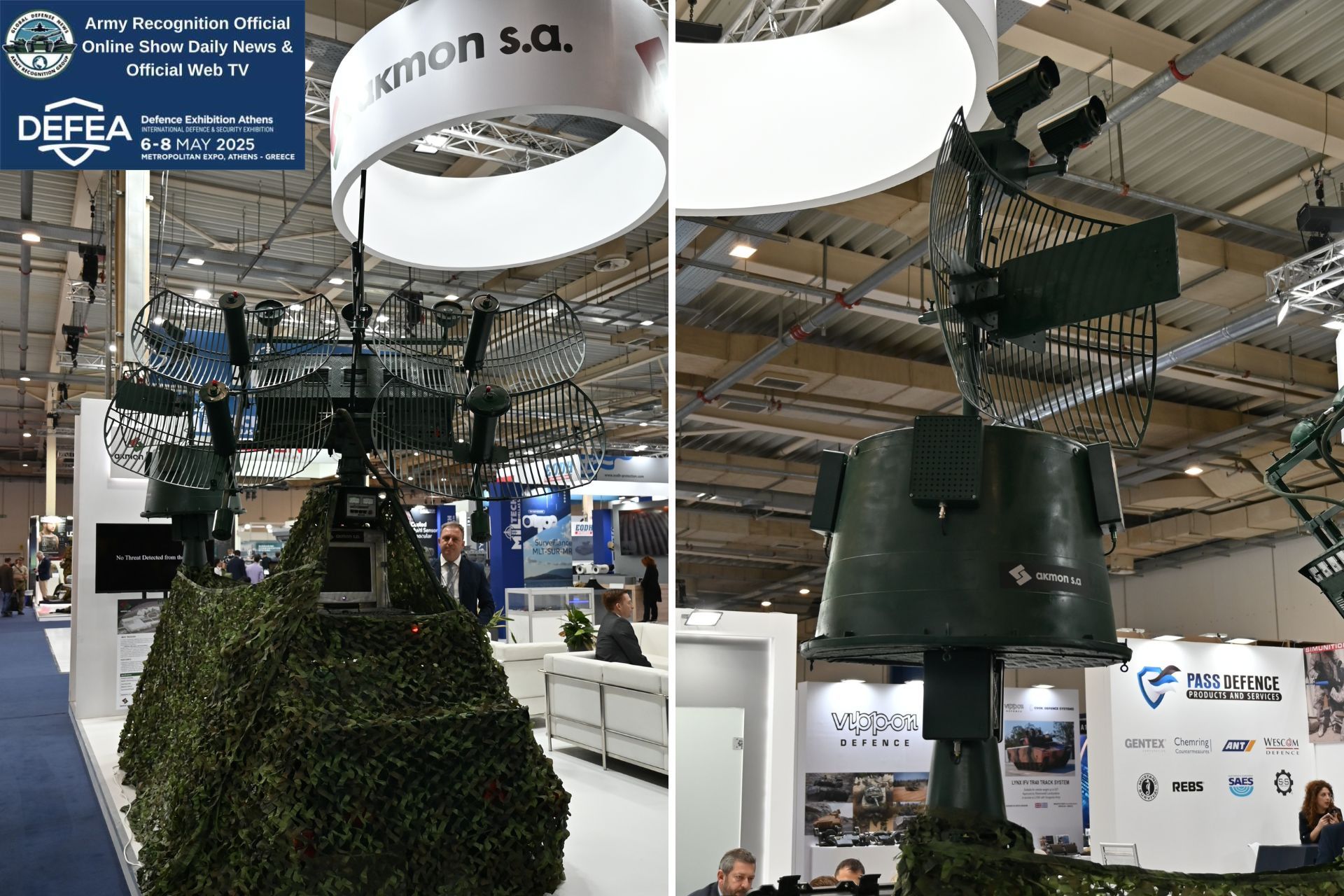
The MEDUSA system uses non-kinetic jamming of GNSS signals to detect, track, and neutralize Class 1 drones, making it suitable for use in civilian or urban environments. (Picture source: Army Recognition)
The development of such a system emerges in a global context marked by the rapid proliferation of both civilian and military drones. These systems are increasingly affordable, easy to operate remotely, and capable of navigating urban or confined environments while avoiding detection. Small aerial platforms, often modified to carry improvised payloads or used for clandestine surveillance, now represent a major asymmetric threat to states, armed forces, and industrial operators. As such, the deployment of counter-UAS (C-UAS) technologies has become a strategic priority for many countries, especially amid rising geopolitical tensions, energy infrastructure attacks, and illicit aerial incursions.
The MEDUSA system, named after the Gorgon of Greek mythology capable of paralyzing enemies with her gaze, is conceived as a targeted electronic response tool. It detects Class 1 drones, tracks their movement, and disrupts their navigation by jamming GNSS signals (GPS, GLONASS, GALILEO, BEIDOU) on L1 and L2 bands. The system uses non-kinetic means, relying on electronic disruption rather than destructive methods, which makes it suitable for use in densely populated areas or near civilian sites where conventional defense tools would be inappropriate.
Technically, MEDUSA offers simultaneous jamming on up to nine channels and operates continuously, 24/7. It relies on a passive detection architecture, meaning it emits no signals and remains undetectable to adversaries, reducing vulnerability to countermeasures or interference. MEDUSA can be deployed in 30 minutes, making it a flexible and mobile solution for temporary site protection during events or high-security operations. Its frequency range spans from 400 MHz to 6000 MHz, including the bands commonly used by drones for control and data transmission, with jamming capacities up to 5800 MHz.
The threats addressed by MEDUSA include industrial espionage, tactical reconnaissance by hostile forces, improvised munition drops, smuggling operations, sabotage attempts, illegal overflights of prisons or government sites, and disruptions of political or public events. In these scenarios, the system enhances early threat response and provides localized technological control against remotely operated aerial systems, sometimes launched from significant distances.
Using systems like MEDUSA has become essential in environments where traditional defense methods are either ineffective or unsuitable. For example, using firearms against low-flying drones in urban settings can pose unacceptable collateral risks. Similarly, conventional radar systems struggle to detect small drones, often built with low-reflectivity composite materials. The solution developed by AKMON S.A. addresses this capability gap by offering a modular, low-signature system that can be integrated into existing security frameworks.
AKMON S.A., based in Ano Liosia in the Attica region of Greece, draws on industrial expertise in defense technologies. The company specializes in electronic systems and security solutions for both military and civilian applications. Through MEDUSA, AKMON demonstrates the Greek defense industry's intent to align with international standards in countering emerging threats. The company also aims to deliver an export-ready, competitive solution to a rapidly expanding market, where demand for effective, easy-to-integrate C-UAS systems continues to grow, particularly in hybrid conflict environments.
The unveiling of MEDUSA at DEFEA 2025 marks a strategic milestone for AKMON S.A. in its efforts to expand internationally. Shortly, this type of technology could see significant proliferation among armed forces and civil security operators alike, faced with increasingly aggressive and diverse uses of modified commercial drones. The broader adoption of such discreet neutralization capabilities may also lead to regulatory debates, doctrinal updates, and standardization efforts for counter-drone strategies at both European and international levels.