






Breaking News






Danish Intel: Russia Steps Up Gray-Zone Pressure in Danish Straits Targeting NATO with Drones.
Denmark’s Defence Intelligence Service said on Oct. 3 that Russia has intensified a gray-zone campaign in the Danish Straits, citing drone incursions and provocative naval behavior that strain allied forces. These critical chokepoints connect the Baltic Sea to NATO waters, implicate shadow-fleet oil traffic, and could trigger alliance responses if incidents escalate.
Denmark’s Defence Intelligence Service (DDIS) confirmed during an Oct. 3 briefing in Copenhagen that Russia is stepping up hybrid pressure against NATO, combining drone incursions that disrupted Danish airports with assertive naval activity in the Danish Straits. The update follows European actions against a suspected “shadow fleet” tanker and highlights how behavior at sea, including radar “lock-ons” reported in the Baltic this year, keeps allied crews under constant strain in confined waters. The Danish Straits are a strategic gateway for U.S. and NATO sea lines, energy flows, and undersea infrastructure.
Follow Army Recognition on Google News at this link
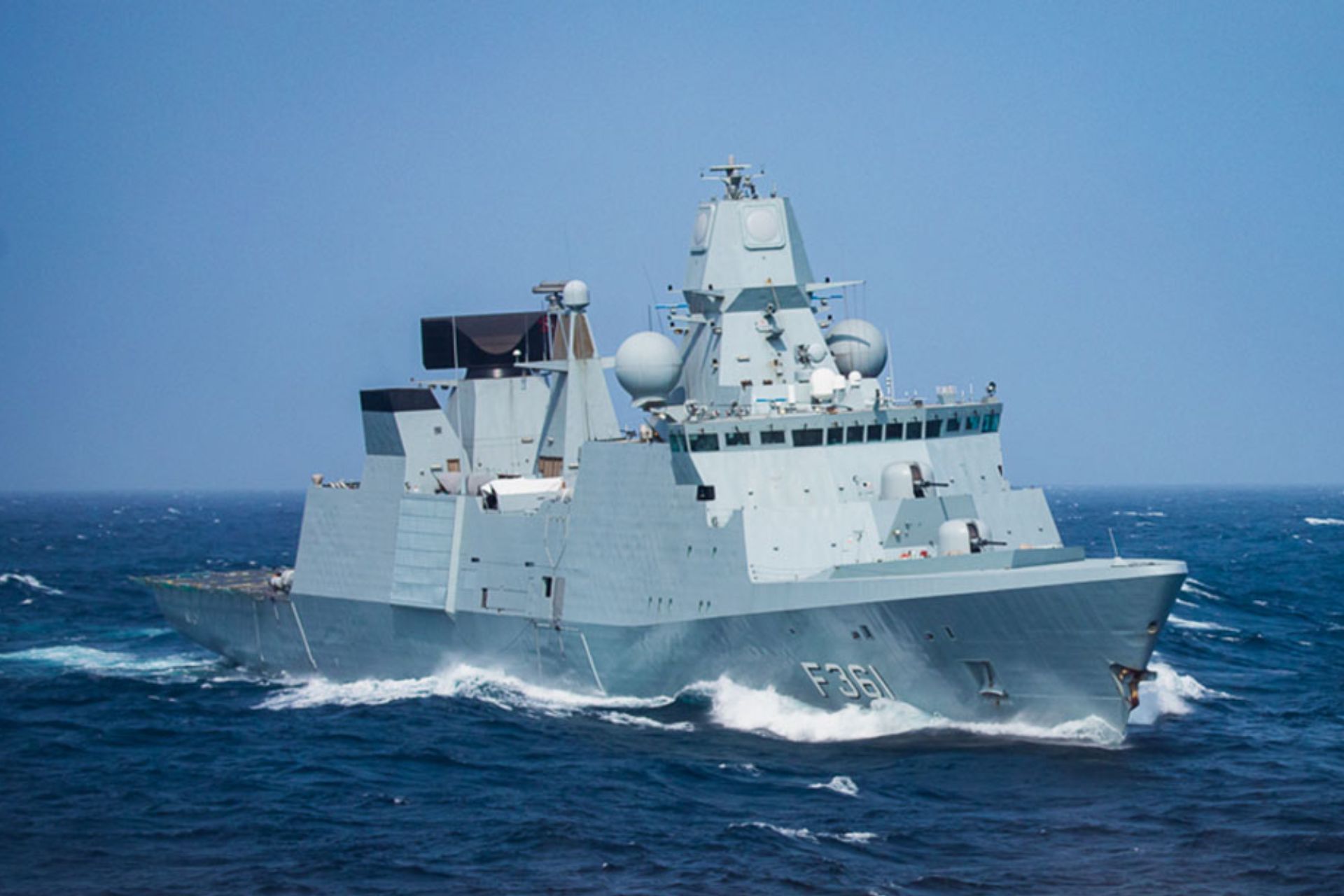
Danish Navy Iver Huitfeldt class frigate underway during routine patrol. The class fields SM-2 and ESSM in Mk 41 cells with a 76 mm gun and 35 mm CIWS. (Picture source: Danish MoD)
When Denmark deploys an Iver Huitfeldt class frigate such as HDMS Niels Juel to exercises like Neptune Strike, it fields a platform designed to manage this kind of sub-threshold pressure. The configuration combines a 32-cell Mk 41 vertical launcher for SM-2 and quad-packed ESSM, a separate Mk 56 installation for additional ESSM, a 76 mm OTO Melara gun, and the 35 mm Millennium close-in system for the last layer. CODAD provides the endurance required for patrols in the North Sea and the Baltic, while a long-range air search radar paired with a multifunction fire control radar enables simultaneous engagements against fast, very low targets that clutter displays in the straits. In short, the open combat system architecture and seamless integration with allied data links provide the technical basis for the posture described above.
Germany’s FGS Hamburg, an air defense frigate of the Sachsen class that called at Copenhagen ahead of the summit, fulfills a comparable role with national specificities. The type pairs the long-range SMART-L radar with a multifunction tracker director to manage intercepts, and the German Navy emphasizes the ability to handle a very large number of airborne tracks at once. Armament centers on SM-2 in vertical launchers for the outer layer, backed by point-defense missiles and a medium-caliber gun. It is not intended as a full-time submarine hunter or coastal law-enforcement asset. Its purpose is escort duty, policing airspace for a fleet or a city, and remaining on station while political leaders address the crisis.
On the U.S. side, USS Bulkeley, an Arleigh Burke-class destroyer, recently joined NATO’s Baltic Sentry effort, a mission that has shifted from protecting subsea infrastructure to counter-drone defense. Bulkeley’s Aegis combat system is built around the SPY-1 phased array radar and a 96-cell Mk 41 battery configurable for air defense, anti-submarine warfare, or land attack as required. In a drone-dense environment, layering is decisive. Long-range interceptors, medium-range ESSM packed four to a cell, and close-in weapons, combined with decoys and electronic warfare, give watch teams multiple solutions to the same problem. Two embarked MH-60R helicopters add flexible sensors and weapons for tracking periscopes, small craft, and slow movers that slip beneath the primary surveillance picture.
The Russian platforms mentioned by Danish accounts are not peripheral. The MiG-31 Foxhound is a long-range interceptor with high speed, a powerful radar, and very long-range air-to-air missiles. A small detachment deployed forward or sweeping Baltic approaches is not subtle signaling. It demonstrates reach and can cover tankers or surface units if required. When Danish or allied crews report being painted by fire control radars from passing Russian warships, the technical explanation is straightforward. Modern directors and electro-optical sights can place a narrow beam on a target without firing. The issue is not physics. It is the intent implied and the compressed reaction time it imposes on a bridge team in a narrow channel busy with merchant traffic and ferries.
Operationally, the pattern described by Danish intelligence is pressure at the margins. A fire control director lingers on a helicopter. A warship follows an odd track that tests the rules of the road. A commercial anchorage becomes an ambiguous waypoint for a tanker that prefers to avoid questions. None of this is a shot fired. All of it consumes time, fuel, and attention. The response is a layered posture built on shared tracks, disciplined emissions, and constant drills. Frigates and destroyers provide an air defense umbrella and the command-and-control backbone. Airports add sensors and filter drone reports to separate confirmed intrusions from identifications. Maritime patrol aircraft, coast guards, and ground-based air defenses fill gaps and address slow, very low targets that can confuse coastal radar. The setup will not be perfect, because the threat set keeps changing. It does, however, reduce the risk of a sudden incident in straits crowded with ferries, pilots, and fishing boats.
Moscow has an interest in maintaining calibrated pressure, moving its oil, and testing alliance reactions while avoiding a clear trigger that would solidify NATO’s political and legal response. Using a shadow fleet, skirting airspace boundaries, and selecting questionable anchorages in choke points such as the Danish straits are methods that create friction without a clear casus belli. For allied capitals, the difficulty is cumulative. Airports in Denmark and Norway have suspended operations after drone reports.
Germany and Belgium have reported clusters of small aircraft near sensitive sites, with some cases dismissed after inquiry, while others remained under review. This mix of confirmed events and false alarms is fertile ground for hybrid activity, because it unsettles the public and ties up personnel even when no damage is recorded. Meanwhile, NATO runs successive Neptune Strike iterations in the North Sea, rotates escorts like Hamburg and Bulkeley through the region, and quietly expands Baltic Sentry to counter-UAS tasks. It is unspectacular work, but it allows governments to state there is no immediate path to war while acknowledging persistent gray zone pressure.