






Breaking News






Czech Republic Rises as Key Tank Manufacturing Hub with Tatra to Build Leopard 2A8 Hulls for KNDS.
KNDS Deutschland and Tatra Defence signed a December 18, 2025 agreement for the production of Leopard 2A8 main battle tank hulls in the Czech Republic. The deal reflects Europe’s accelerating heavy armor buildup as NATO nations respond to the war in Ukraine and renewed Russian military pressure.
On December 18, 2025, KNDS Deutschland and Czech manufacturer Tatra Defence announced a major industrial agreement for the production of Leopard 2A8 main battle tank hulls, as reported by KNDS Deutschland in an official press release. Under the contract, Tatra will build 150 hulls with an option for up to 300 additional units, elevating the Czech Republic to the rank of core production site within the pan-European Leopard 2A8 programme. This move comes as European armies accelerate the renewal of their heavy armour in response to the war in Ukraine and rising concern over Russian rearmament, with KNDS already holding hundreds of orders for the new Leopard 2 variant from several European countries including Germany, the Netherlands, Norway, Lithuania and the Czech Republic. In this context, the deal is not a simple subcontract but a structural shift that ties Czech industry into the long-term supply chain of NATO’s future heavy brigades.
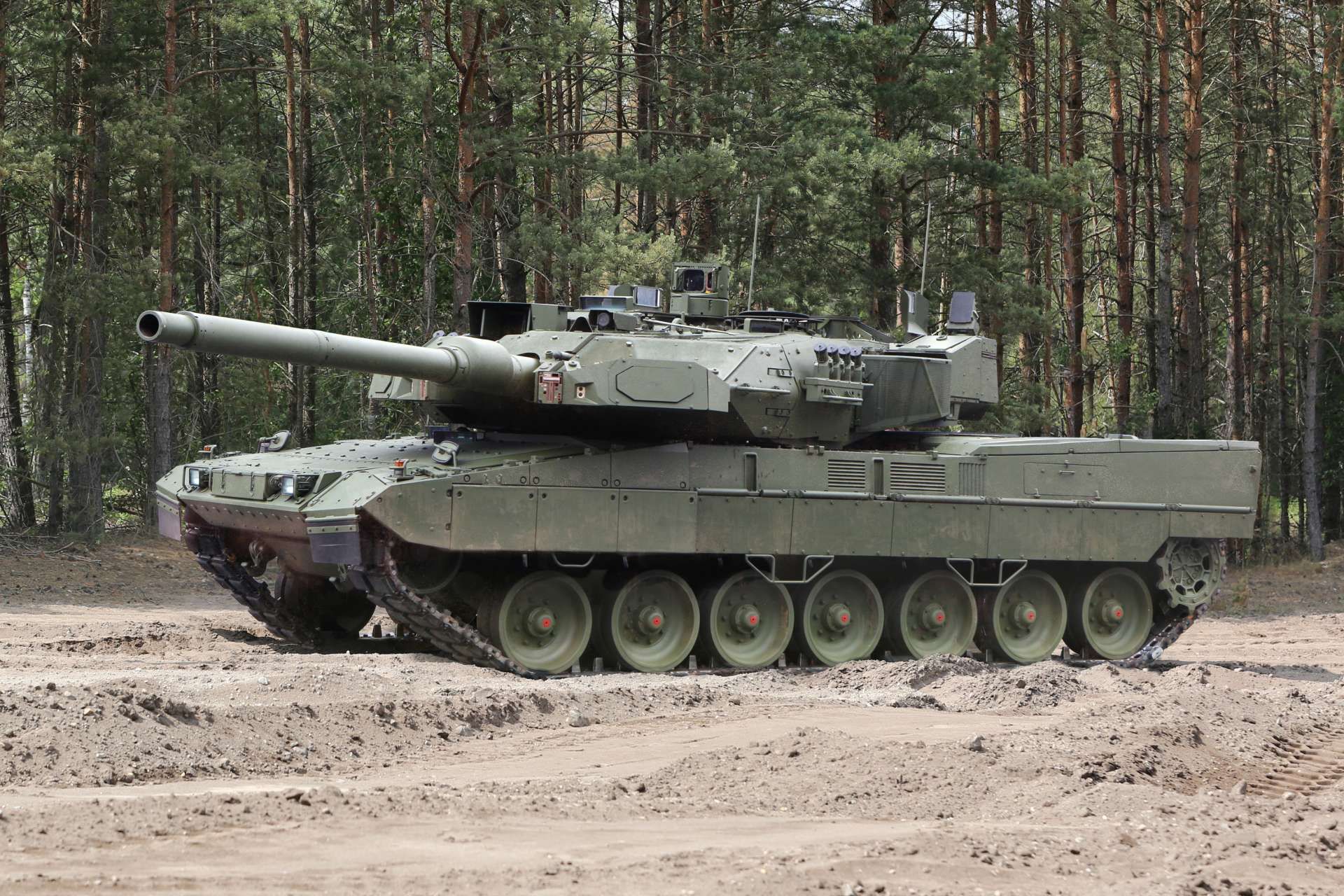
KNDS Deutschland’s agreement with Tatra Defence to produce Leopard 2A8 tank hulls makes the Czech Republic a core manufacturing hub in Europe’s accelerating heavy armor rearmament driven by the Ukraine war and NATO defense planning (Picture Source: KNDS)
At the centre of the agreement lies the hull of the Leopard 2A8, the armoured structure that carries the crew, engine and turret and defines much of the tank’s survivability. Tatra Defence will be responsible for welding these hulls, including quality control and the associated technological processes, with KNDS transferring the necessary know-how and tooling. According to the two companies, this will bring new technologies, additional manufacturing capacity and skilled employment to the Moravian-Silesian region, while anchoring heavy armoured production on Czech soil. KNDS stresses that the contract forms part of the broader Czech commitment to the Leopard 2A8 programme, which Prague has joined alongside other European partners and which it presents as a concrete example of European defence cooperation rather than a classic offset package.
Beyond the 2A8, the roadmap already points to increased production volumes and a possible extension of cooperation to other KNDS platforms, such as the Leguan bridge-laying system, in which the Czech Army has expressed interest , and intensified work with KNDS France on the 6×6 Titus wheeled vehicle and related systems. The announcement coincided with a public parade in Hungary marking the completion of deliveries of Leopard 2A7HU tanks, underlining how the Leopard family has become a vehicle not only for armoured modernisation, but also for industrial integration across Central Europe.
From the operational standpoint, the hulls that will leave Kopřivnice are destined for the latest member of a lineage that began with the original Leopard 2 introduced in 1979 and now serves as the standard heavy tank for numerous NATO and EU armies. The Leopard 2A8 is derived from the Leopard 2A7V/A7+ configuration but incorporates a series of deep upgrades: a reinforced hull and turret with enhanced mine and top-attack protection, an improved 120 mm L55A1 smoothbore gun, a fully digital electronic architecture and the EuroTrophy active protection system derived from Israel’s Trophy, providing 360-degree radar coverage and hard-kill interception of incoming projectiles and drones.
These modifications reflect operational feedback from deployments in Afghanistan and Iraq as well as the lessons emerging from Ukraine, where loitering munitions, artillery and top-attack anti-tank weapons have exposed the vulnerabilities of older generations of armour. German and Central European analyses further point out that the 2A8 design builds heavily on the customised Leopard 2A7HU developed for Hungary, illustrating how national variants are feeding directly into the “baseline” model now being procured by a growing number of users.
These design choices produce a main battle tank optimised for high‑intensity, drone‑dense combat: a 1,500 hp powerpack, upgraded suspension and advanced fire‑control preserve mobility and first‑shot lethality, while a reinforced hull and under‑belly improve resistance to mines and IEDs. EuroTrophy active protection around the turret and hull counters ATGMs, RPGs and some loitering munitions, complementing layered passive armour. Digital mission systems, panoramic third‑generation thermal sights and programmable ammunition (e.g., DM11) enable detection, classification and engagement beyond 4 km and rapid sharing of targeting data with nearby units and command. Reliable hull production is therefore essential to field coherent, modern armoured battalions for Leopard 2A8 users within NATO timeframes.
Strategically, the Tatra contract plugs the Czech Republic into an emerging distributed production network for the Leopard 2A8. Final assembly and integration will continue in Germany, but an assembly plant for Leopard 2A8s is already planned elsewhere in Europe, and other industrial agreements have been signed to produce hulls and turret structures in partner countries. KNDS reports that orders for the new variant have reached several hundred tanks from Germany, the Netherlands, Norway, Lithuania and the Czech Republic, with additional customers in discussion, and national budget documents show that individual packages often amount to several billion euros once training, spares and support are included.
Other national contracts illustrate the financial scale of the programme: the Netherlands has committed significant funding for its 46 Leopard 2A8s, Lithuania’s package for its future fleet is valued at close to one billion euros, and the Czech Republic’s initial purchase of 44 vehicles amounts to tens of billions of crowns with options that could bring its fleet to 77 tanks. Recent agreements by other European states for Leopard 2A8 tanks, simulators and extended warranties, some partially financed by EU instruments, confirm that the Leopard 2A8 is already supported by a dense portfolio of defence contracts, into which the Czech hull production will now be structurally integrated.
By combining a long-term hull production contract with technology transfer and a clear pathway towards further cooperation on systems such as Leguan and Titus, the KNDS–Tatra agreement redefines the position of the Czech Republic in Europe’s land-defence industrial landscape. It consolidates the Leopard 2A8’s status as the reference main battle tank for many NATO allies while ensuring that manufacturing capacity is spread beyond Germany to the eastern flank of the Alliance, closer to the likely theatres of deployment.
For the Czech Republic, the project delivers both industrial gains and a strategic means to strengthen its modern heavy brigade in close coordination with key allies. For KNDS, it establishes a reliable partner in Central Europe as global demand for advanced armour grows and the company positions for expansion. Amid the ongoing war in Ukraine and rising concerns about Russia’s conventional forces, transforming Kopřivnice into a major Leopard 2A8 hull production hub represents more than an economic achievement, it is a measured investment in Europe’s resilience and collective deterrence.
Written by Teoman S. Nicanci – Defense Analyst, Army Recognition Group
Teoman S. Nicanci holds degrees in Political Science, Comparative and International Politics, and International Relations and Diplomacy from leading Belgian universities, with research focused on Russian strategic behavior, defense technology, and modern warfare. He is a defense analyst at Army Recognition, specializing in the global defense industry, military armament, and emerging defense technologies.