






Breaking News






Chinese Army Engineers Test Systems for Planning Simultaneous Nuclear-Strike Options.
Papers by researchers at the PLA’s Army Engineering University present laboratory experiments on how closely sequenced underground blasts interact and report increased crater/collapse measures in controlled tests.
The work published on September 10, 2025, in Explosion and Shock Waves and attributed to Xu Xiaohui’s team at the PLA’s Army Engineering University describes a laboratory method to study sequenced nuclear strikes on a single point. From an operational perspective, the main interest lies in controlling the timing between several low-yield pulses to achieve cratering and collapse effects more efficiently than with a single shot. In practical terms, the aim is to exploit shock-wave coherence to degrade buried and hardened structures more quickly while keeping individual yields constrained.
Follow Army Recognition on Google News at this link
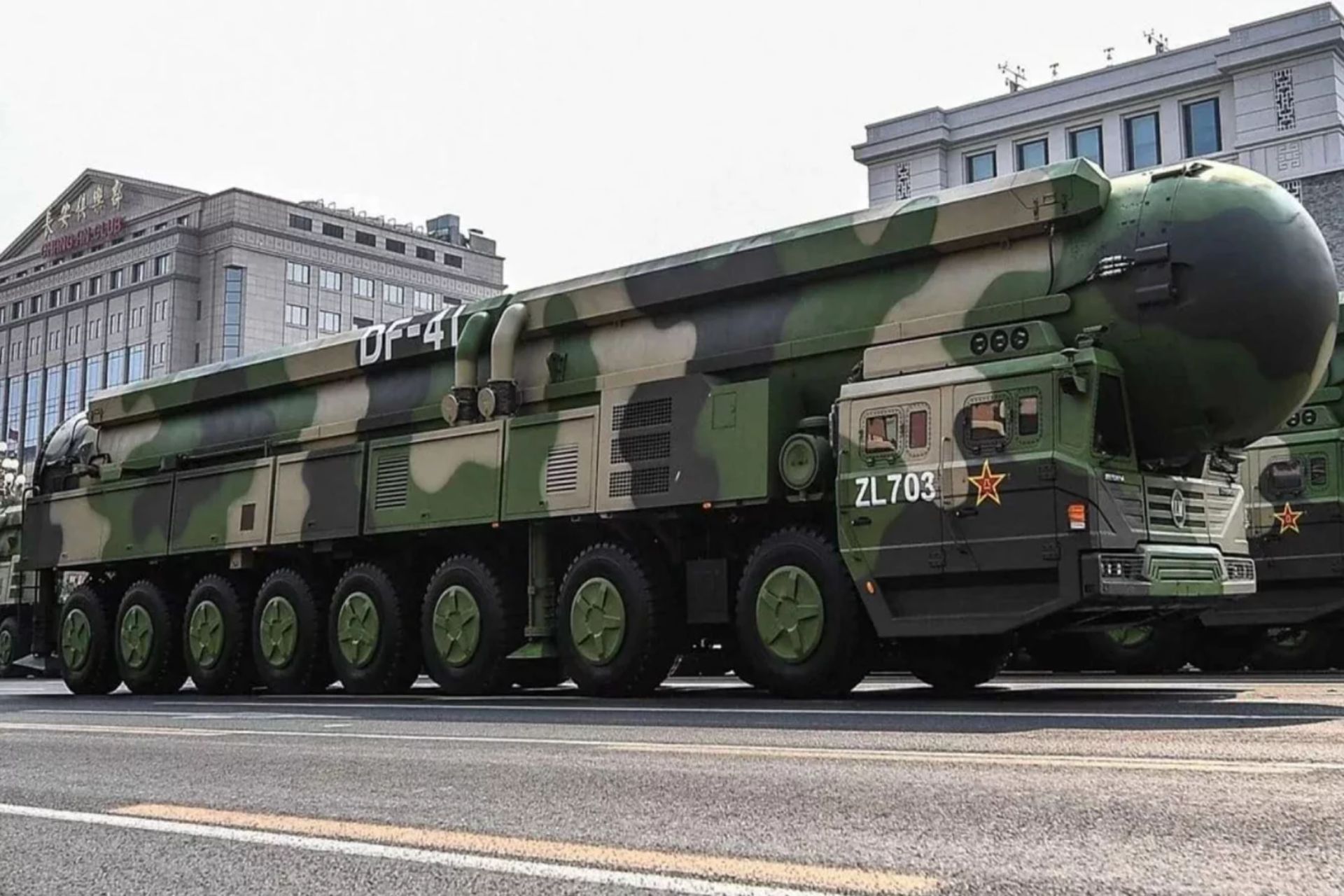
DF-41 missile launchers of the PLA Rocket Force, land-based delivery system of China's nuclear triad (Picture source: PLA)
The methodological contribution is central. The vacuum test rig, the two-stage gas gun, and the use of similitude theory do not describe a deployed system, but they provide reproducible data on shock-front merging when detonations occur at millisecond-scale intervals. This clarifies parameters of interest to planners: optimal detonation depth, interval between pulses, sensitivity to geological layering, cumulative damage zone, and the threshold at which a cavity opens to the surface. Compared with a Palanquin-type reference shot, three-pulse sequences showed clear increases in crater radius, depth, and especially volume, which, when scaled, suggests a higher likelihood of meeting neutralization criteria for a buried target.
Translated into military requirements, such a profile presumes delivery systems able to place multiple charges on the same point with metric accuracy and tight chronology. This points to multiple reentry vehicles or sequential hypersonic carriers, hardened electronics that survive penetration, and fuzing devices synchronized to the microsecond. The C2 chain must ensure sequencing, redundancy, and the ability to adjust in flight if a vehicle misses its timing window. Terminal navigation and in situ measurement of medium density become critical, since the effectiveness of the second and third pulses depends on exploiting the zone already weakened by the first.
For defenders, these experimental results encourage a reassessment of underground hardening principles. Beyond concrete thickness, the geometry of structures, the presence of decoupling volumes, sacrificial layers, and discontinuities designed to break phase alignment of waves could regain importance. Another operational corollary is that, if pulse coherence is exploitable, some desired effects might be obtained with lower yield per charge, which partly changes cost-effectiveness, mission logistics, and planning margins in constrained political-military contexts.
In concrete terms for a penetrating bomb, these results open several design and employment options. A lower-yield warhead, intended for limited initial penetration into rock or reinforced concrete, could be programmed for three closely spaced pulses, each triggered by time and proximity fuzes coupled with acceleration and strain sensors. The first pulse initiates damage and creates weakness paths. The second, arriving within a very short temporal window on the order of a millisecond, takes advantage of the degraded medium to expand the cavity and approach the collapse threshold. The third, synchronized with the rebound phase or peak instability, aims to open a conduit to the surface and bring down adjacent galleries. Materially, this implies a reinforced warhead with a penetrating nose, an internal structure isolating the charge from initial shocks, and fuzes that tolerate very high accelerations while preserving sequencing accuracy.
In a realistic firing architecture, the effect could be achieved by a reconfigured MIRV bus delivering three reentry vehicles to the same coordinate with a CEP of a few meters, or by a sequential hypersonic vector releasing penetrating charges that adopt the same pulse logic. The target detonation depth would be adjusted by onboard sensors measuring deceleration and medium density to approach an optimal collapse without prematurely venting gases. For comparable total yield, the pulsed approach seeks to enlarge the useful structural damage zone, raise the probability of neutralizing critical points such as access shafts, control rooms, and HVAC ducts, and reduce reliance on a single higher-yield device, thereby limiting some collateral consequences. The mission profile also changes: less mass per warhead, but tighter demands on synchronization, terminal guidance, and subsystem hardening.
Regarding effects and damage assessment, a sequenced bomb of this kind produces superposed seismo-acoustic signatures with a more coherent equivalent wavefront. BDA teams could use this signature to distinguish a cavity collapse from a shallow surface crater. Conversely, defensive designs may incorporate dissipative layers, discontinuous geometries, and decoupling volumes to disrupt the temporal coherence sought by the sequence. This becomes a contest between timing precision and underground architecture.
At this stage, nothing demonstrates a declared capability or doctrinal change. This is an experimental program that reduces uncertainty about the physics of underground collapse under sequenced loads. However, the existence of laboratory data on wave merging and crater volume growth can quickly enter planning assumptions. Staffs working on options to neutralize buried targets may see a case for more modular warhead architectures, convergent approach profiles, and narrower firing windows, with greater constraints on inter-vector synchronization.
At the strategic level, the issue concerns the credibility of holding deeply buried infrastructure at risk and the stability of escalation dynamics. Higher efficiency at lower yield can, in practice, lower the technical threshold for use while complicating defense. Conversely, implementation complexity, dependence on terminal accuracy, and sensitivity to geological conditions create vulnerabilities that countermeasures can exploit. In short, the study does not announce a new operational capability. It refines a physical lever that forces may seek to integrate, cautiously, into strike schemes against buried objectives, with potential effects on facility design, C2 requirements, and deterrence dynamics.