






Breaking News






China Reveals New Generation Airborne IFV Integrating Active Protection And Dual Missile Systems.
On August 16, 2025, an image taken by defense photographer David Wang and shared on the social media platform X revealed what appears to be a new generation of airborne infantry fighting vehicle (IFV) under development for the People’s Liberation Army (PLA). The vehicle, bearing PLA insignia and finished in digital desert camouflage, is believed to be undergoing advanced trials and could be officially presented to the public during the upcoming September 3 Victory Day parade in Beijing, which will commemorate the 80th anniversary of the end of World War II. If confirmed, the unveiling would mark one of the most significant additions to China’s airborne forces in two decades.
Follow Army Recognition on Google News at this link
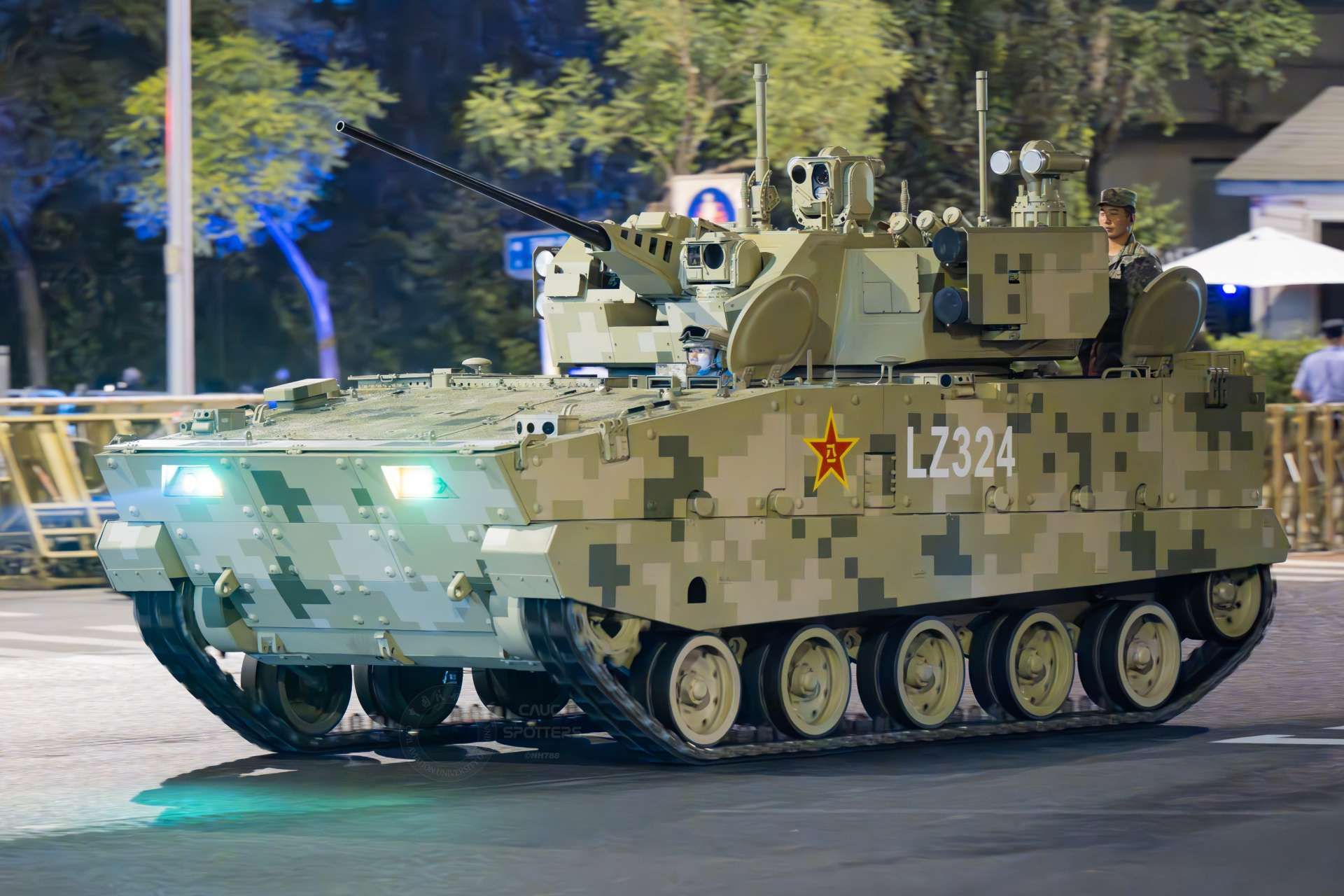
The emergence of the new airborne IFV is not only a technological milestone but also a symbol of how China is adapting its military to lessons drawn from recent wars. For the PLA, it represents a step toward a more credible expeditionary capability, giving its rapid-reaction forces the resilience and firepower to operate in high-threat conditions (Picture source: X/David Wang)
The platform is widely regarded as the successor to the ZBD-03, the light airborne IFV that entered PLA service in the early 2000s. While the ZBD-03 was praised for its air transportability and amphibious capability, it was also criticized for its limited armor protection, which made it vulnerable in high-intensity combat environments. The newly sighted vehicle appears to address those shortcomings. It adopts a more angular and robust hull design, reinforced with modular ceramic armor and a reconfigured rear compartment optimized for amphibious troop deployment. Importantly, despite its heavier profile, the vehicle reportedly retains compatibility with the Y-20 strategic airlifter, ensuring that it can still be deployed rapidly to distant theaters.
From a firepower perspective, the new vehicle signals a leap forward. It is equipped with an automatic cannon estimated in the 30–35 mm range, paired with a coaxial machine gun for close engagements. Unlike its predecessor, however, this platform carries a much wider arsenal of secondary weapons. On its left side is a twin pack of heavy anti-tank guided missiles (ATGMs), likely capable of penetrating modern main battle tank armor. On its right, defense analysts identified a quad launcher for smaller rockets, which may serve in anti-personnel, incendiary, or thermobaric roles. This diverse mix suggests a deliberate emphasis on versatility, allowing a single airborne IFV to engage a broad spectrum of targets from tanks to fortified infantry positions.
The sophistication of the onboard protection suite is equally striking. Alongside traditional smoke grenade launchers, the vehicle mounts advanced day-night optics and thermal imagers, ensuring operability in all weather conditions. Most notable is the placement of three optical sensors on each side of the hull, front, center, and rear, providing true 360-degree situational awareness. These sensors are networked with the GL-6 active protection system, a hard-kill defensive measure capable of neutralizing incoming anti-tank missiles, loitering munitions, and even first-person-view (FPV) drones, which have emerged as a major threat on modern battlefields. Complementing the APS is a small radar antenna dedicated to counter-unmanned aerial system (C-UAS) tasks, indicating that designers have prioritized layered defenses against both ground and aerial threats.
Strategically, the development of this airborne IFV illustrates an important evolution in Chinese doctrine. Airborne units have historically emphasized speed and mobility over protection, but the battlefield lessons of Ukraine and the South Caucasus have shown that lightly armored vehicles suffer devastating losses in environments saturated with drones and precision-guided weapons. By fielding an airborne platform that combines stronger armor, heavy missile firepower, and robust anti-drone defenses, the PLA Airborne Corps moves closer to the standards of NATO mechanized forces, where survivability and integrated electronic warfare are considered as essential as mobility.
The timing of the program is also significant. In recent years, the PLA has emphasized the need for rapid-reaction forces capable of projecting power across regional flashpoints, from the South China Sea to the Taiwan Strait. The new IFV, transportable by Y-20 aircraft, would give Chinese paratroopers the ability to deploy not just as light infantry but as a mechanized formation capable of seizing and holding ground against modern adversaries. Such a capability could prove decisive in scenarios where the PLA needs to establish lodgments before heavier armored brigades arrive.
Beyond its immediate tactical implications, the vehicle reflects broader trends in global armored warfare. Modern conflicts have underscored that the decisive factor is no longer raw armor thickness or sheer firepower but the integration of multi-domain protection systems against drones, loitering munitions, and precision strike assets. The PLA’s new design fits this paradigm by blending kinetic and electronic defenses into a single airborne platform, thereby improving the survivability of troops in contested environments.
In this sense, the emergence of the new airborne IFV is not only a technological milestone but also a symbol of how China is adapting its military to lessons drawn from recent wars. For the PLA, it represents a step toward a more credible expeditionary capability, giving its rapid-reaction forces the resilience and firepower to operate in high-threat conditions. Whether deployed in defense of China’s borders or as part of more ambitious regional operations, the platform enhances Beijing’s ability to project power at short notice. Its anticipated public debut in September would confirm China’s determination to modernize its airborne forces and highlight the growing role of mechanized, drone-resistant units in future conflicts.