






Breaking News






China conducts first public live fire test of HQ-20 air defense missile system.
China has released footage of the HQ-20’s first publicly shown live fire test, confirming its move from parade display to active operational use.
On November 11, 2025, China released an Air Force anniversary film that included the first publicly documented live fire test of the HQ-20 air defense missile system, showing the complete launch sequence from canister elevation to interceptor release. The footage indicates that the system has moved from its initial public appearance in the September 2025 Victory Day Parade to use in regular training activities across China’s air defense structure. It also provides a clearer view of the eight-cell launcher layout and the system’s position within China’s defense network, where it is positioned to fill the medium to upper medium range segment between HQ-16 and HQ-22A units.
Follow Army Recognition on Google News at this link
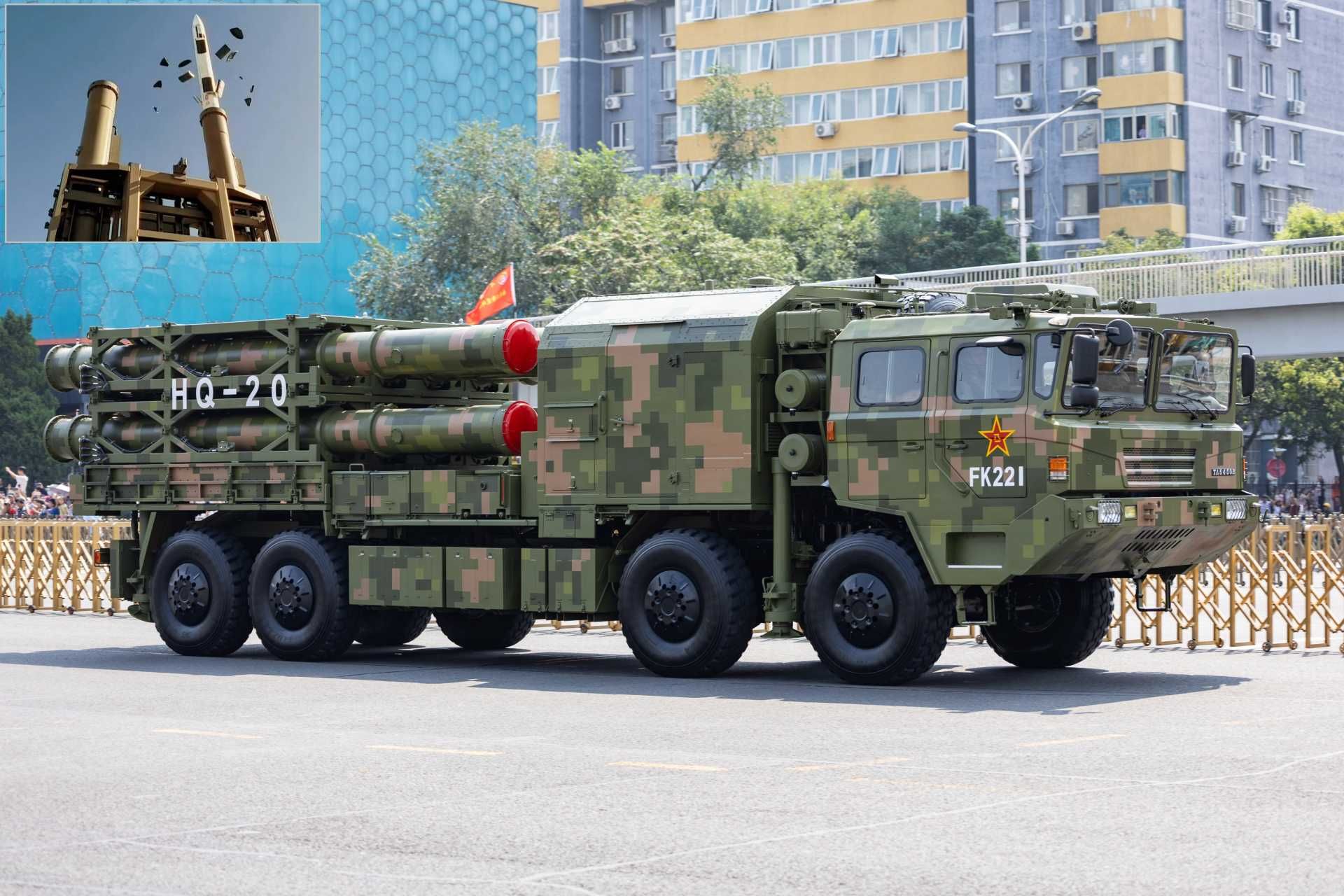
The HQ-20’s appearance is part of an ongoing modernization of the Chinese air defense network, which relies on a combination of ground-based radars, air force interceptors, airborne early warning aircraft, and multiple classes of surface-to-air missiles. (Picture source: Chinese Air Force and X/David Wang)
This footage provided the first operational firing sequence ever displayed to the public, following the HQ-20’s initial public appearance during the Victory Day Parade held in Beijing on September 3, 2025, which commemorated the 80th anniversary of the end of the Second World War. The earlier parade had shown the HQ-20 only as part of a ground formation, whereas the November video provided a full launch cycle confirming active use within training activities. These two events frame the system’s transition from public introduction to an operational phase supported by its initial operational capability date in September 2025. The live fire sequence also allowed visual confirmation of its eight-round vertical launcher configuration and its role within the broader Chinese air and missile defense architecture. The HQ-20 is therefore now presented by the country as a fully fielded component of China’s layered defensive structure rather than as a concept or early development system.
The historical background of the HQ-20 can be traced to a multi-year effort to modernize the medium and upper medium range segment of China’s surface-to-air missile inventory. Earlier Chinese air defense systems included the HQ-2, HQ-61, HQ-12, and HQ-16, which progressed from inclined launch to vertical launch, while HQ-22 was introduced as a larger and lower-cost complement to the long-range HQ-9. Development of the HQ-20 sought to replace remaining inclined launch medium-range systems with a vertical launch solution capable of all azimuth engagement and faster reaction times to meet multi-direction threat environments. Program work involved reducing missile size while maintaining or extending range, integrating new seekers, and improving radar and data link resistance to interference. These upgrades were paired with a requirement for more ready-to-fire missiles on a single vehicle. Firing trials during 2020 through 2024 in coastal, desert, and high interference conditions reportedly served to validate guidance behavior, radar stability, and mobility, and by 2025, the HQ-20 appeared in the September parade, meaning that it had possibly reached its initial operational capability.
The HQ-20 battery seems to be structured around mobile transporter erector launchers (TELs), radar vehicles, and command elements combined to form a complete firing unit. Each launcher is mounted on a heavy wheeled chassis, commonly described as an 8×8 high mobility vehicle, and carries eight sealed vertical canisters arranged in two rows. The launcher elevates the canister block to the vertical position and is reportedly able to fire in any direction without rotating the vehicle, which supports engagements against aircraft, helicopters, unmanned aerial vehicles, and cruise missiles approaching from several azimuths. Radar components associated with the system include a meter wave early warning radar, often linked to JY-27 type sensors for detecting targets with reduced radar cross sections at long distances. Fire control functions are said to be provided by active phased array radars capable of precision tracking, command updates, and multi-target management. The command element processes data from these sensors and from external networks, allocates targets across multiple launchers, and maintains connectivity across dispersed deployment areas to reduce vulnerability. This structure is designed to operate as part of a larger air defense network.
Descriptions of the HQ-20 missile state that it is a vertically launched solid rocket interceptor using inertial navigation and midcourse command guidance, followed by terminal active radar homing. Some technical accounts also refer to a dual pulse rocket motor that extends powered flight into the terminal phase and supports maneuvering against cruise missiles or evasive aircraft. Range figures vary depending on interpretation: early basic tables list a weapon range around 50 kilometers, later technical descriptions place effective reach around 150 to 160 kilometers, and some strategic assessments mention a potential band reaching between 400 and 500 kilometers. Engagement altitude is described as starting from very low levels, around 10 meters, up to approximately 25 kilometers, covering low flying cruise missiles, unmanned systems, fighters, and some missile trajectories in terminal descent. Intercepts are attributed to eight simultaneous engagements from one battery, with indicative single-shot probabilities around 0.92 for aircraft and around 0.85 for cruise missiles. Fire control radars are described as detecting approximately 100 airborne objects at around 400 kilometers and prioritizing about 20 during tracking.
The HQ-20’s performance data reflects a concept centered on increased fire density, improved coverage, and short reaction time in the medium to upper medium range band. The eight-missile launcher increases ready-to-fire capacity compared with earlier six-round systems, such as HQ-16 launchers, and removes the need for mechanical rotation during azimuth changes. System behavior is described as benefiting from rapid radar refresh rates, automated threat evaluation, and the ability to manage fast flying or maneuvering targets. This is matched by descriptions of resistance to interference through radar frequency management and secure data links. The HQ-20 is intended to support continuous operation during saturation attack scenarios, with launchers able to fire multiple rounds in short succession while relying on external or internal sensors for targeting. Its mobility allows the HQ-20 to support both fixed installations and forward elements, reflecting its dual association with the Chinese Air Force and Chinese Ground Force units. The November 2025 live fire confirms that the system is now used in practical missile training, not only in ceremonial formations or controlled demonstrations.
Within the broader Hongqi series, the HQ-20 is positioned between short- and long-range interceptors and is integrated into a structure that includes HQ-7, HQ-10, HQ-11, HQ-13, and HQ-17 launchers in the short range, HQ-12 and HQ-16 in the medium range, HQ-22 and HQ-22A in the medium-to-long range band, and HQ-9, HQ-9B, and HQ-9C in the long range band. High altitude and exo-atmospheric roles are carried by HQ-19, HQ-26, and HQ-29. During the 3 September 2025 parade, HQ-11, HQ-20, HQ-22A, HQ-9C, HQ-19, and HQ-29 units were presented jointly as a multi-segment and multi-layer formation covering far, medium, and short ranges and high, medium, and low altitudes. This structure is described by China as forming continuous engagement coverage against aircraft, drones, cruise missiles, and ballistic missiles in terminal and midcourse phases. In this arrangement, the HQ-20 forms an intermediate layer between the HQ-11 and the HQ-22A or between the HQ-16 and HQ-22A, depending on the classification used.
Direct comparison between HQ-20, HQ-9, and HQ-16 clarifies the system’s specific function within this structure. The HQ-9 and its later HQ-9B and HQ-9C versions serve as long-range interceptors with ranges between roughly 125 kilometers and approximately 400 kilometers and carry four larger missiles per launcher. They are used for extended area coverage and for certain ballistic missile trajectories. The HQ-16 covers shorter engagement zones with ranges between about 40 and 160 kilometers, depending on version, using six missiles per launcher and providing medium-range protection for maneuver units or fixed facilities. The HQ-20 occupies the intermediate band by combining an estimated range between about 150 and 200 kilometers, an eight-missile launcher, and vertical launch architecture suitable for 360-degree engagements. This positioning could give the HQ-20 a higher ready-to-fire density than the HQ-9 and HQ-16 and allows it to intercept targets that fall outside the optimal bands of the other two systems, such as low-observable aircraft or cruise missiles operating below HQ-9 intercept geometry but beyond HQ-16’s strongest performance envelope. Together, these three systems generate overlapping distance and altitude ranges that reinforce the Chinese air defense network.
The place of HQ-20 is also shaped by the distribution of air and missile defense responsibilities within China’s armed forces. Ground based long range surface to air missiles form part of the national air defense system operated by the Chinese Air Force, which coordinates with fighter aircraft and airborne early warning aircraft for wide area coverage. The Chinese Ground Force operates large numbers of short and medium-range systems intended to protect mobile and static command and logistic nodes and to move with combined arms brigades and group armies. In 2023, the Chinese Navy transferred its remaining ground-based air defense sites to the air force, centralizing territorial air defense command, while retaining ship-based systems for fleet protection. Within this framework, the HQ-20 is associated with both air force ground-based units and ground force air defense regiments, supporting fixed-site protection and mobile operations. The November 2025 launch confirms that the HQ-20 is functioning within this distributed structure and contributes to a wider defensive arrangement intended to handle an expanding set of aerial and missile threats.
The emergence of the HQ-20 also fits into China’s wider effort to build a multi-layer defensive architecture that extends beyond individual interceptors and into a national and global early warning structure represented by the recently tested 'Chinese Golden Dome' prototype, able to track up to 1,000 missile launches worldwide. This prototype, described as a physically dispersed but logically unified early warning environment integrating data from satellites, radars, optical sensors, and electronic reconnaissance systems, illustrates how air defense units such as those equipped with HQ-20 are expected to function inside a broader situational awareness network. The integration of distributed early warning nodes, QUIC-based data exchange, and large-scale parallel processing allows Chinese surface-to-air missile systems to receive unified launch alerts, trajectory estimates, and identification products derived from multiple sensor types without requiring hardware replacement across earlier generations. The contrast with the United States’ Golden Dome concept, which remains years from demonstrable capability and faces architectural and cost uncertainties, highlights how China has moved to combine early warning fusion with fielded interceptors such as the HQ-20, HQ-22A, HQ-9C, HQ-19, and HQ-29.
Written by Jérôme Brahy
Jérôme Brahy is a defense analyst and documentalist at Army Recognition. He specializes in naval modernization, aviation, drones, armored vehicles, and artillery, with a focus on strategic developments in the United States, China, Ukraine, Russia, Türkiye, and Belgium. His analyses go beyond the facts, providing context, identifying key actors, and explaining why defense news matters on a global scale.