






Breaking News






Breaking News: Sweden Closes Air Defence Gaps with IRIS-T SLM System Acquisition.
Europe’s air defence landscape continues to evolve with the signing of a major contract between Sweden and Germany. Stockholm has formalised the acquisition of seven IRIS-T SLM surface-to-air missile fire units from German defence company Diehl Defence. Valued at approximately USD 925 million, this agreement falls under the European Sky Shield Initiative (ESSI), a multinational effort to develop an integrated air and missile defence architecture across the continent. Swedish Prime Minister Ulf Kristersson confirmed the announcement, while Diehl Defence has yet to comment officially.
Follow Army Recognition on Google News at this link
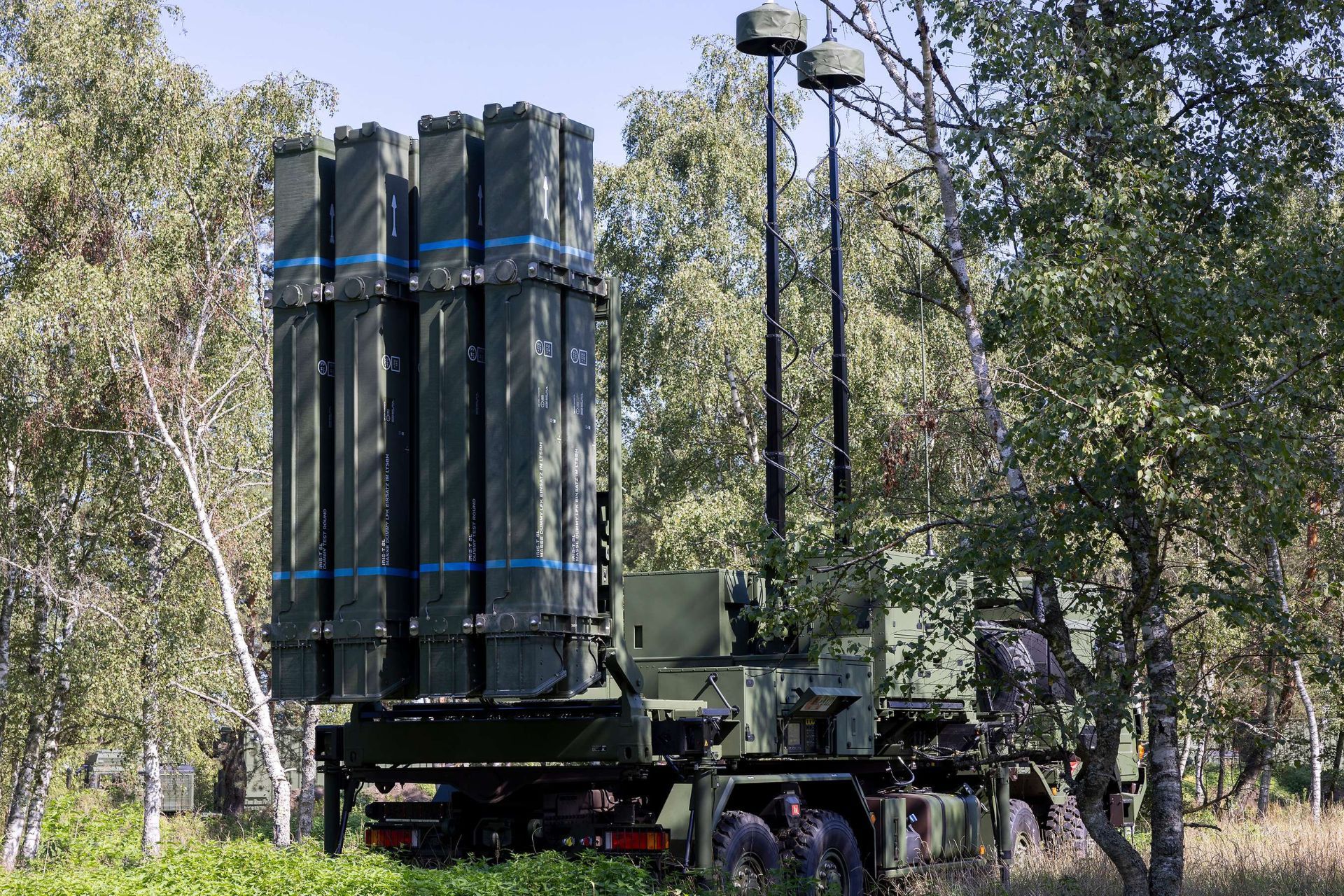
Designed to provide 360-degree protection against a wide range of aerial threats, including aircraft, helicopters, cruise missiles, and guided munitions, the system can engage multiple targets simultaneously with extremely short reaction times (Picture source: Bundeswehr)
This strategic agreement, overseen by Sweden’s Defence Materiel Administration (FMV), includes an initial delivery of components by mid-2028, with full operational capability anticipated by 2030. Sweden’s participation in ESSI marks a key step in its integration into Europe's collective defence system, at a time when aerial threats, particularly missiles and drones, have increased near the continent’s eastern borders.
Before this acquisition, Sweden’s air defence capabilities were largely based on very short-range systems such as the Robot 70 and the Robot 98, the latter being a localized variant of the FIM-92 Stinger integrated into the RBS 70 NG family. These portable or vehicle-mounted systems were limited in both range and coverage. To address this gap, Sweden received its first Patriot PAC-3 long-range air defence systems starting in 2021, marking the initial step toward a layered missile defence capability. However, no intermediate-range system was in place to bridge the gap between point defence and high-altitude interception. The acquisition of the IRIS-T SLM fills precisely this operational void, offering a mobile, network-integrated solution that complements Sweden’s existing assets and contributes to a fully layered, interoperable architecture.
The IRIS-T SLM system is a medium-range air defence solution developed by the German company Diehl Defence. Designed to provide 360-degree protection against a wide range of aerial threats including aircraft, helicopters, cruise missiles, and guided munitions, the system can engage multiple targets simultaneously with extremely short reaction times. Mounted on an 8x8 MAN truck chassis, the launcher carries eight ready-to-fire missiles. The missile itself is derived from the IRIS-T air-to-air model, adapted for surface launch with an enhanced propulsion system, inertial and satellite navigation, terminal infrared homing (IIR), and an imaging infrared seeker coupled with a radar proximity fuse.
The missile is capable of intercepting targets at ranges up to 40 km and altitudes of up to 20 km, including short-range ballistic missiles, UAVs, and precision-guided weapons. It is supported by multifunction radars such as the HENSOLDT TRML-4D or CEA Technologies’ CEAFAR, linked to a tactical operations centre developed in cooperation with Airbus, using the IBMS-FS command software. The system can be deployed in both mobile and fixed configurations, ensuring interoperability with allied forces and providing effective coverage in multidomain air warfare environments.
The ESSI, led by Germany, is structured as a layered defence system. The IRIS-T SLM provides the medium-range component alongside the U.S.-made Patriot and Israel’s Arrow 3, both covering long-range interception. This mix is designed to address the full spectrum of aerial threats, ranging from low-flying drones to ballistic missiles, while enhancing the resilience of member states against simultaneous or complex attacks.
The IRIS-T SLM has demonstrated its capabilities in operational conditions in Ukraine, where it has performed against a broad range of airborne targets. Since 2022, several European countries, including Germany, Latvia, and Estonia have adopted the system, contributing to its growing operational track record. Concurrently, Germany has continued supplying Ukraine, recently delivering a third IRIS-T SLM unit, an undisclosed number of IRIS-T SLS missiles, and a TRML-4D radar to enhance Kyiv’s air defence network.
In a statement, the FMV indicated that this acquisition strengthens Sweden’s role within ESSI and contributes to the continent’s collective security. As European nations work to close capability gaps and align their defence systems, this Swedish-German agreement reflects a broader trend of increased cooperation and targeted investment in interoperable and field-tested defence solutions.
This acquisition represents both a national effort to modernise Sweden’s air defence and a commitment to European security integration. By adopting a system that has proven its utility in high-threat environments, Sweden positions itself within the framework of mutual support promoted by ESSI. The IRIS-T SLM is now emerging as a central component of Europe’s evolving ground-based air defence structure.