






Breaking News






Breaking News: Denmark selects three European air defense missile systems to quickly defend key national assets.
On June 10, 2025, the Danish Ministry of Defence confirmed the selection of three short-range ground-based air defense systems for urgent acquisition, following a joint decision by Defence Minister Troels Lund Poulsen and the unanimous approval of the parliamentary defense agreement parties. The systems, namely the NASAMS from Norway’s Kongsberg (leased), the IRIS-T SLM from Germany’s Diehl Defence, and the VL MICA from France’s MBDA, will be financed through the Accelerationsfonden for a total value exceeding 6 billion kroner (€800 million).
Follow Army Recognition on Google News at this link
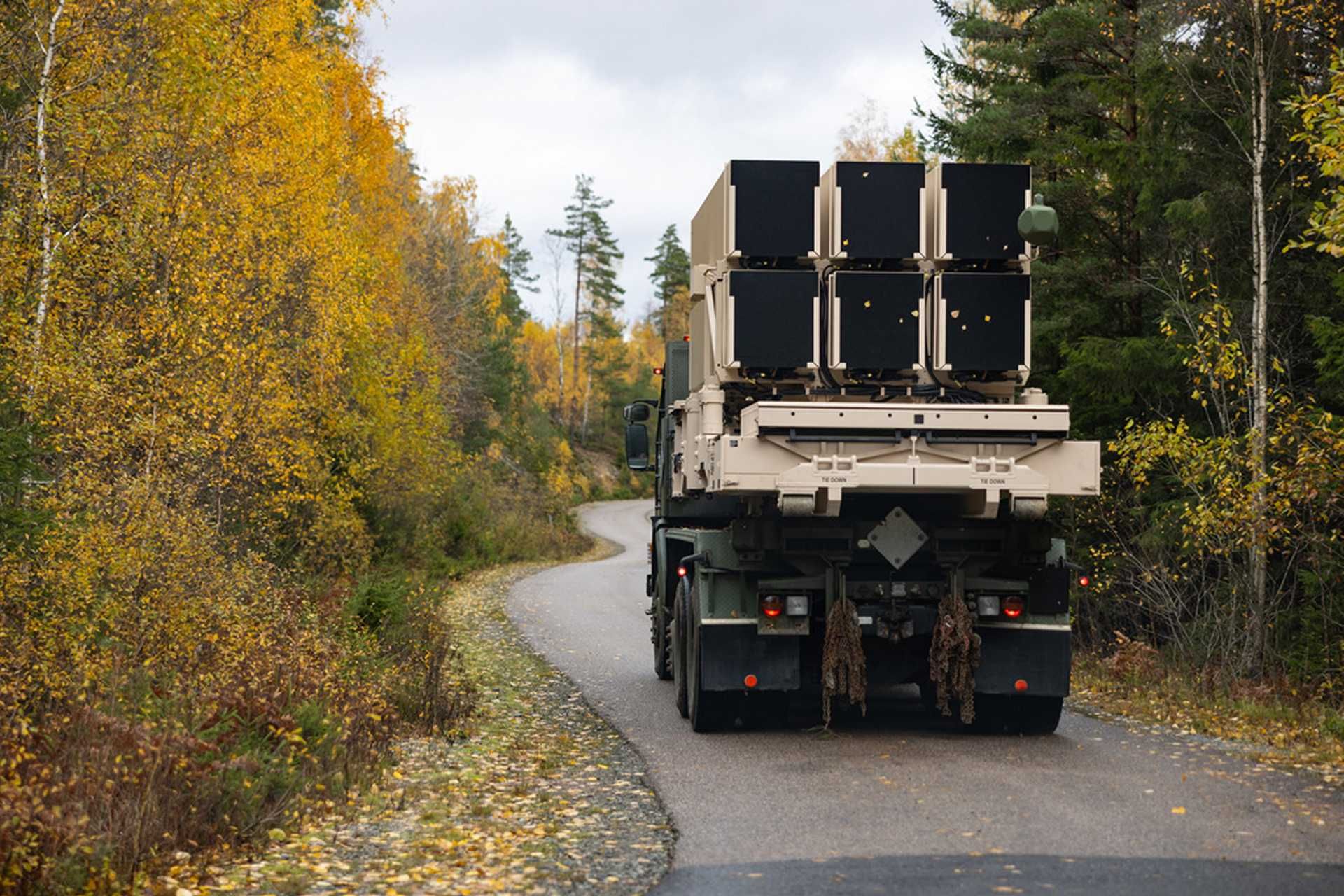
All three air defense systems (NASAMS, IRIS‑T SLM, and VL‑MICA) can be mounted on trucks, allowing them to cover different geographic areas without relying on fixed infrastructure. (Picture source: Norwegian MoD)
The goal is to ensure initial operational effectiveness no later than 2026 as part of an accelerated procurement path that bypasses standard tendering procedures. The decision aligns with a recommendation by the Chief of Defence and is presented as a response to the need to protect the civilian population, military installations, and critical infrastructure against air threats. It also contributes to bridging the existing gap until a long-term solution for a permanent air defense system is identified and deployed.
Denmark received ten offers from suppliers in Germany, Norway, France, Italy, Türkiye, and Israel. The Ministry of Defence chose to proceed with three European systems in the initial stage, citing the combined operational value and the opportunity to contribute to the development of the European defense industry in one of the EU’s prioritized strategic capability areas. The acquisition process is part of a two-track strategy established earlier in 2025. The first track focuses on an immediate capability deliverable by 2026, while the second seeks a long-term solution expected to be decided later this year. Denmark is evaluating two long-range systems for this purpose: the American Patriot PAC-3 MSE and the Franco-Italian SAMP/T NG. The shortlisting process has included considerations of operational performance, NATO interoperability, supply security, and delivery timelines. The permanent system is scheduled to be operational by 2028.
According to Minister Poulsen, the security environment requires rapid acquisition of critical defense capabilities, and ground-based air defense has been designated as a top priority. The urgency of the procurement led to an abbreviated process with increased autonomy for military leadership. The Danish Defence Acquisition and Logistics Organisation (DALO) has confirmed that this approach may lead to higher costs, with estimates suggesting price increases of 10 to 15 percent compared to standard acquisition programs. The decision was supported by the Chief of Defence, General Michael Wiggers Hyldgaard, who emphasized that the Accelerationsfonden enables not only procurement of material but also recruitment and training of personnel at a rapid pace. The Chief of DALO, Per Pugholm Olsen, added that the selection, occurring only months after the two-track model was initiated, reflects cooperation between authorities and potential suppliers and enables both the deployment of initial systems by 2026 and the groundwork for a permanent solution. Together, the three selected systems will bring distinct capabilities.
The NASAMS (National Advanced Surface-to-Air Missile System), developed by Kongsberg and RTX, is a modular system that uses X-band radars such as the AN/MPQ-64 Sentinel or GhostEye MR to detect targets beyond 120 kilometers. It fires AIM-120 AMRAAM, AMRAAM-ER, and AIM-9X Sidewinder missiles with engagement ranges up to 40 kilometers. It includes a distributed command and control architecture based on fire distribution centers, and Link-16 networking for coordination with other systems. The NASAMS has been operational since 2007 and is in service with at least 13 countries. It is currently used by Norway, the United States, Ukraine, and Belgium, among others. Norway will provide one NASAMS battery to Denmark via a leasing agreement. Its mobility, integration capability, and radar reach make it suitable for area defense against fixed- and rotary-wing aircraft, drones, and cruise missiles.
The IRIS-T SLM is a medium-range system developed by Diehl Defence and derived from the IRIS-T air-to-air missile. It is mounted on MAN 8×8 trucks and integrates with multifunction radars such as HENSOLDT’s TRML-4D or Saab’s Giraffe. The missile has a maximum range of 40 kilometers and an altitude ceiling of 20 kilometers. It uses thrust-vector control and combined infrared and radio command guidance. Its speed reaches Mach 3, and it is optimized for interception of aircraft, cruise missiles, guided bombs, and UAVs. The system includes a tactical operations center and was first tested in 2014. It has been operational since 2022 and has been used in combat, notably in Ukraine, where it has reportedly demonstrated high effectiveness. The IRIS-T SLM has also been acquired by Germany, Estonia, Latvia, Switzerland, and other countries. Denmark will receive its system as part of this procurement package.
The VL MICA, completely ITAR-free, is a vertically launched air defense system developed by MBDA France. It launches MICA missiles equipped with either active radar (RF) or imaging infrared (IR) seekers. The missiles are vertically launched from truck-based platforms, typically Renault chassis, with each launcher holding four to six missiles. The system can engage targets at ranges up to 80 kilometers in its NG version, and the missiles can reach speeds up to Mach 4. VL MICA batteries are configured with launchers, a tactical operations center, and a 3D radar such as the Thales Ground Master 200. The system offers 360-degree defense coverage against aircraft, drones, helicopters, loitering munitions, cruise missiles, and guided bombs. It has been deployed for national events such as the 2024 Paris Olympics and during the French Air Force’s ASTER25 exercises. Its dual-seeker capability provides redundancy in contested environments with electronic countermeasures.
These three air defense systems could operate together as a multi-layered air defense solution, as the NASAMS will provide extended detection and command coordination for large areas, the IRIS-T SLM will cover medium-range threats with precision-guided interceptors, while the VL MICA will offer rapid response to short-to-medium-range threats. The diversity of guidance technologies, radar-guided (AMRAAM), infrared (IRIS-T), and dual-mode (MICA), reduces vulnerability to countermeasures. All three systems are truck-mounted and air-transportable, which supports flexible deployment and mobility. They can be integrated into NATO’s defense networks and are aligned with the principles of the European Sky Shield Initiative (ESSI), in which Denmark participates. While SAMP/T NG is not part of ESSI, Denmark’s evaluation of it as a long-range option reflects a broader assessment of operational requirements. The inclusion of European systems in the interim procurement has been interpreted by some observers as influenced in part by political developments, including U.S.-Danish tensions over Arctic policy.
As of mid-2025, Denmark possesses no operational ground-based surface-to-air missile systems. Its air defense relies on Iver Huitfeldt-class frigates armed with ESSM and SM-2 missiles, F-16 and F-35 fighter aircraft, and radar surveillance networks. The Air Defence Wing, established at Skalstrup Air Station in March 2025, has not yet fielded any ground-based missile systems. To address very low-altitude threats, Denmark has contracted Rheinmetall to deliver 16 Skyranger 30 very short-range air defense systems mounted on Piranha V vehicles. These will be delivered between 2026 and 2027 and are designed to intercept drones and helicopters. However, the introduction of NASAMS, IRIS-T SLM, and VL MICA is the first initiative to establish medium-range ground-based air defense on Danish territory. These systems are expected to enter service incrementally starting in late 2025 and throughout 2026, forming the initial framework of a future layered air defense capability that will be completed with a forthcoming long-range solution.